
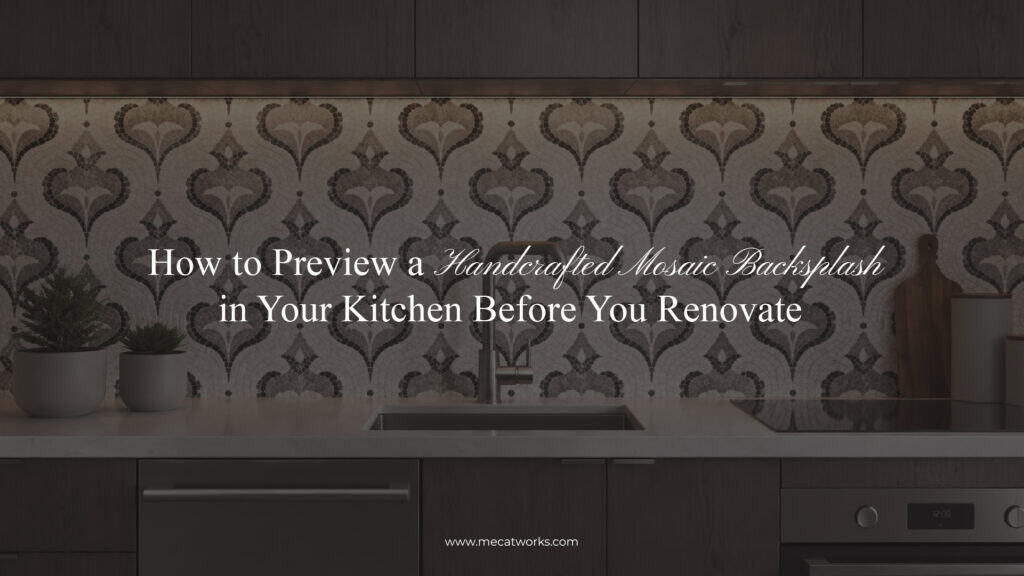
Choosing a kitchen backsplash sounds simple until you actually have to commit to one, making it essential to have the preview mosaic backsplash. Because a small tile sample may look perfect in your hand. Then you hold it against the wall and suddenly wonder whether it’s too dark. A beautiful geometric mosaic might catch your eye online, yet you can’t tell whether the pattern will compete with your marble countertop. Even a color you love or choose can change the mood once it sits between counters, cabinets, under warm lighting, and beside stainless steel appliances.
That’s why using AI to preview handcrafted mosaic backsplash designs inside your own kitchen before renovation begins can make such a difference.
With the MEC AI Mosaic Studio, you can upload a photo of your kitchen, select the backsplash area, and explore different mosaic directions without installing a single tile. And this blog explains exactly how to preview mosaic backsplash designs, how the AI studio works, what details to examine, and how a digital idea moves toward a real handcrafted installation.
Table of Contents
| A digital preview helps you decide what you want. Skilled mosaic design and craftsmanship determine how that idea becomes a real surface. Try the MEC AI Mosaic Studio |
Why Kitchen Backsplash Decisions Are So Hard to Get Right the First Time
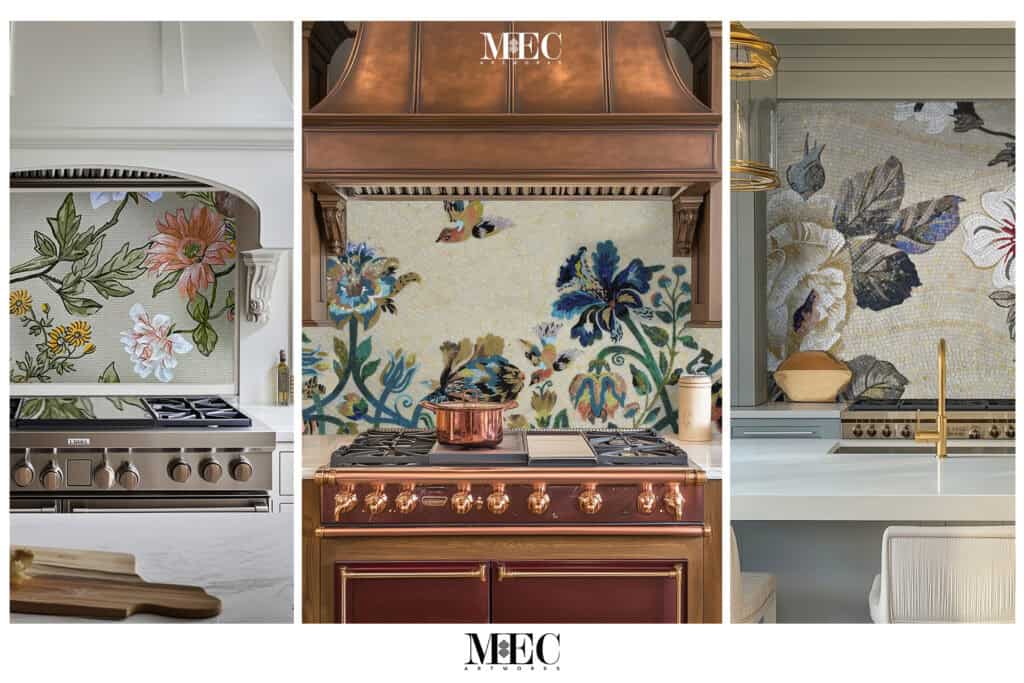
A backsplash sits in one of the most visually complicated parts of a kitchen. It rarely occupies a blank wall. Instead, it has to live between countertops, cabinetry, shelves, windows, switches, appliances, range hoods, faucets, and lighting. That makes kitchen backsplash design surprisingly sensitive to context.
Imagine holding a four-inch mosaic sample against a white background in a showroom. The blue glass looks rich and luminous. Now place the same concept inside a kitchen with dark walnut cabinets, dramatic Calacatta veining, brass hardware, and warm under-cabinet lighting. It may feel completely different.
The problem isn’t necessarily the mosaic. The problem is the setting. But our own AI visualization guidance makes the same distinction: instead of asking only whether you like a mosaic, you need to ask whether that mosaic actually belongs in your space. Surrounding cabinets, countertops, fixtures, lighting, flooring, and architectural boundaries all influence how the final composition reads.
The Gap Between a Tile Sample and a Full Wall
A physical mosaic tile sample remains useful. It lets you inspect finish, material, edge quality, color variation, and surface character. What it cannot easily show is composition at architectural scale.
A two-inch floral fragment tells you almost nothing about how a six-foot botanical composition will move behind a stove. Likewise, a handful of geometric tesserae can’t show whether a repeating pattern will feel elegant or exhausting once it stretches across twelve linear feet. This is where a custom mosaic backsplash preview becomes valuable. Instead of looking at the material in isolation, you begin evaluating how the entire pattern interacts with the kitchen.
Space Lighting Can Completely Change the Mood
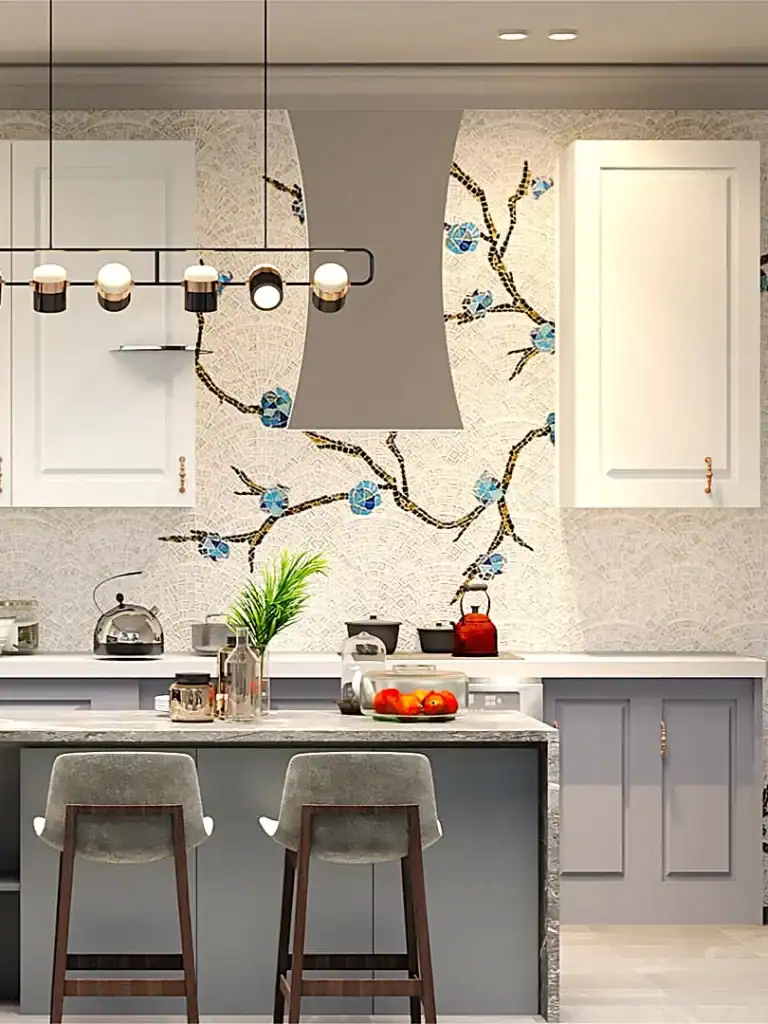
Light affects every kitchen backsplash, although reflective materials make the difference especially noticeable. Morning daylight may bring out cooler undertones. Warm LEDs can make cream, bronze, amber, and gold hues feel richer. Directional under-cabinet lights can reveal individual tesserae and create tiny highlights across glass.
Dark areas also matter. A backsplash installed beneath deep upper cabinets may receive much less natural light than the same material displayed vertically in a showroom. This doesn’t mean an AI image will reproduce every real reflection perfectly. It won’t.
However, an AI kitchen backsplash visualizer lets you judge something more fundamental: whether the overall light-dark balance works with the room you already have.
Kitchen Cabinets and Countertops Control More Than You Think
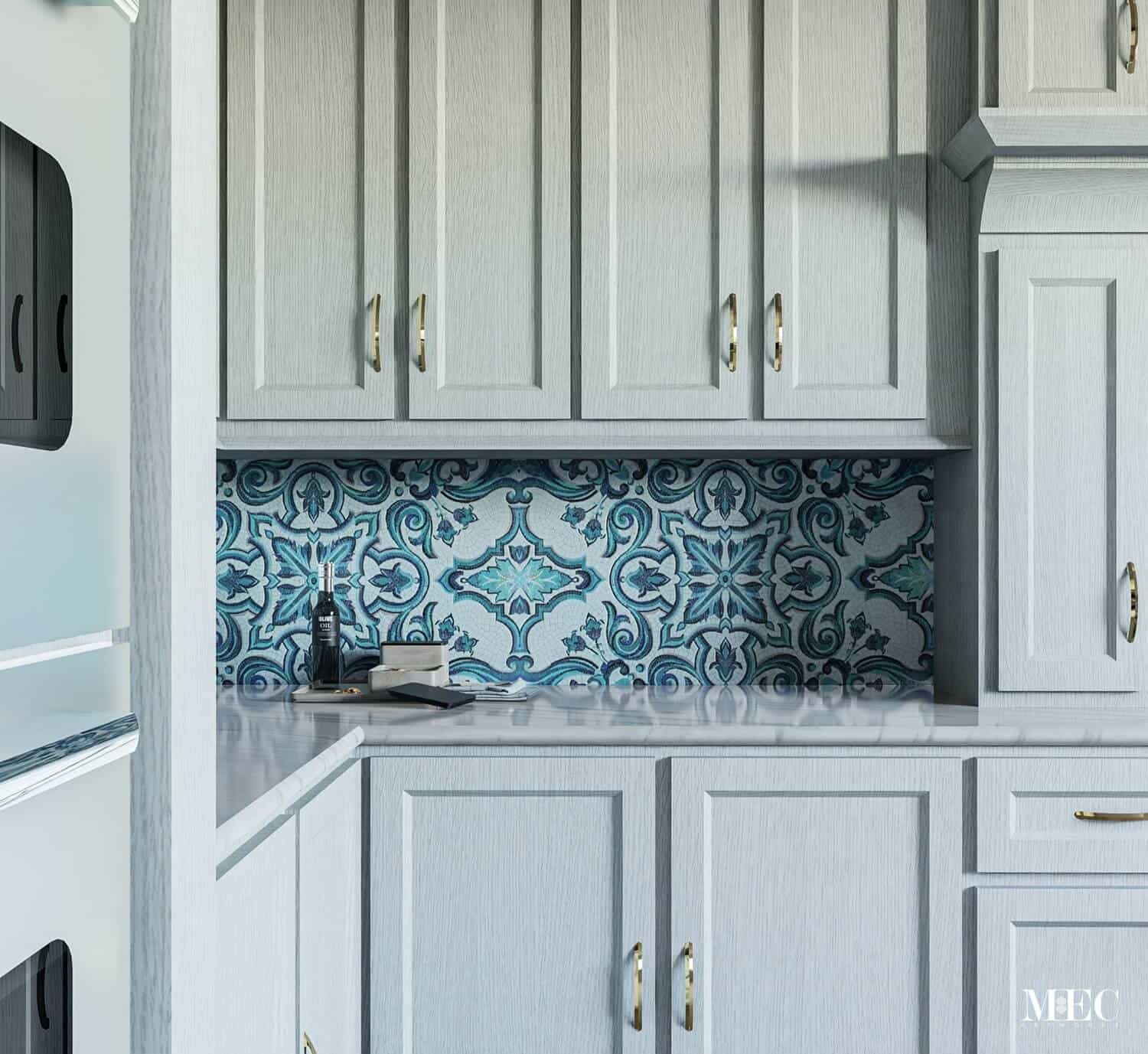
Your countertop often occupies the visual foreground directly beneath the backsplash. If it has strong veining, a detailed mosaic behind it may create too many competing lines.
The same applies to cabinetry. Flat-front white cabinets leave plenty of visual breathing room for a complex mural. Heavily grained wood, decorative door profiles, or colorful cabinetry may call for a quieter backsplash. One practical rule helps: The more visual movement you already have, the more carefully you should introduce additional movement.
That doesn’t mean busy surfaces can never work together. They simply require better coordination.
The Problem with Traditional Backsplash Planning
Designers have planned kitchens successfully for decades without AI. Material boards, renderings, physical samples, elevations, and mockups still matter.
The weakness appears when homeowners depend on only one of these tools. A single sample doesn’t show scale. A showroom doesn’t reproduce your lighting. A Pinterest image doesn’t reproduce your architecture. The best planning process uses several forms of information together.
Small Tile Samples Don’t Show the Full Mosaic Pattern
Suppose you’re considering a handcrafted floral backsplash. The sample contains one leaf, part of a flower, and several background tiles. You may love all three. Yet the finished wall could include dozens of flowers, directional vines, tonal gradients, and complex transitions. That’s an entirely different visual question. A pattern operates at two levels:
- Micro scale: individual tesserae, color variation, texture, grout, cutting style
- Macro scale: the overall motif, rhythm, negative space, focal points, repetition, and movement
Physical samples are strongest at micro scale. Visualization helps with macro scale. For a successful custom project, you eventually need both.
Showroom Lighting Isn’t Your Kitchen’s Lighting
Showrooms exist to present materials attractively. They often use controlled illumination. Your kitchen may have sunlight from one side, pendant lights overhead, LEDs beneath cabinets, and very little light behind the range.
That difference can affect how you perceive color. A pale gray might feel blue in cooler daylight. Cream may become warmer beneath incandescent-style LEDs. Iridescent glass can produce highlights that shift as you move through the room.
When using a handcrafted tile backsplash design tool, upload a photo taken under the lighting conditions you use most often. If your kitchen looks dramatically different morning and evening, take more than one photo.
MEC’s current visualization guidance recommends clear, sharp images with even lighting. Natural daylight works well when it doesn’t create harsh shadows. It also suggests including the countertops and upper cabinets when photographing a backsplash.
Inspiration Photos Aren’t Your Kitchen
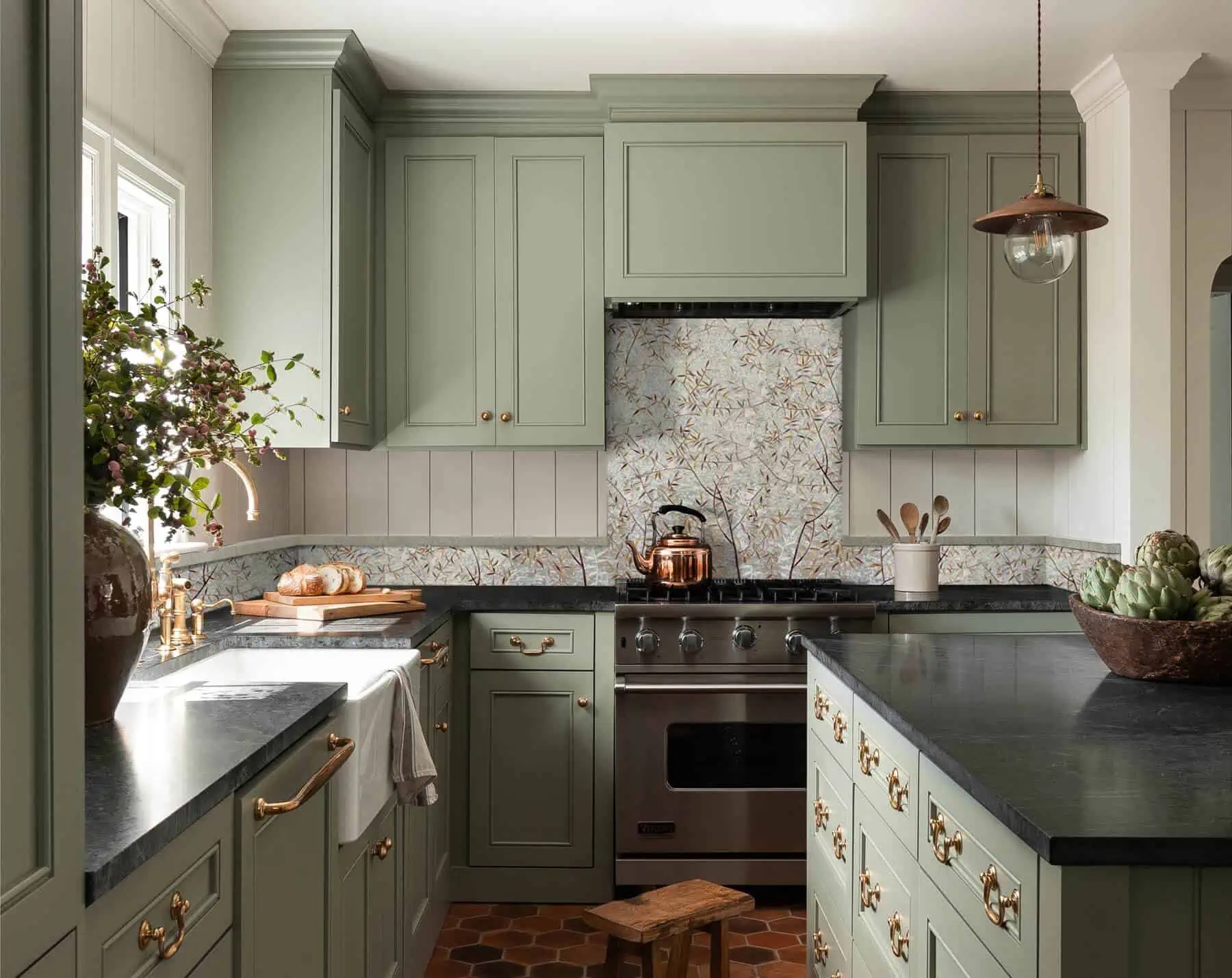
Pinterest can show you what you like. It can’t show you what fits. Maybe you saved a dramatic black and gold Art Deco backsplash from a large open-plan kitchen. Your own kitchen has lower ceilings, a narrower cooking zone, and cream cabinetry. The design may still work. The proportions may not.
This is why previewing custom tile design on kitchen wall workflows is more useful than simply collecting inspiration images. Instead of saying: “I want this kitchen.” You can begin saying: “I like the geometry of this design, but I want to see whether a softer version works with my cabinets.” That’s a much better design conversation.
How MEC AI Mosaic Studio Helps You Preview Handcrafted Mosaic Backsplash
The MEC AI Mosaic Studio includes a Customize Your Space workflow designed around real room photography. You upload your own image. The tool then lets you identify where the mosaic should appear and explore a bespoke visual direction. The current interface includes Auto-detect, Backsplash, Accent wall, Floor medallion, Pool, and Entryway placement choices.
For kitchen planning, choose Backsplash. The process looks roughly like this:
Your kitchen photo → backsplash area → design direction → AI preview → compare variations → select a favorite concept → professional mosaic development
The important word here is concept. The AI preview gives you a clear visual direction, helping you see how the mosaic could look in your actual kitchen before finalizing materials, colors, dimensions, and other design details. Once you choose a concept you love, MEC Artworks’ expert designers can refine it into a detailed handcrafted mosaic ready for fabrication and installation.
Upload a Photo of Your Actual Kitchen Wall
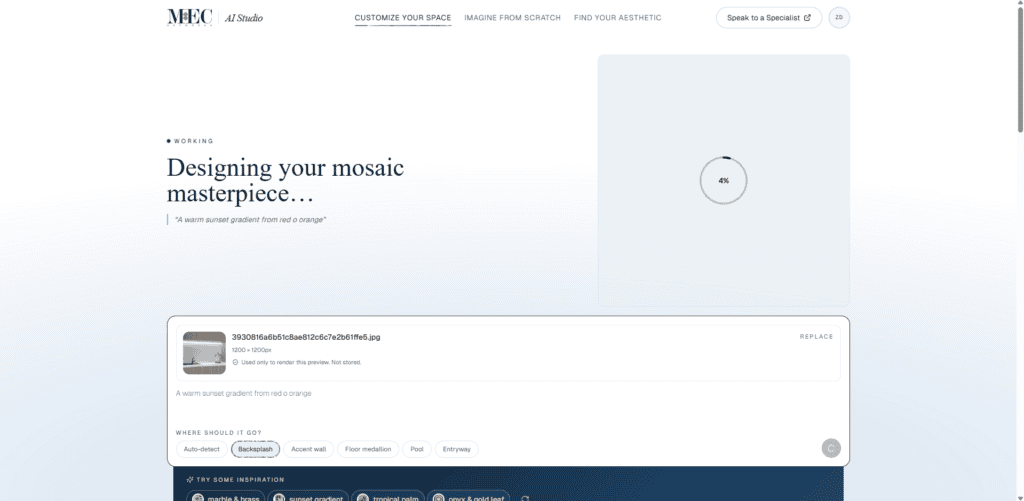
Start with a clear photo. You don’t need a professional camera. A modern smartphone photo can work well when the backsplash zone is visible, and the image isn’t blurry or heavily filtered. MEC AI Studio currently accepts JPEG, PNG, and WebP uploads up to 10 MB. The studio also states that uploaded images are used to render the preview and aren’t stored. For the most useful result, photograph the kitchen straight on. Include:
- The countertop
- Upper cabinets
- Range or cooktop
- Range hood
- Sink if relevant
- Nearby windows
- Visible flooring where possible
- Hardware and major finishes
See the Mosaic Mapped onto Your Kitchen
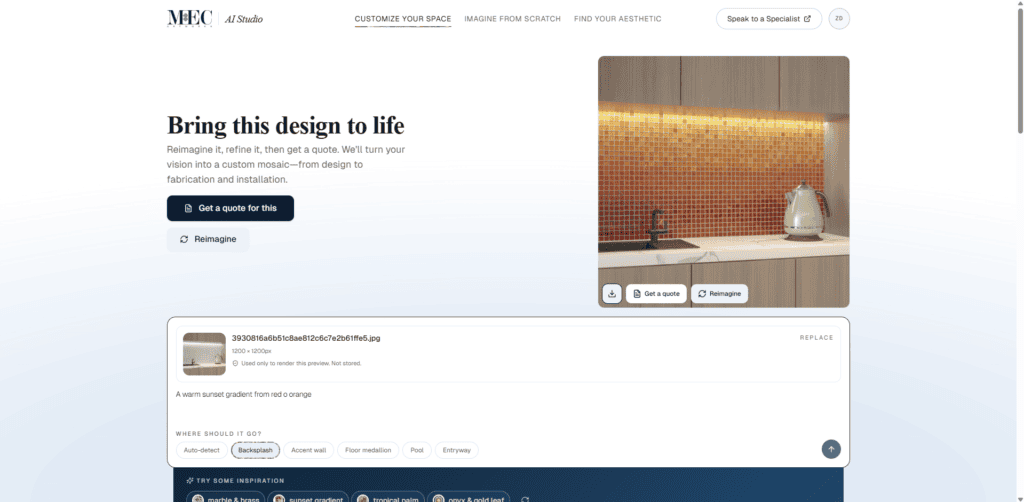
Once the tool understands the intended surface, it generates a visualization of the mosaic within the photo. This is where the process becomes much more useful. Instead of trying to imagine how a small tile sample might look across your kitchen wall, you can preview a handcrafted mosaic backsplash directly in your space. This makes it easier to compare colors, patterns, scale, and overall design before moving forward.
- Does the dark blue fight with the cabinets?
- Is the floral composition too large?
- Would a lighter background create more breathing room?
- Does the mosaic need to stop at the stove rather than span the entire wall?
You can start evaluating the room as a whole.
Compare Different Designs Without Touching a Single Tile
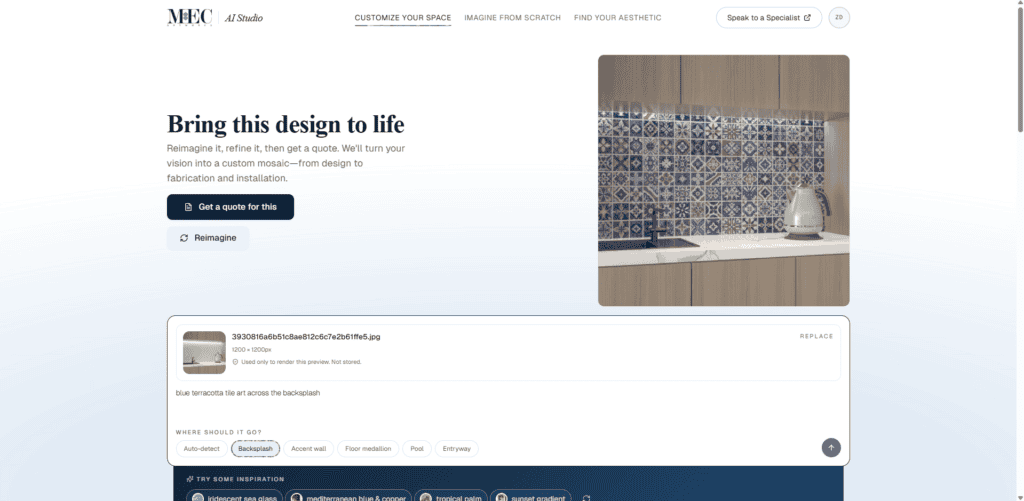
The biggest benefit isn’t seeing one rendering. It’s seeing alternatives. Create variations deliberately. Try changing only one factor at a time. For instance:
- Version A: Deep emerald botanical glass mosaic
- Version B: Sage and ivory botanical glass mosaic
- Version C: Monochrome white and soft gray botanical mosaic
Now the comparison tells you something useful. If you change the style, palette, material appearance, density, and scale all at once, it’s harder to understand why you prefer one result. Treat the studio like a controlled design experiment.
Moreover, save the concepts that produce an immediate positive reaction. Then compare them again after a day or two. The goal isn’t to generate endless images. The goal is to narrow uncertainty. Preview Your Own Backsplash Now
What to Look for When You Preview a Handcrafted Mosaic Backsplash
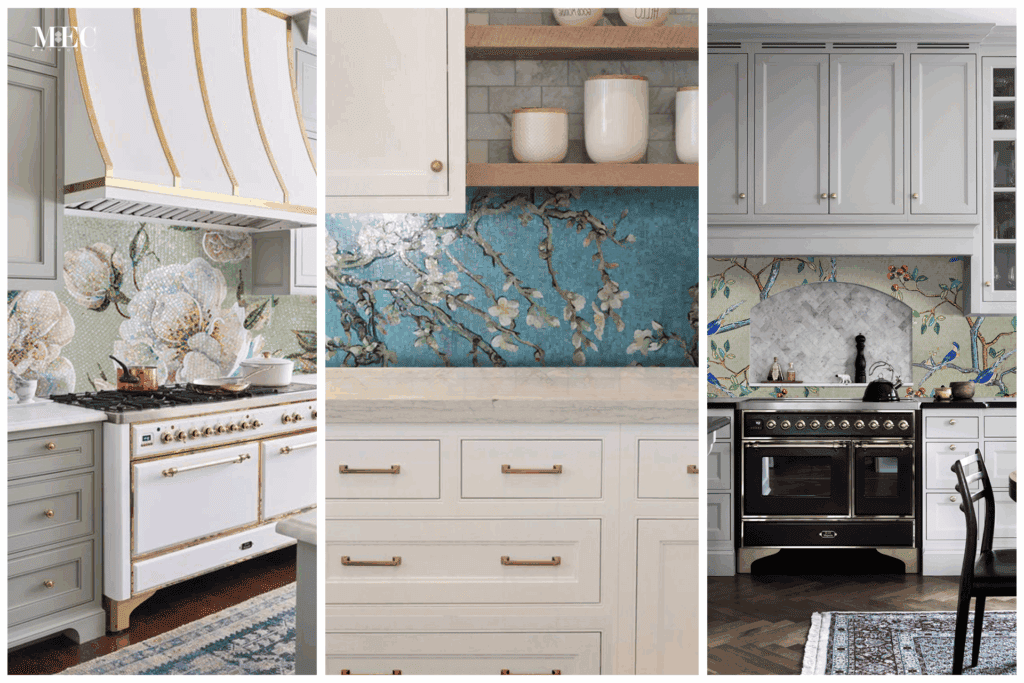
A rendering can look impressive and still lead you toward the wrong design. Don’t judge only by whether the image looks “pretty.” Use the preview like a design review. Pay attention to scale, contrast, architectural balance, color relationships, and visual hierarchy.
Pattern Scale in a Custom Mosaic Backsplash Preview
Scale often makes or breaks custom mosaic design. A botanical leaf that spans eighteen inches behaves differently from the same leaf at six inches. Large motifs feel calmer because fewer elements occupy the wall. Small motifs create more rhythm, detail, and visual activity. When looking at your preview mosaic backsplash, examine it from two mental distances: close range and across the kitchen.
Color Harmony with Cabinets, Countertops, and Flooring
Never choose backsplash colors in isolation. Instead, identify your kitchen’s dominant undertones. Is the countertop warm or cool? Does the cabinetry lean yellow, gray, red, or blue? Does your flooring add another strong hue? Once you identify these anchors, your mosaic can either harmonize or deliberately contrast. Some color recommendation options are:
| Existing Kitchen Colors | Mosaic Direction to Test |
| Warm walnut cabinets | Cream, amber, olive, teal, ivory |
| White cabinets + gray stone | Blue, charcoal, jade, soft green |
| Navy cabinets | Ivory, white, pale blue, warm metallic accents |
| Cream cabinets | Sage, terracotta tones, soft blue, green |
| Black cabinets | White marble tones, jewel-like glass, controlled metallic detail |
| Strongly veined marble | Quieter background with selective focal motifs |
Grout Lines and Texture in a Handcrafted Tile Backsplash Design
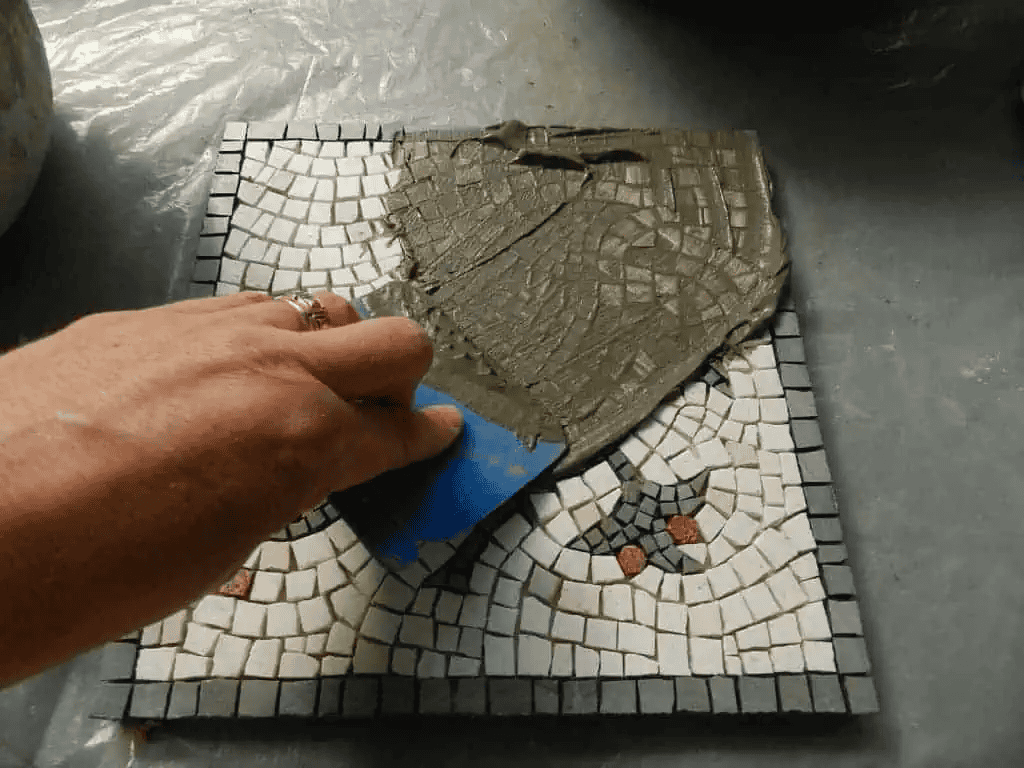
This is where digital visualization has limits. A handcrafted mosaic gets much of its character from small physical details:
- Tessera size
- Tile edge variation
- Cutting style
- Surface finish
- Light reflection
- Marble veining
- Glass depth
- Grout width
- Grout color
- Hand placement
An AI image can suggest these qualities. It cannot perfectly predict them. That distinction matters. Use the visualization to evaluate overall visual character, then use physical samples and professional design development to finalize the actual material. For example, MEC describes its kitchen backsplash work as using glass and marble mosaics and notes that glass backsplashes offer extensive possibilities in color and finish.
Common Backsplash Styles Worth Testing in an AI Kitchen Backsplash Visualizer
Don’t start with fifty ideas. Start with several clearly different design families. Doing so helps you discover what genuinely suits your space.
Classic Patterns Reimagined as Handcrafted Mosaic
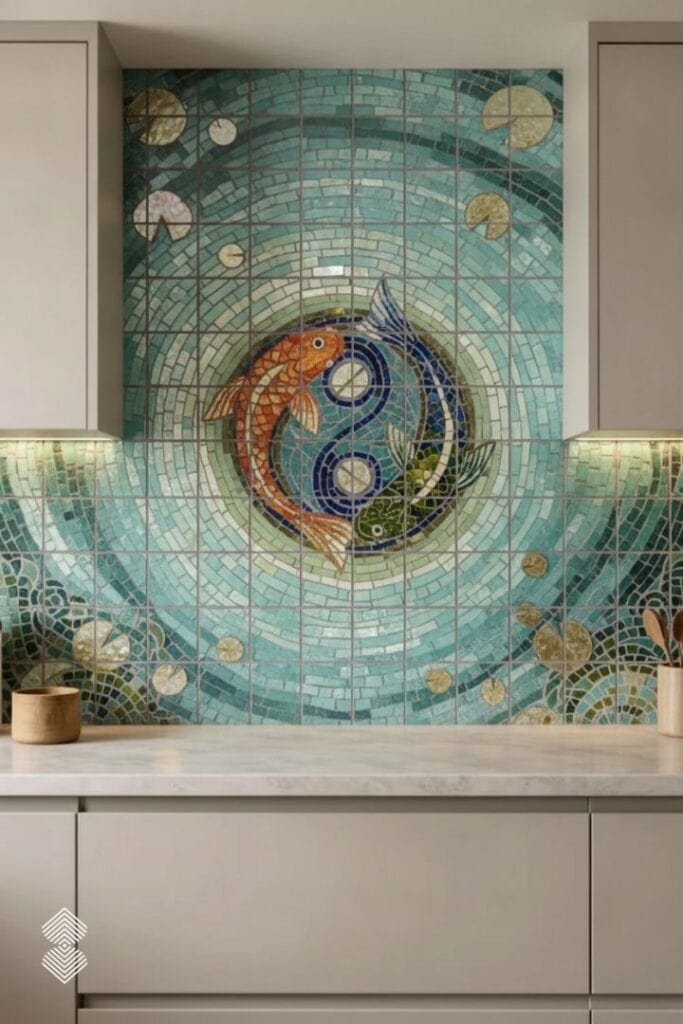
Classic doesn’t have to mean plain. Simple repeating structures can become much richer when artisans create them in hand-cut glass or marble. Test:
- Offset rectangular layouts
- Herringbone rhythms
- Basketweave-inspired structures
- Elegant borders
- Soft repeating geometry
- Simplified Art Deco forms
These styles often work in kitchens where the cabinetry already provides significant architectural detail. They give the eye structure without turning the wall into a mural.
Bold Geometric and Moroccan-Inspired Mosaic Backsplashes
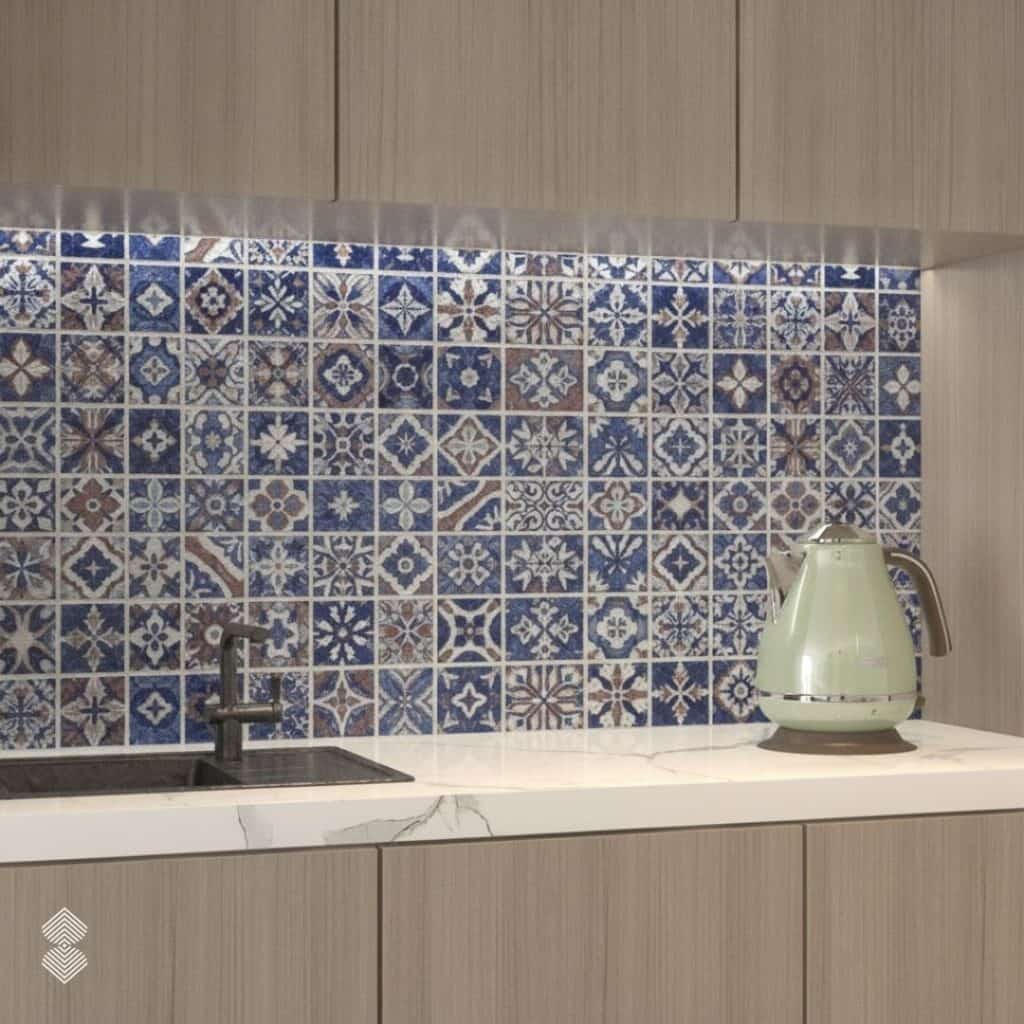
Geometric design creates energy. Repeated stars, interlocking polygons, angular motifs, and Moroccan-inspired patterns can turn the backsplash into a major architectural feature. Use the AI tool for kitchen backsplash renovation to test pattern density carefully. Ask yourself:
- Is the pattern competing with the countertop?
- Does it feel balanced behind the stove?
- Would fewer colors make it calmer?
- Should the pattern cover the whole wall?
- Would a framed focal area work better?
Sometimes the best solution isn’t removing the pattern. It’s reducing the palette. A complex geometric composition in ivory, charcoal, and soft gray may feel more refined than the same layout in Moroccan seven contrasting colors.
Nature-Inspired and Organic Mosaic Motifs
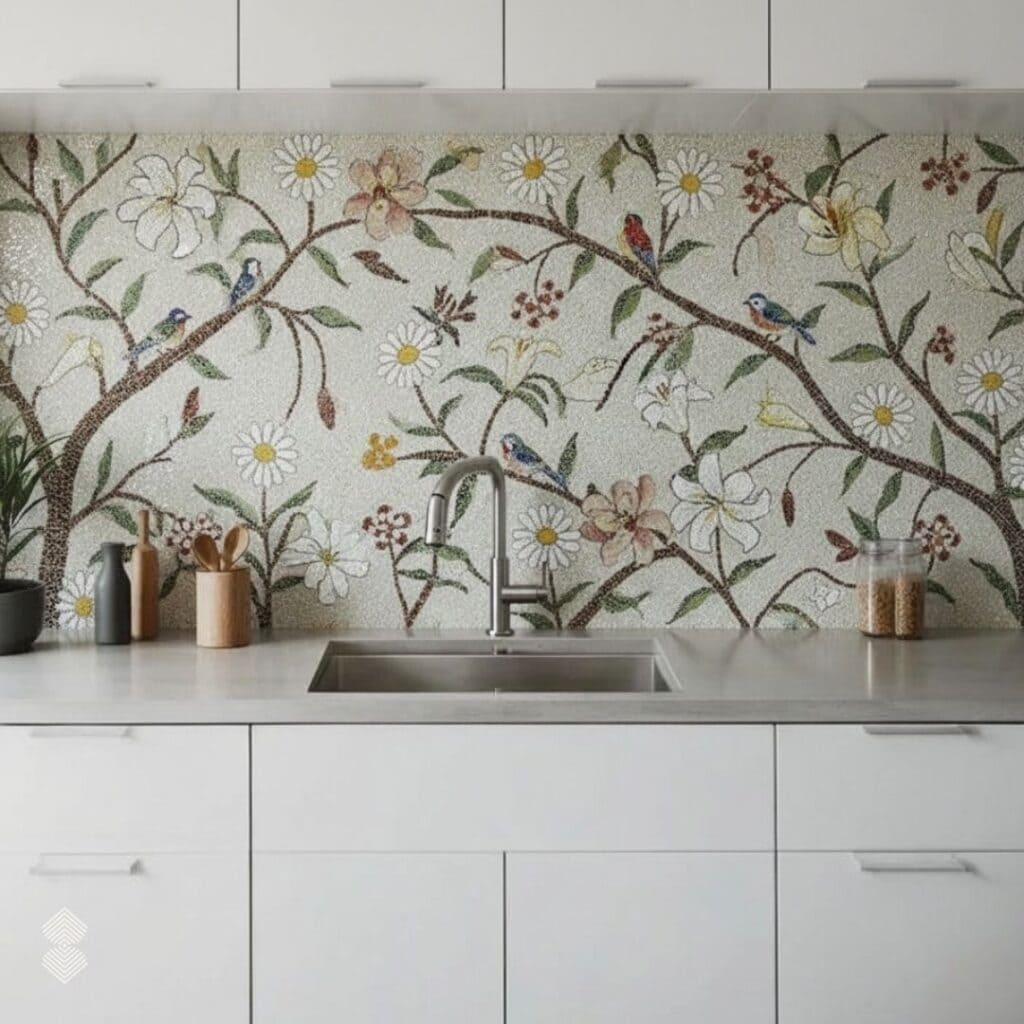
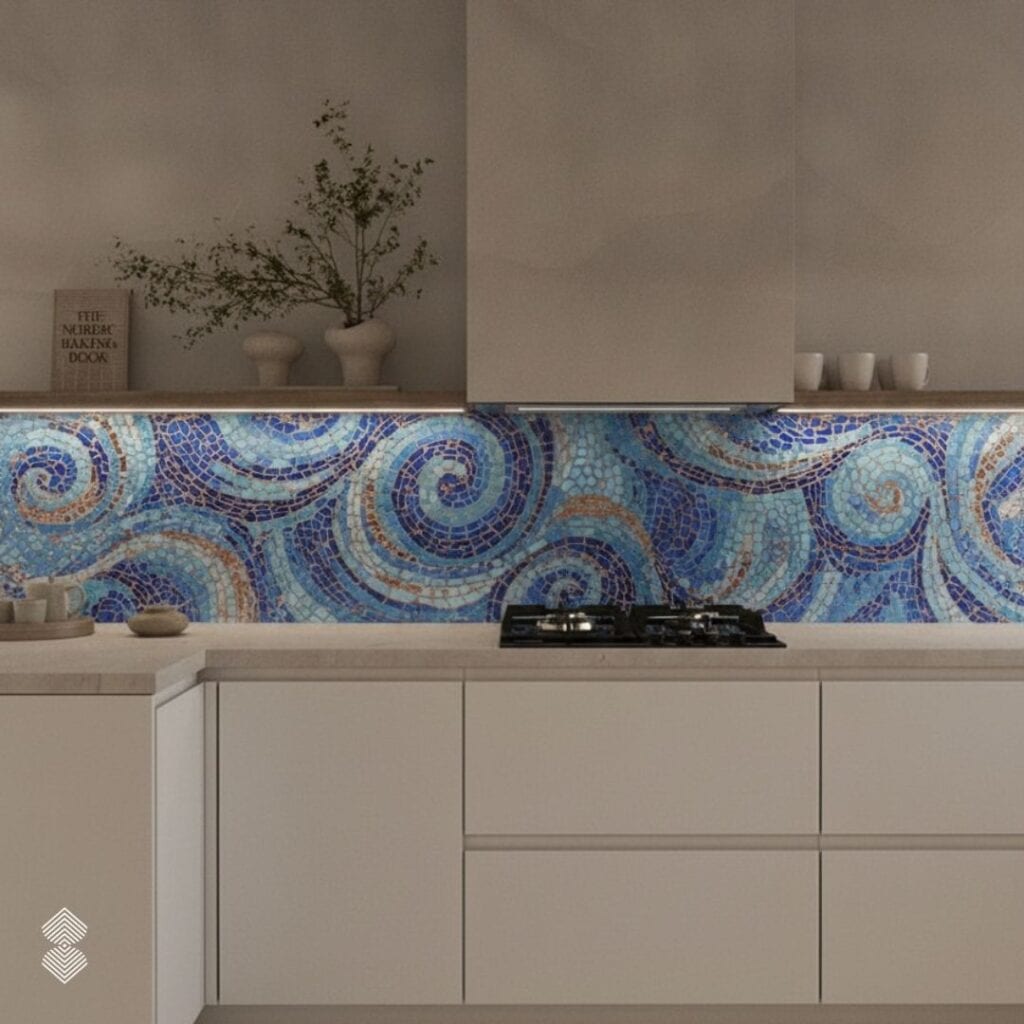
Botanical mosaics work especially well when you want the backsplash to feel like art. Flowers, leaves, branches, birds, waves, and abstract natural forms can move across the wall rather than repeat mechanically.
MEC’s Vermont kitchen project offers a useful real-world example. The backsplash incorporated wildflowers, native plants, butterflies, and other natural references linked to the local landscape. The project later expanded so the floral idea could continue onto columns.
That shows an important principle. A custom mosaic doesn’t have to behave like wallpaper. It can respond to architecture. A branch can rise around a window. Flowers can become denser behind a range. A quiet background can occupy less important areas. The composition can change as it travels.
When you visualize handcrafted mosaic tile in your own kitchen, test whether the organic design feels connected to the architecture rather than simply pasted onto the wall.
Monochrome and Minimalist Glass Mosaic Backsplashes
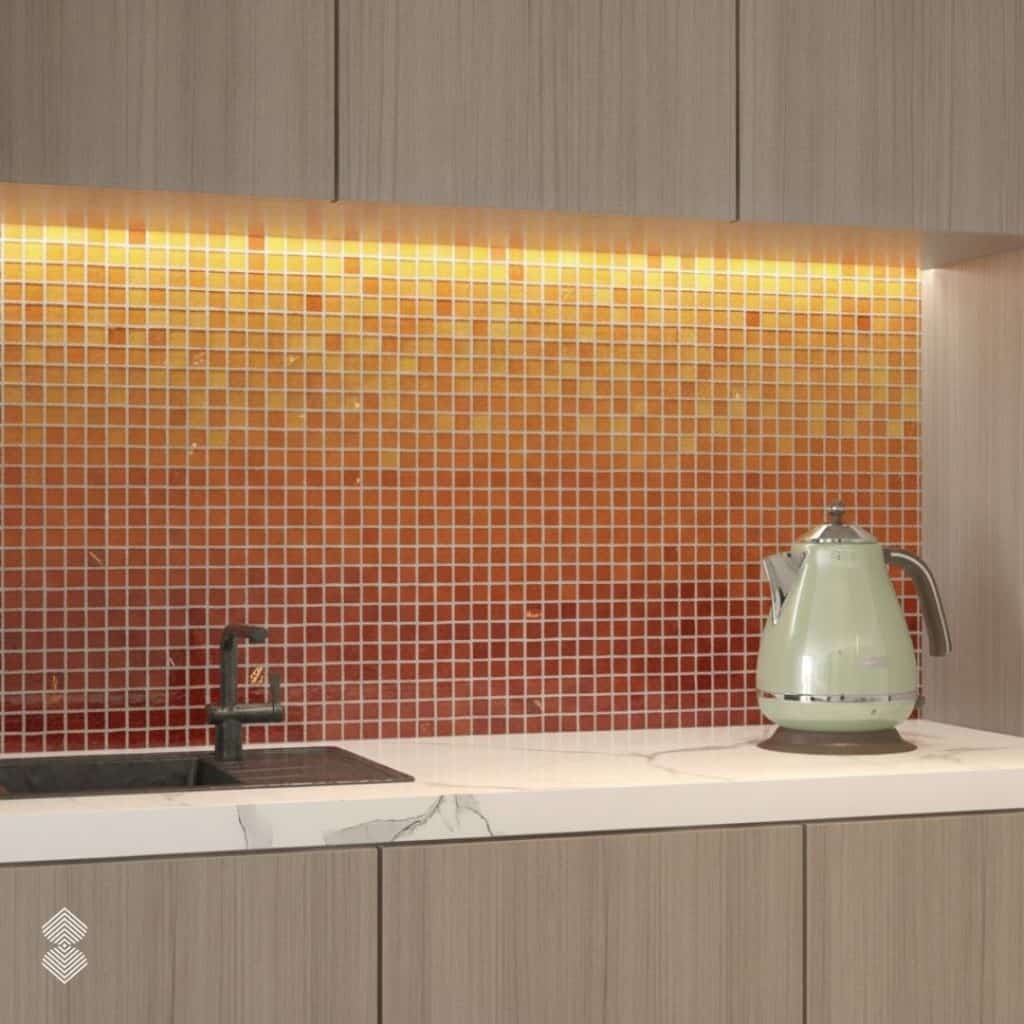
Minimalist doesn’t mean lifeless. A backsplash can use shades of white, cream, gray, black, or blue while relying on texture and subtle tonal shifts for depth. This approach suits kitchens with strong countertops or cabinetry. Imagine a white kitchen with heavily veined marble. Adding an equally dramatic multicolor mural could overwhelm the space.
A pale glass mosaic with subtle movement may create enough interest without competing. Glass can also interact strongly with light. MEC describes glass mosaic backsplashes as non-porous and highlights their reflective visual character and broad color possibilities.
From Preview to Renovation: Turning an AI Idea into a Handcrafted Mosaic Backsplash
Finding a favorite AI image isn’t the end. It’s the beginning of a clearer professional design conversation. Once you know what you want visually, the mosaic must be adapted to real dimensions, real materials, and real architectural conditions.
MEC’s visualization guidance notes that after you preview handcrafted mosaic backsplash concepts, professional development can consider exact dimensions, surface area, material choice, tessera size, cutting method, color range, custom details, installation conditions, shipping destination, and project timing.
Turn the Preview into Exact Measurements
AI works from an image. Fabrication works from dimensions. A professional design needs the exact width and height of the backsplash along with architectural interruptions. That may include:
- Full wall width
- Counter-to-cabinet height
- Range dimensions
- Window openings
- Outlet locations
- Switch plates
- Shelving
- Corners
- Columns
- Hood width
- Sink placement
This is where the visual concept becomes a technical project. A floral branch that looked perfect in the AI preview might need to move six inches to avoid an outlet. A border may need to narrow near a cabinet. The design adapts to the wall. The wall shouldn’t be forced to adapt to the image.
Choosing Mosaic Materials: Glass, Marble, or Ceramic Mosaic
For MEC Artworks’ handcrafted work, glass and marble are central mosaic materials. Each creates a different visual personality.
| Material | Best For | Visual Character | Key Features |
| Glass Mosaic | Contemporary kitchens, colorful backsplashes, bold designs | Bright, luminous, and reflective | Rich colors, reflective depth, crisp contrast, jewel-like details, non-porous surface, easy to clean |
| Marble Mosaic | Neutral kitchens, classical interiors, geometric designs | Natural, refined, and architectural | Natural veining, subtle color variation, softer texture, works well with monochrome and neutral palettes |
| Ceramic Mosaic | Simple backsplashes and traditional tile applications | Clean and versatile | Available in many colors, shapes, finishes, and repeating patterns |
Finalize Colors, Tesserae, & Details with the Mosaic Designer
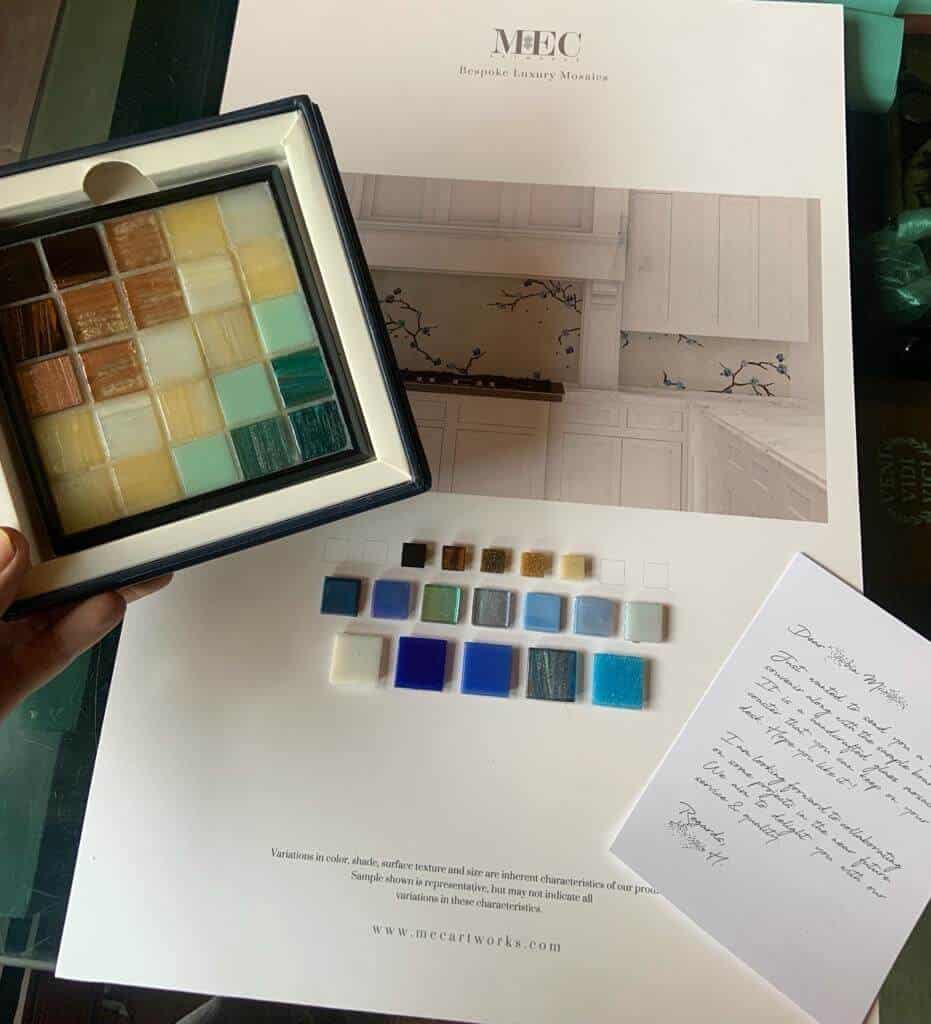
At this stage, MEC Artworks’ expert designers take the initial concept and refine it for the actual space. The team carefully develops the final color palette, tessera size, cutting direction, material finish, borders, focal elements, gradients, pattern transitions, negative space, and overall architectural fit.
This level of detail matters because a custom mosaic isn’t simply an image divided into small pieces. The direction and placement of each tessera influence how the artwork moves and feels. MEC Artworks designers carefully position the pieces to follow the curve of a flower, define the shape of a leaf, or create the natural movement of a wave.
While a digital rendering helps you visualize the initial idea, MEC Artworks’ designers and artisans bring it into the real world. They adapt the concept to physical materials, exact dimensions, and architectural details so the finished mosaic feels intentionally designed for the space.
Final Thought: Preview the Idea, Then Craft the Real Kitchen Mosaic
A backsplash occupies only a portion of the kitchen, yet it can change the mood of the entire room. That’s why guessing from a sample often isn’t enough.
When you preview handcrafted mosaic backsplash concepts directly in your own kitchen, you can see how different colors, patterns, scales, and placements work with your existing space. The MEC AI Mosaic Studio makes this process easier by letting you upload a photo of your kitchen and explore different mosaic design ideas directly on the backsplash area. Once you find a direction you love, MEC Artworks’ expert designers can refine the concept and prepare it for handcrafted production.
FAQs
Do I need a professional photo of my kitchen to preview a Mosaic backsplash accurately?
No. A clear smartphone photo can work well. MEC recommends using a sharp image with good visibility and balanced lighting. For a kitchen backsplash, include the countertop and upper cabinetry so you can judge how the mosaic interacts with the surrounding finishes. Try taking the photograph straight on rather than from an extreme angle. Natural daylight often works well as long as harsh shadows or glare don’t hide the backsplash area.
Can the AI Tool show how a handcrafted mosaic will look with my existing cabinets and countertops?
Yes, that’s one of the main reasons to upload a photograph of your real kitchen. The existing cabinetry, counters, appliances, and other visible architectural elements remain part of the visual context. This lets you examine whether a proposed palette or pattern feels balanced within the room rather than judging it against a blank background. Still, treat the result as a design visualization. It’s useful for understanding relationships between colors, patterns, and surfaces rather than predicting every physical material detail.
How close is the preview to how real glass or marble mosaic will actually look and catch light?
The AI preview helps to communicate design direction, composition, approximate color relationships, placement, scale, and mood. When you preview handcrafted mosaic backsplash designs, remember that real glass and marble contain physical qualities that a screen can’t reproduce perfectly. Glass may reflect or refract light differently as you move through the room. Marble can contain natural veining and tonal variation. Tessera edges, grout, cutting direction, surface finish, and individual placement also influence the final appearance. For that reason, use the AI rendering for early visual decisions. Then use material samples and professional design development to make final specifications.
Can I test multiple backsplash designs on the same kitchen Photo before deciding?
Yes. In fact, testing variations is one of the best ways to use an AI kitchen backsplash visualizer. Keep the kitchen image consistent while changing one major factor. For example, compare: emerald versus sage green, large versus small floral motifs, full-wall design versus a range-centered focal piece, geometric versus organic patterns, and high contrast versus tonal color palettes. This makes it easier to identify what you’re actually responding to.
Once I choose a design, can MEC help translate the preview into an exact custom order?
Yes. The AI image can become a visual reference for the next design stage. After you preview handcrafted mosaic backsplash concepts and choose your preferred direction, MEC’s process can move into the details that digital visualization can’t finalize, including actual wall dimensions, surface area, material choices, tessera sizes, cutting methods, color ranges, project details, fabrication, and installation requirements. The idea gets refined rather than copied blindly. That distinction is important because the final goal isn’t to reproduce pixels. It’s to create a handcrafted mosaic that belongs naturally within the real architecture.