
You may admire a vibrant geometric pattern on Pinterest, follow a gentle floral painting from Instagram, and then realize that you have found an abstract one that has changed your mind. Take into account such factors as colors, room dimensions, furniture, walls, lighting, and materials, and a fun choice will easily turn into a difficult task.
That is why learning how to choose the right mosaic style matters before you settle on colors or materials. Because the best mosaic doesn’t simply look beautiful on its own. It should belong to the room. It needs the right scale, mood, pattern, and visual weight to match the surrounding architecture. This is where MEC AI Studio can make the process easier.
Using the Find Your Aesthetic feature in our MEC AI Studio, you will be able to go through an entire step-by-step process involving style, shape, color, space, and finally the end product. You will no longer have to sift through hundreds of sources without knowing where to start; instead, your design concepts will have greater clarity.
Table of Contents
Why Choosing a Mosaic Style on Your Own Is Harder Than It Looks
Most people don’t struggle because they have no taste. They struggle because they have too many choices. You may know what you like when you see it. Translating that instinct into a mosaic design is another matter.
A mosaic artwork isn’t a framed picture you can move later. In many homes, mosaic becomes an integral part of the architecture. It may cover a pool floor, shower wall, hallway, staircase, kitchen feature, bathroom niche, or large interior wall. That makes every design choice more permanent. Choose the Right Mosaic Style by considering several key factors.
| Design factor | Why it matters |
| Style | Establishes the overall visual language |
| Scale | Determines how much detail people can actually see |
| Shape | Helps the artwork fit its architectural surface |
| Color | Connects the mosaic with surrounding finishes |
| Placement | Changes viewing distance and visual impact |
| Lighting | Affects contrast, reflections, and color perception |
| Material | Influences texture, depth, and surface character |
| Room function | Helps determine how bold or calm the design should feel |
Introducing Find Your Aesthetic: MEC AI Studio’s Guided Style Finder
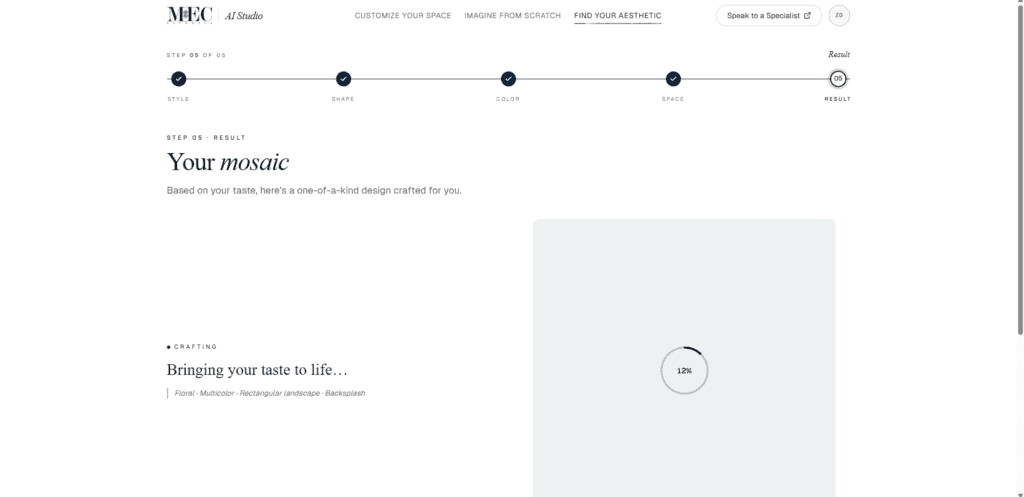
If you’ve ever opened a design platform and faced an empty prompt box, you’ve probably had the same thought: “What am I supposed to type?” Blank canvases sound freeing. In practice, they can feel intimidating.
The MEC AI Studio Find Your Aesthetic feature takes a different approach. Instead of expecting you to arrive with a complete design idea, it guides you through the decisions that shape one. Think of it as a mosaic-style finder tool in 2026 rather than a traditional image generator. The process helps you explore your aesthetic through several connected choices:
Style → Shape → Color → Space → Result
Each step reduces uncertainty. You begin with broad visual preferences. Then, you narrow them by considering form, palette, and placement. This guided process helps you choose the right mosaic style and reach a clearer aesthetic direction.
The Six Mosaic Style Categories to Know
Before using any mosaic style quiz or style finder, it helps to understand what the main categories actually mean. There is no rule saying your final artwork must fit neatly inside one box. In fact, some of the most interesting custom mosaic designs blend two or more influences. Still, these six categories give you a practical starting point.
Abstract Mosaic Style
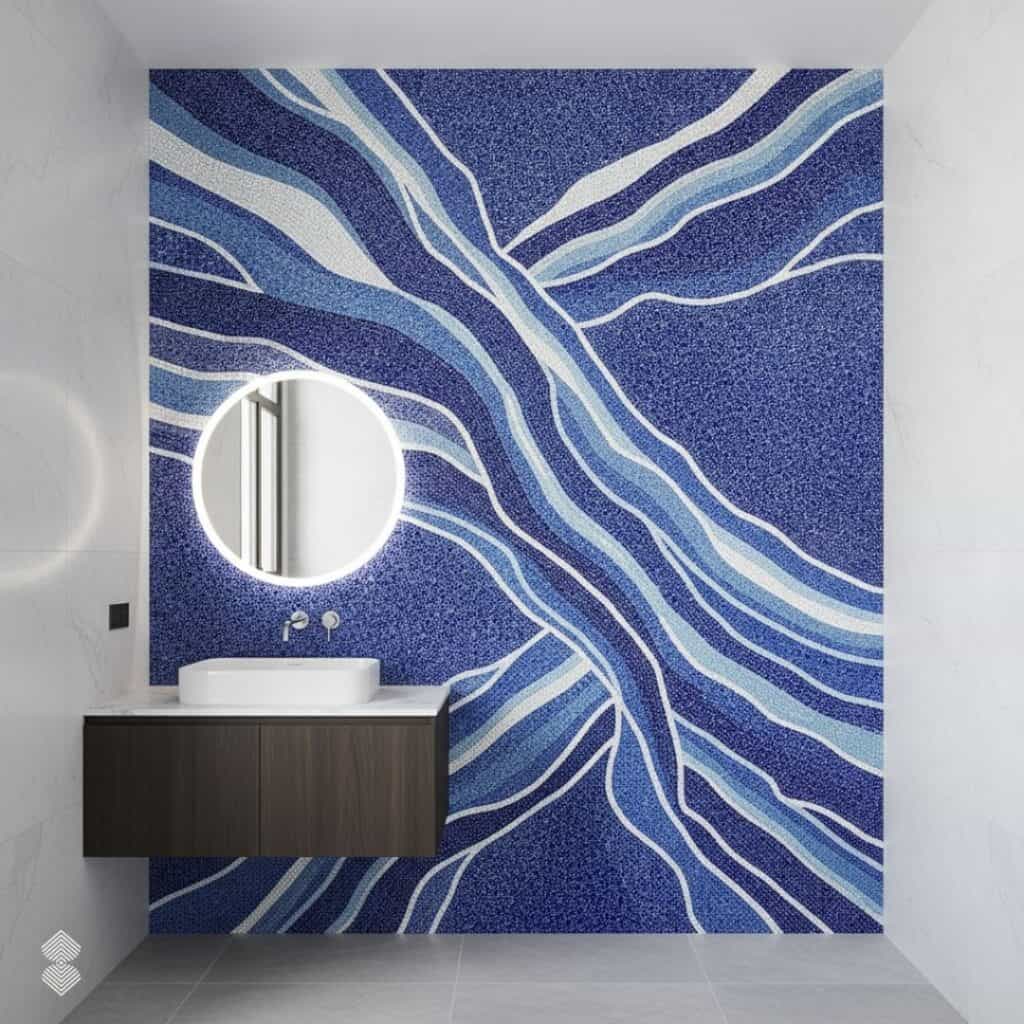
Abstract mosaic art doesn’t need to show a recognizable person, flower, animal, or landscape. Instead, it uses color, movement, texture, rhythm, and form to create emotion. That freedom makes abstract mosaics especially useful in modern homes. An abstract mosaic composition depends on:
- Flowing lines
- Layered color fields
- Swirls
- Fragmented shapes
- Organic curves
- Gradients
- Wave-like movement
- Irregular patterns
- Contrasting blocks of color
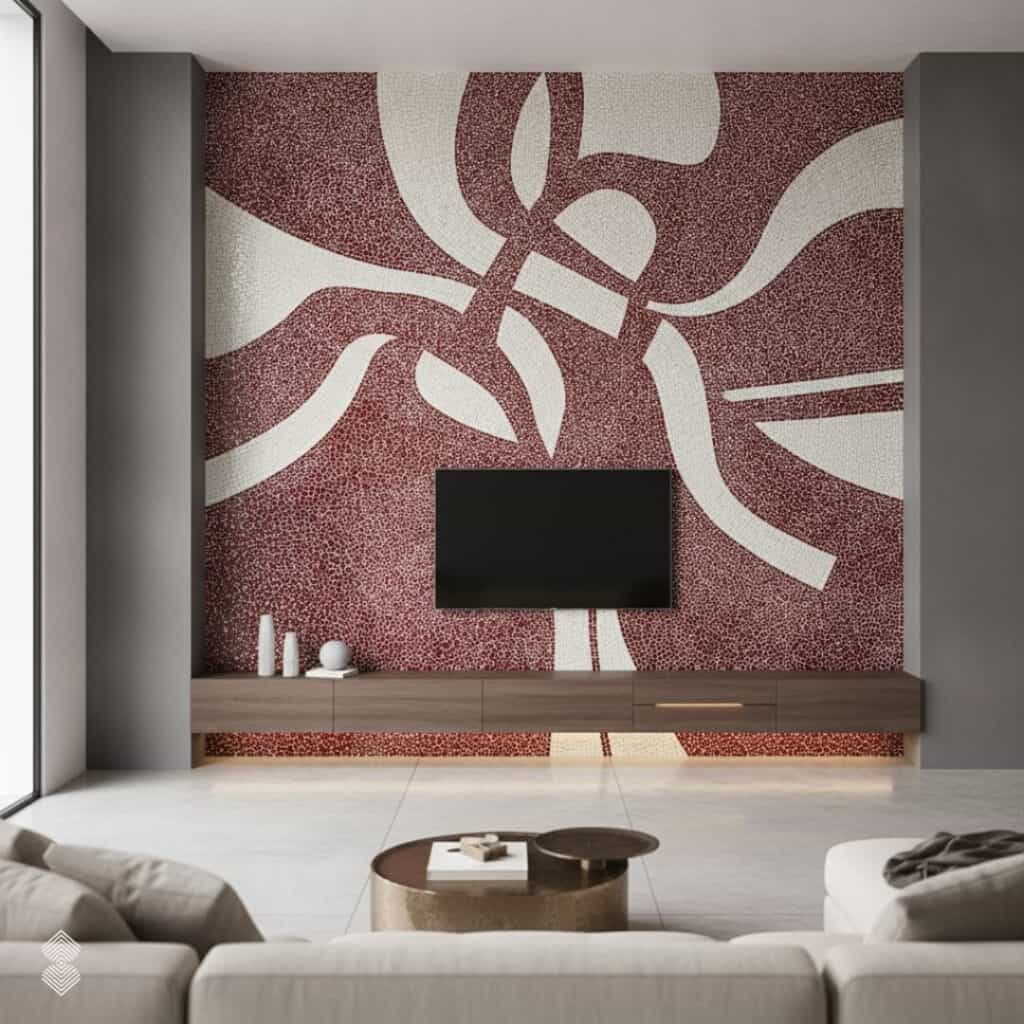
Because there is no fixed subject, you can adapt abstract art easily to unusual architectural surfaces. Abstract mosaics work particularly well in:
- Contemporary living rooms
- Pools
- Spa areas
- Large feature walls
- Hallways
- Hospitality-inspired home interiors
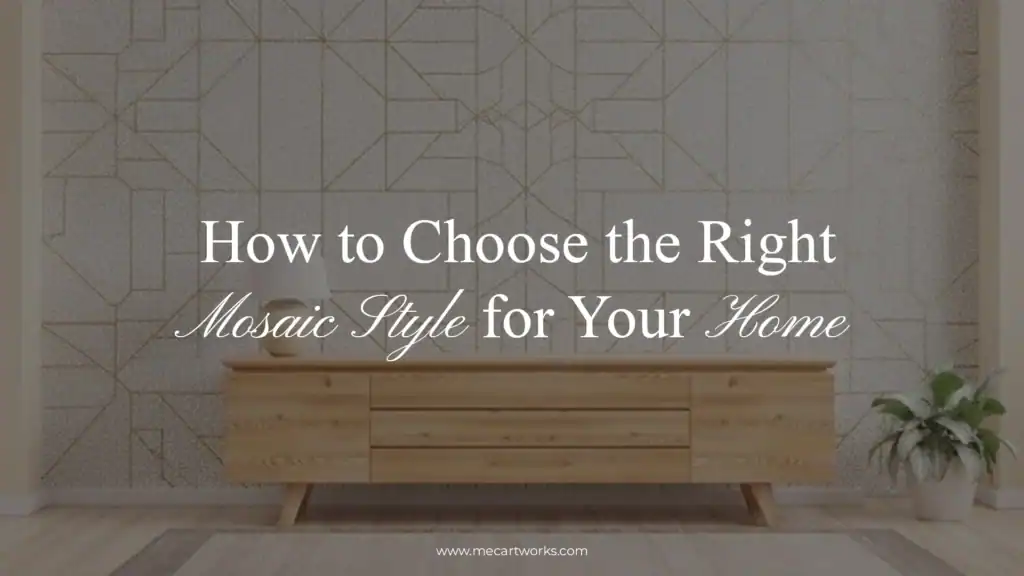
Geometric Mosaic Style
Geometric mosaic design relies on order. Lines meet deliberately. Shapes repeat. Symmetry creates rhythm. Typical geometric elements include:
- Squares
- Hexagons
- Diamonds
- Circles
- Stars
- Triangles
- Interlocking polygons
- Repeated grids
- Radial motifs
- Tessellated patterns
Geometric designs can look ancient, modern, minimalist, or highly decorative depending on how you use them. A black-and-white marble pattern with large, clean shapes can feel strikingly contemporary. That flexibility makes geometry one of the easiest mosaic styles to adapt and work especially well on:
- Entryway floors
- Bathroom floors
- Kitchen backsplashes
- Hallways walls
- Stair risers
Floral Mosaic Style
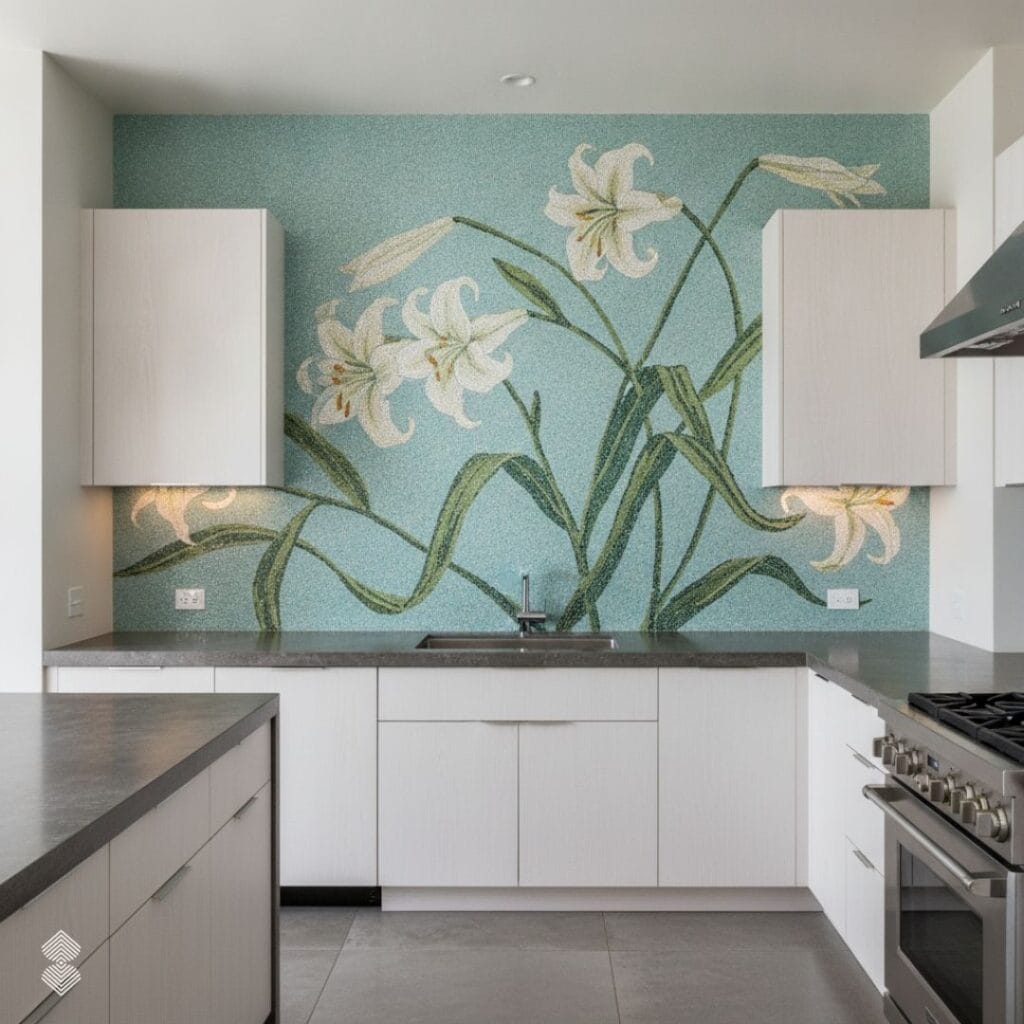
Floral mosaic collections sit somewhere between decorative art and nature-inspired storytelling. They can feel soft and romantic. They can also look dramatic, sculptural, tropical, classical, or highly contemporary. The only difference comes down to the composition. A floral mosaic might show:
- Large blossoms
- Botanical branches
- Vines
- Leaves
- Wildflowers
- Roses
- Tropical foliage
- Stylized petals
- Floral borders
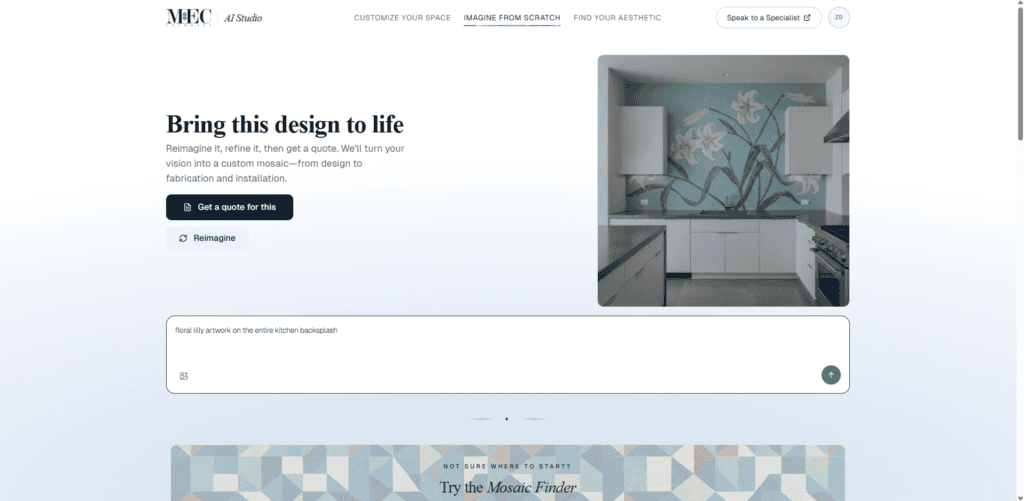
You don’t need to cover a wall with hundreds of flowers. Sometimes one oversized botanical form creates more impact than a dense garden scene. Floral mosaics often suit:
- Kitchen backsplash
- Bedrooms
- Dressing rooms
- Garden walls
- Spa spaces
- Entrance features
- Living room accent walls
One major advantage of floral design is its flexibility. You can make it traditional or highly modern. Reduce the palette and enlarge the forms, and botanical art suddenly feels more contemporary. Add intricate petals, vines, and detailed shading, and it becomes more decorative. (See our detailed floral mosaic collection)
Landscape Mosaic Style
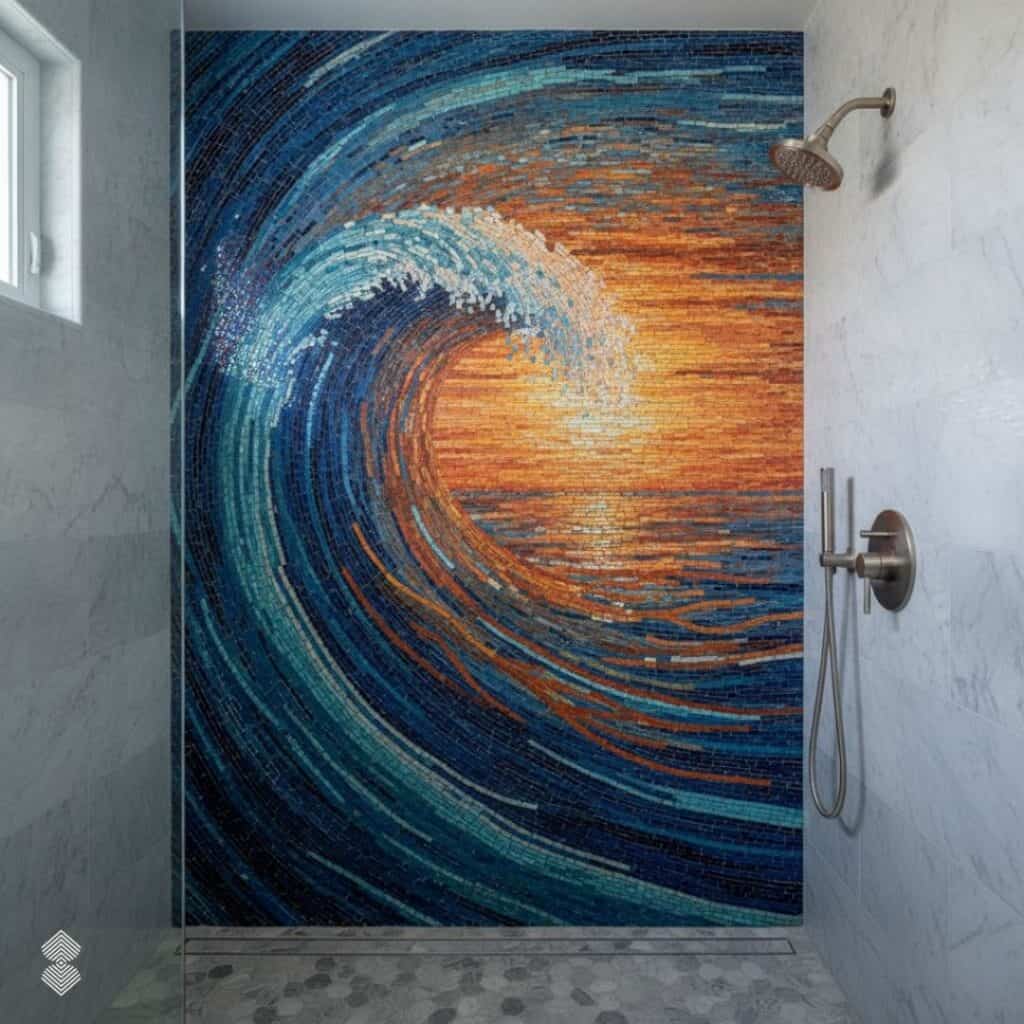
Landscape mosaics turn walls and surfaces into scenes. It usually uses small pieces of materials like colored glass, stone, marble, or ceramic tiles arranged together to picture natural scenes like:
- Mountains
- Beaches
- Forests
- Deserts
- Gardens
- Skylines
- Sunsets
- Lakes
- Mediterranean scenery
- Tropical settings
Landscape art tends to work best when you have enough surface area to create depth. Why? Because landscapes rely heavily on layers. You may need a foreground, middle distance, background, horizon, sky, and focal point. If the available area is too small, those layers can collapse into visual clutter. Landscape styles often suit:
- Pool walls
- Garden features
- Large bathrooms
- Interior feature walls
- Courtyards
- Outdoor entertaining areas
- Home spas
- Large entrance walls
Portrait Mosaic Style
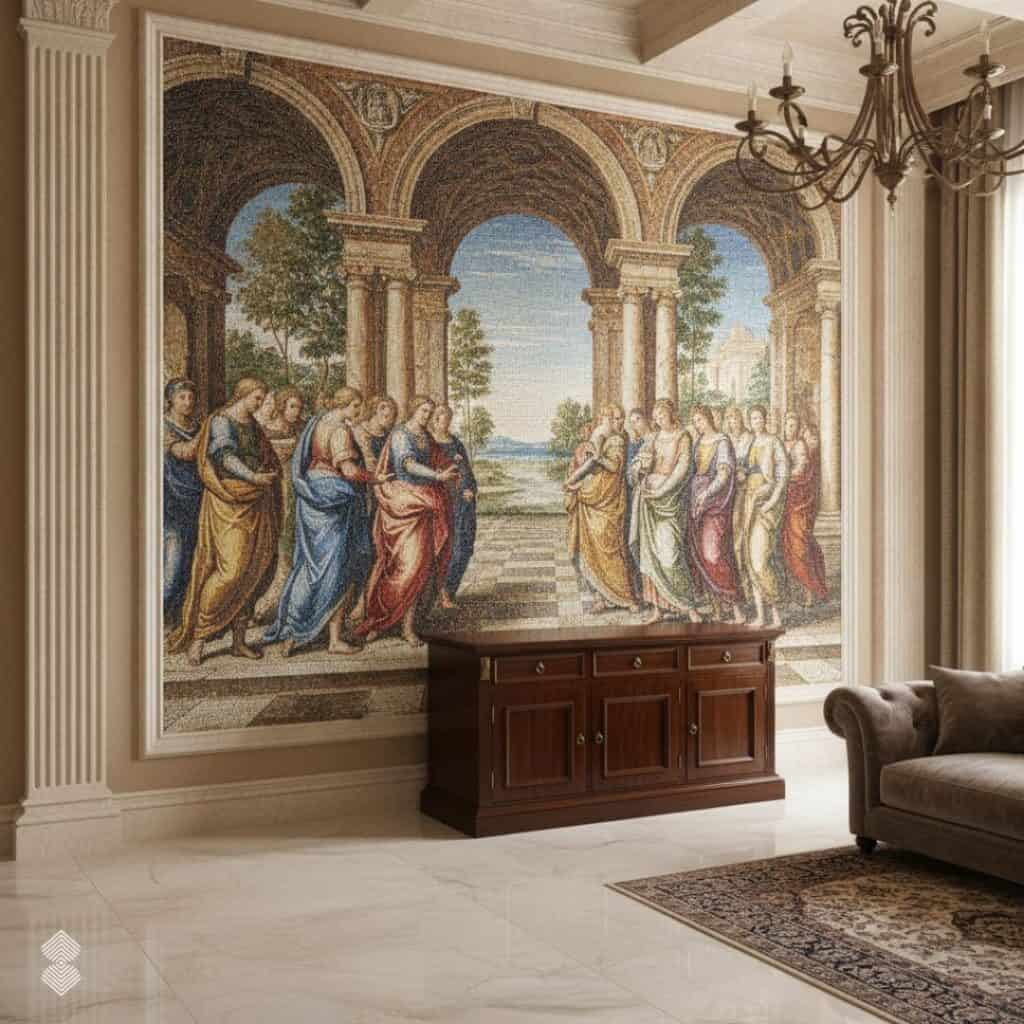
Portrait mosaics are among the most technically demanding categories. Faces are unforgiving. Move a line slightly around an eye or mouth and the expression can change completely. That means portraits depend heavily on proportion, contrast, shading, and tile placement. Portrait mosaics may depict:
- Family members
- Cultural figures
- Historical personalities
- Stylized faces
- Classical subjects
- Personal photographs
- Artistic silhouettes
The larger the portrait, the easier it becomes to preserve fine visual information. Think of a digital photograph. Zoom in far enough, and you see pixels. Mosaic works on a similar principle, except each tessera becomes part of the visual translation.
Moreover, portrait mosaics make the most sense when the artwork carries personal or symbolic meaning. They aren’t usually background decoration. They are focal points for:
- Large interior walls
- Private galleries
- Entrance halls
- Personal libraries
- Home offices
- Courtyards
- Memorial or heritage spaces
Animal Mosaic Style
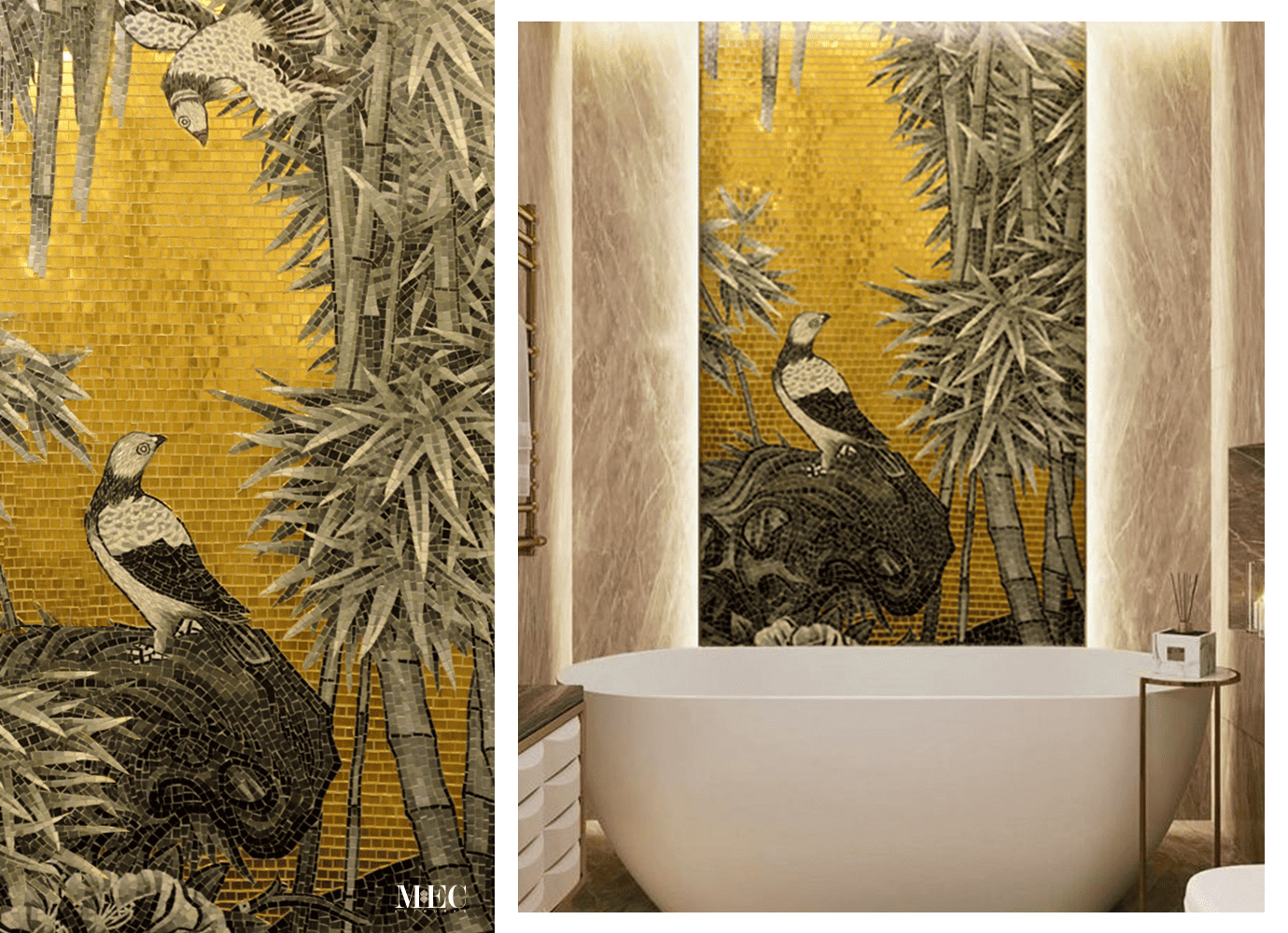
Animal mosaics combine storytelling with nature personality. They can feel elegant, playful, symbolic, dramatic, or deeply personal. Popular animal mosaic subjects may include:
- Birds
- Horses
- Fish
- Butterflies
- Peacocks
- Big cats
- Marine life
- Pets
- Wildlife
- Mythical creatures
The style can range from realistic to highly stylized. For example, a koi fish mosaic on a pool floor could use flowing lines that interact with moving water. A leopard on an entrance wall might use rich jewel tones. A family pet could become a detailed portrait mosaic for a private interior. Animal designs work especially well when the subject connects naturally with the room. Like:
- Marine life suits pools and spas.
- Birds and botanical elements fit gardens.
- Horses may feel appropriate in countryside residences or equestrian properties.
How to Find Your Aesthetic Works: Five Steps from Style to Result
Understanding the six categories gives you design ideas. Now you need to turn your design preference into direction. The easiest way to find your mosaic aesthetic is to separate what you like from what your room needs. A useful mosaic style finder tool should narrow your choices rather than add more. Find Your Aesthetic does this through five connected stages.
Step 1: Style
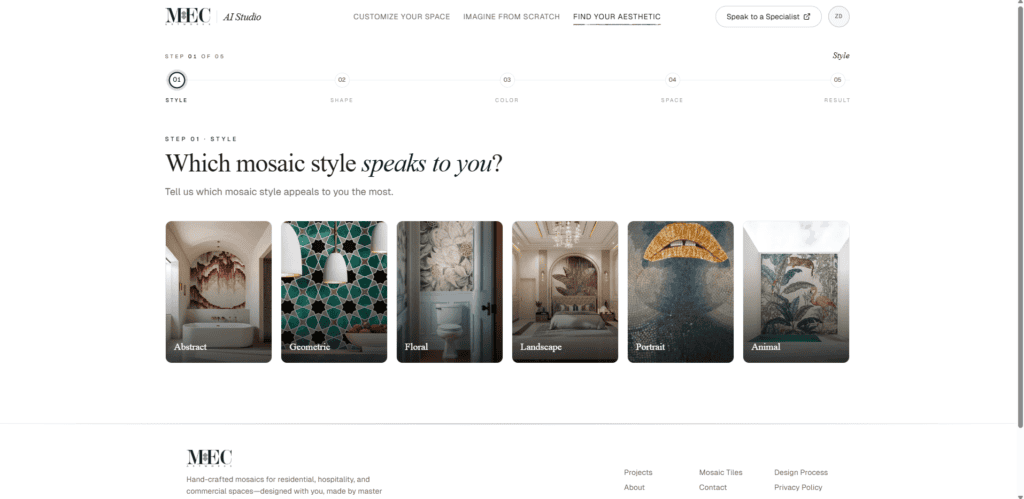
Style answers the biggest question first: What kind of visual language appeals to you? You begin by exploring broad directions such as Abstract, Geometric, Floral, Landscape, Portrait, and Animal. Don’t overthink this stage. Choose the category that gives you the strongest immediate reaction. If you like two categories, that’s useful information too. For instance:
- Floral + Geometric could become a botanical center framed with structured borders.
- Animal + Landscape could create a wildlife scene.
- Abstract + Geometric might combine loose color movement with crisp repeating forms.
Step 2: Shape
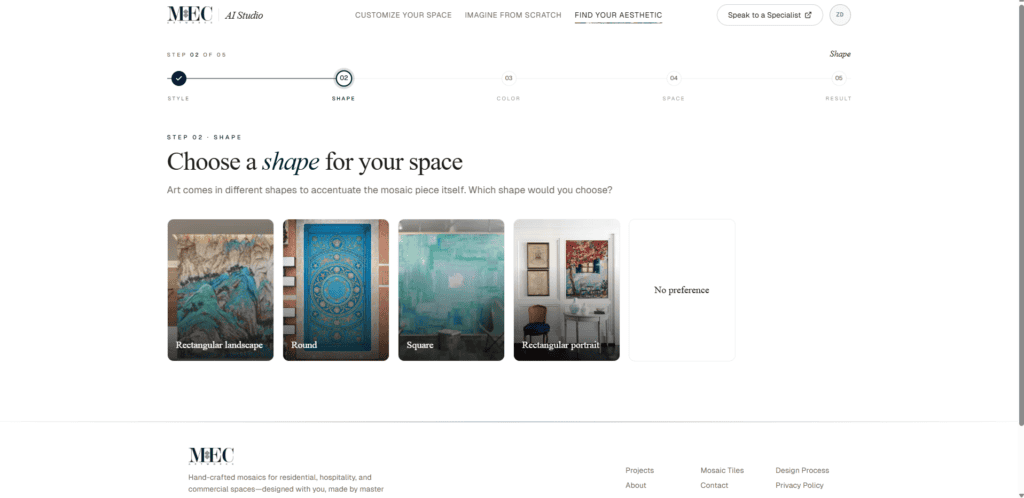
Once you’ve chosen a style, shape helps define how the artwork should behave. Shape affects composition more than many homeowners realize. A square feature wall encourages one kind of layout. A long horizontal wall suggests another. Likewise, circular pool medallions require different compositions from tall vertical bathroom walls. Possible shapes might influence whether your design feels:
- Centered
- Panoramic
- Vertical
- Radial
- Repeating
- Border-driven
- Free flowing
Step 3: Color
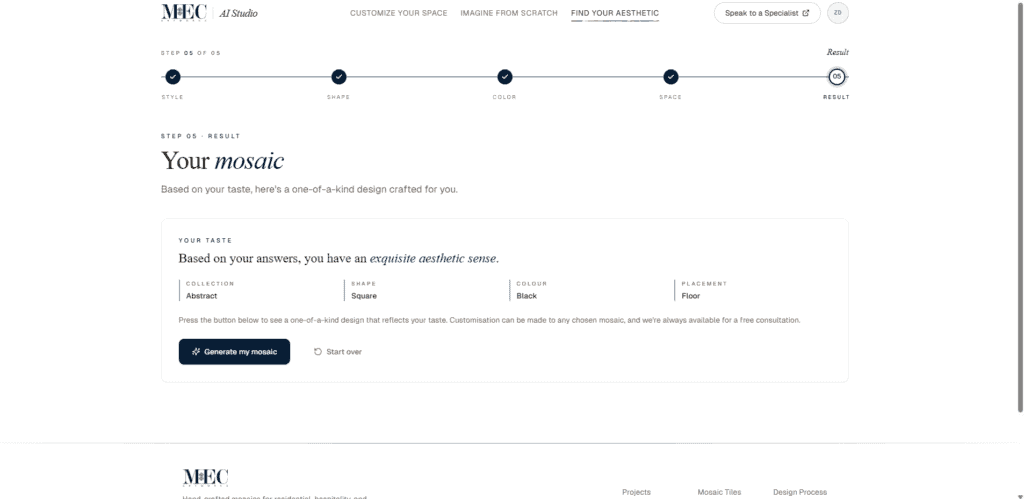
Color palette is where mood enters the process. Even when two mosaics share the same pattern, color can make them feel entirely different. For example: Consider a geometric design. Create it in black and white, and it may feel sharp and architectural. Use sand, cream, and warm beige, and it becomes quieter. Or use cobalt, turquoise, emerald, and gold, and the same pattern turns bold and decorative.
When choosing color, don’t focus only on your favorite shades. Look at the room. Pay attention to tiny details and aesthetics before setting to color mood board: One easy technique is the anchor color method. Choose one existing tone from the room, such as warm beige from marble veining. Bring that color into the mosaic. Then build other colors around it. The repeated tone creates visual continuity.
Step 4: Space
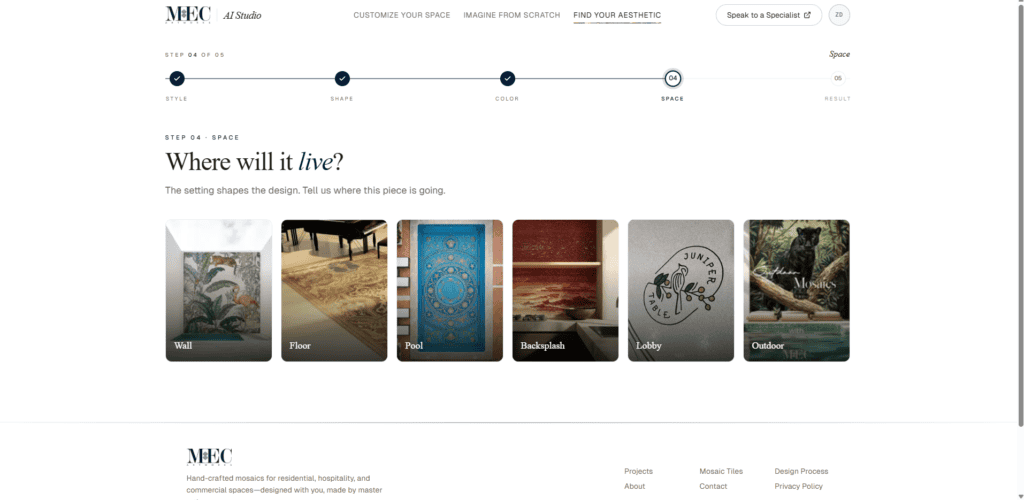
A mosaic only makes sense once it has a home. That’s why space matters so much. A design that works beautifully on a pool floor may fail on a kitchen backsplash. Likewise, an intricate portrait intended for a feature wall wouldn’t translate naturally onto narrow stair risers. When choosing your space, think about:
- Viewing distance: Will people see the mosaic from two feet away or twenty?
- Surface size: Large surfaces support more visual detail.
- Room purpose: Relaxing spaces often benefit from calmer compositions. Social areas can handle more drama.
- Furniture and fixtures: Artwork shouldn’t lose key details behind sinks, vanities, seating, shelves, or doors.
- Water and light: Pool mosaics change visually under moving water. Glass mosaics can sparkle beneath direct lighting.
Space gives your aesthetic context. Without it, you’re choosing art in isolation.
Step 5: Result
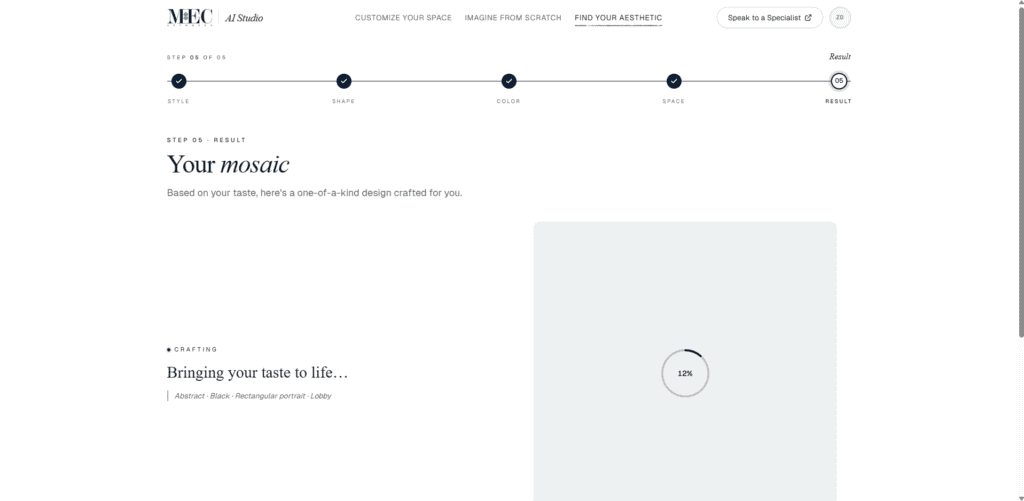
The result brings your choices together. At this point, you’ve moved through style, form, color, and space. That doesn’t mean you now have a final fabrication drawing. Think of the result as your visual design brief. It gives you something far more useful than saying: “I want something beautiful on this wall.” Instead, you might arrive with a direction such as: “I want a large floral composition for my bathroom wall, using soft green, ivory, and warm gold tones with an organic shape.” That statement gives a professional designer something tangible to develop. You’ve turned taste into information.
Why Starting with Style Makes the Rest of the Process Easier
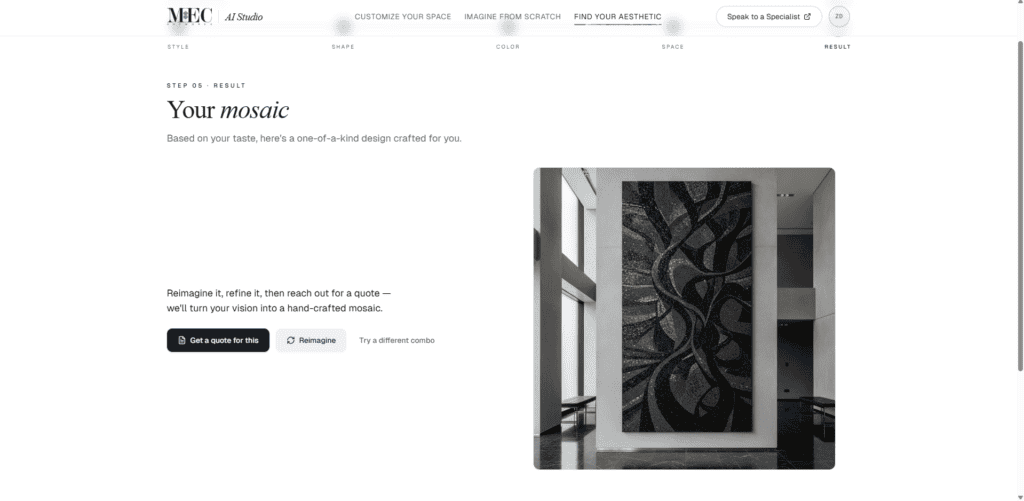
Design decisions become difficult when you try to make them all at once. Should you choose blue or green? Glass or marble? A large mural or repeating pattern? A circular composition or full-wall artwork? Without a visual direction, every choice creates another question. Style reduces the number of possibilities. Suppose you’ve already decided on geometric mosaic art or any other Art Deco mosaic pattern. You can now ask more specific questions:
- Should the pattern feel contemporary or traditional?
- Do you want large shapes or intricate repetition?
- Should the palette remain neutral?
- Would marble support the architecture better than glass?
- Do you want symmetry or controlled asymmetry?
You’ve gone from thousands of possibilities to a manageable group.
From Result to Reality: Turning Your Aesthetic into a Finished Mosaic
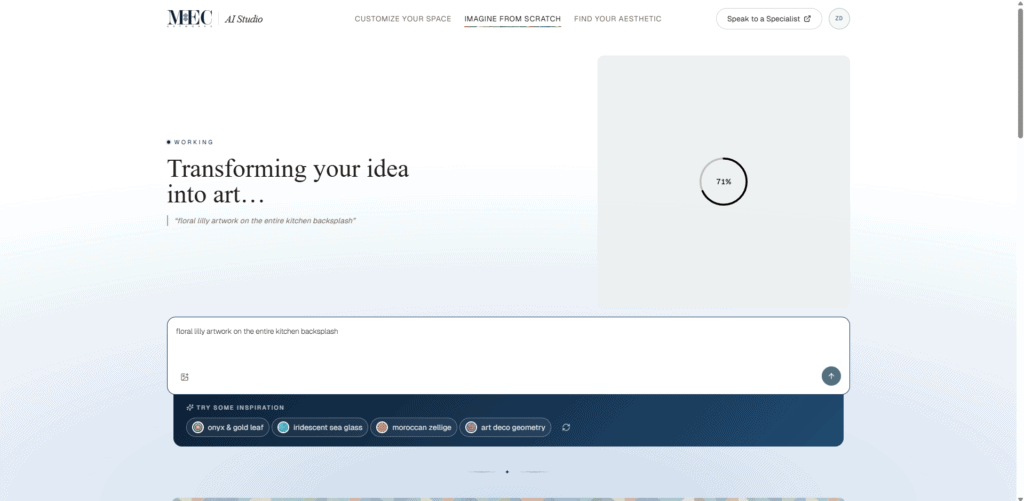
A digital result can only give your project direction. A finished mosaic requires another level of thinking. Once you know your aesthetic, a professional mosaic process can refine that visual idea according to real dimensions, materials, architecture, and fabrication requirements. A typical custom mosaic design process may look like this:
Aesthetic Result → Design Consultation → Measurements → Design Refinement → Material Selection → Artwork Approval → Fabrication → Delivery → Installation
Final Thoughts: How to Choose the Right Mosaic Style That Feels Like It Belongs to You
Learning how to choose the right mosaic style isn’t about memorizing design rules. It’s about narrowing possibilities until your taste becomes clear. You may discover that you love the rhythm of geometric patterns. Perhaps oversized floral art feels more natural. Maybe you’re drawn toward abstract movement because you don’t want the artwork to tell one fixed story.
Any of those choices can work. The important part is connecting your preferred style with the real space. That’s why MEC AI Studio Find Your Aesthetic feature gives you a practical place to begin that journey. Instead of jumping straight into detailed design decisions, you can explore your visual preferences step by step through style, shape, color, space, and result.
FAQs
What if I like more than one mosaic style, like Geometric and Floral?
You don’t have to choose only one. Custom mosaic design allows styles to overlap naturally. For example, you could place a floral composition inside a geometric border. You could simplify flowers into repeated geometric shapes or use structured symmetry behind organic botanical forms. When combining styles, choose one as the dominant direction. If Floral is primary and Geometric is secondary, let the botanical artwork take the spotlight while geometry provides framing or rhythm. This prevents the design from feeling confused.
Does Find Your Aesthetic account for my room’s shape and color palette too?
The Find Your Aesthetic process goes beyond choosing a broad visual category. The guided journey includes choices for Style, Shape, Color, Space, and Result. That matters because a mosaic style rarely works in isolation. Shape influences composition. Color controls mood. Space tells you how the artwork may relate to a real environment. Together, those steps create a clearer starting point than choosing an image based only on appearance.
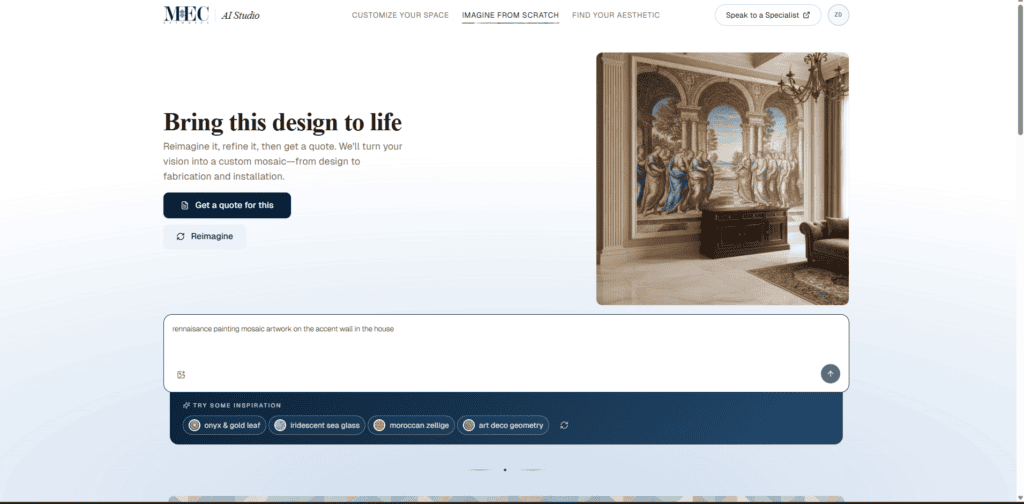
How is Find Your Aesthetic different from Customize Your Space or Imagine From Scratch?
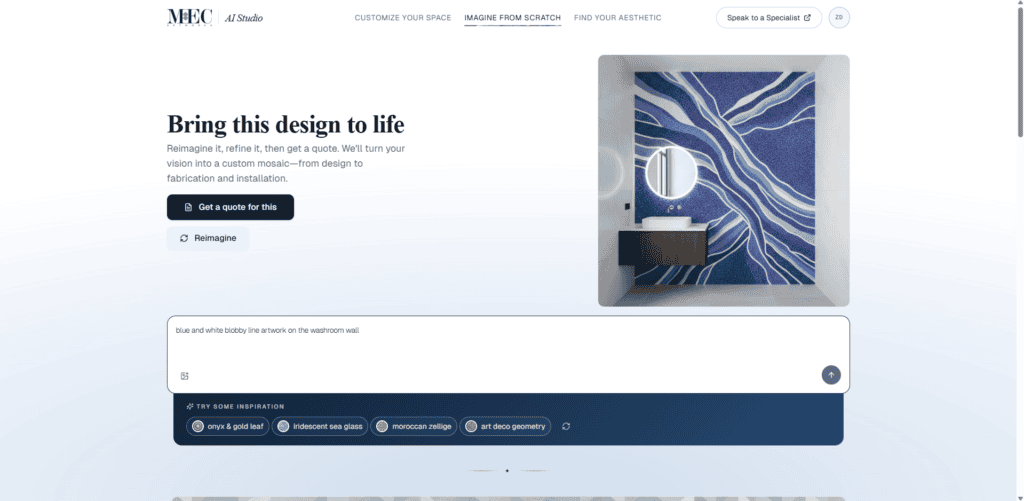
Each MEC AI Studio experience supports a different stage of the creative process. Find Your Aesthetic works best when you aren’t sure which mosaic direction suits you. It guides you through style, shape, color, and space choices. Customize Your Space is more useful when you already have a real room or surface and want to explore how a mosaic concept could look within it. Imagine From Scratch suits users who already have an idea in mind and want to develop a visual concept from a prompt.
Once I get my Result, can MEC help turn it into a real installation?
Yes. Your aesthetic result can serve as the starting point for a custom mosaic project. From there, the concept can move through professional design refinement, project measurements, composition development, material selection, color review, fabrication planning, and installation coordination. The key is understanding that the AI result establishes direction. The final mosaic still needs to adapt to the actual architecture and fabrication requirements.