
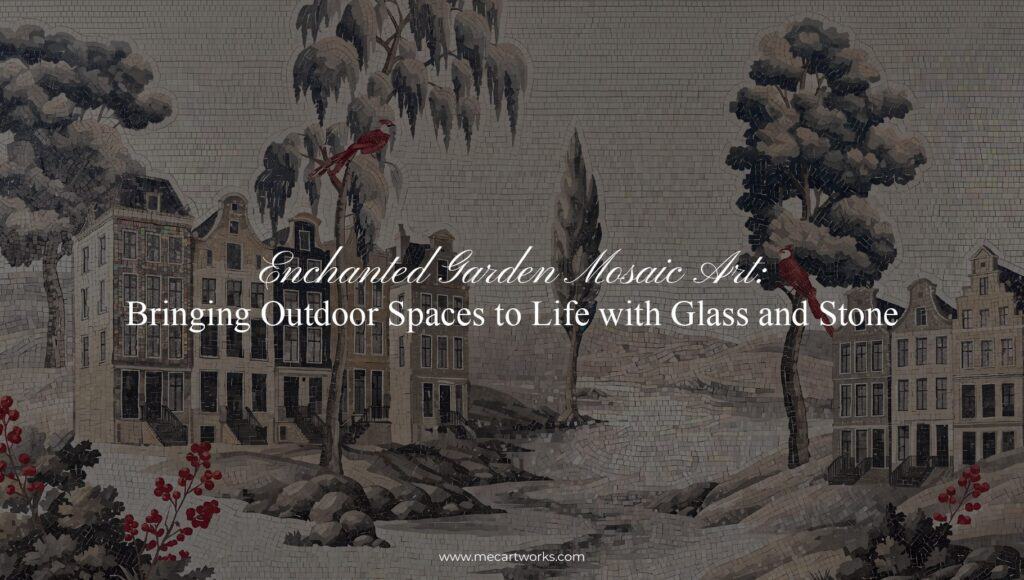
What if a garden could bloom across a wall and never fade? Enchanted garden mosaic art turns flowers, climbing vines, birds, ponds, and other natural details into an architectural artwork made from individual pieces of glass and stone. But a successful garden mosaic mural isn’t simply a collection of botanical motifs. The mosaic composition needs depth, movement, balanced color, and a clear focal point. The direction of each tessera can follow a curling vine, shape a flower petal, define a bird’s feathers, or create ripples across water.
This makes every garden scene highly adaptable. From bathroom walls and kitchen backsplashes to pools and large feature walls, the garden mosaic art can grow around the architecture and create a design that feels permanently part of the space. With our new enchanted garden mosaic art collection as inspiration, this blog explores what you should know about designing these scenes, from motifs and materials to placement and customization.
Table of Contents
What Is an Enchanted Garden Mosaic?
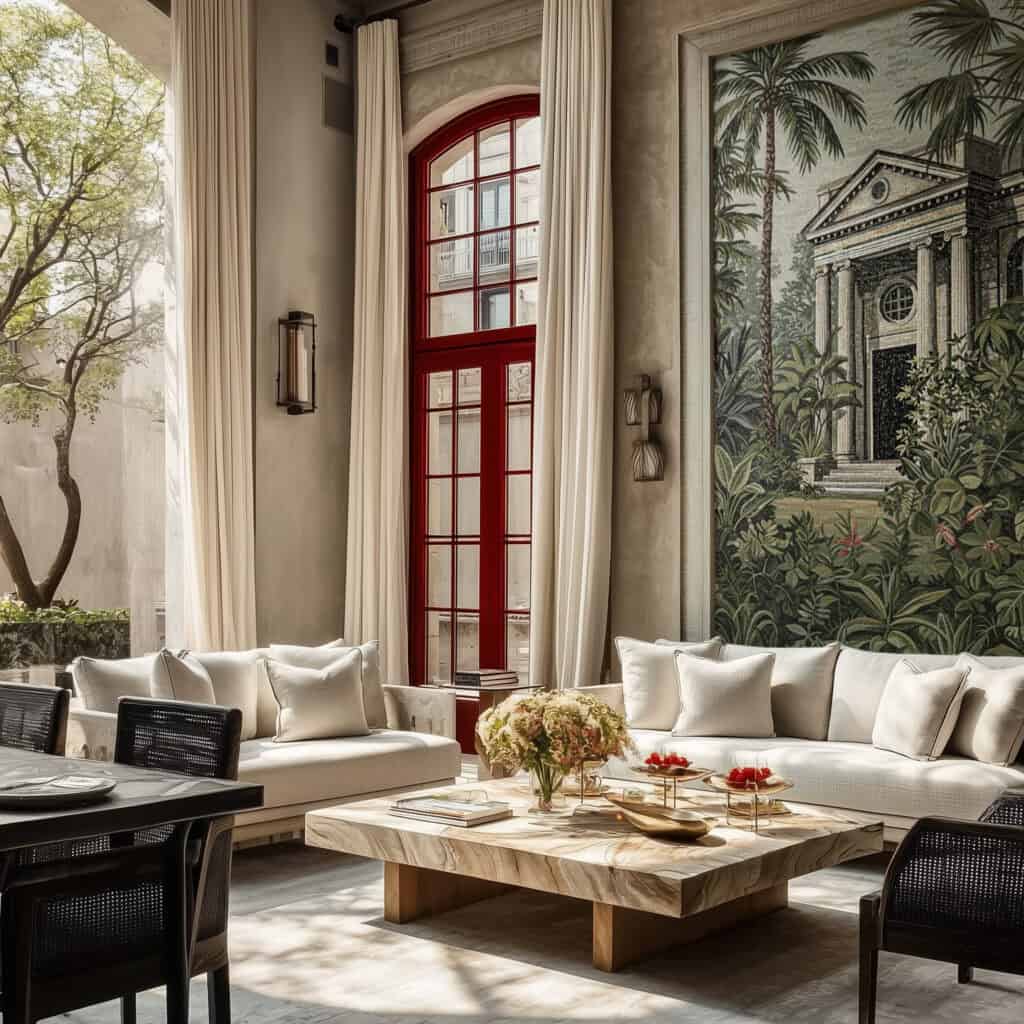
The enchanted garden mosaic is an art form that uses imagery of nature combined with the magical or romantic feeling of discovering or exploring something. Nature provides the primary base for the image to be created using flowers and trees. This can then be supplemented by birds, butterflies, ponds, architecture, etc.
Moreover, the word enchanted doesn’t mean the artwork needs fairies or fantasy creatures. Enchantment can come from atmosphere. Imagine pale flowers disappearing into a misty background, a single bird hidden among branches, or moonlight reflected across a dark blue pond. This is what separates an illustrated garden scene from a repeated botanical tile pattern. A repeating pattern relies on rhythm. Enchanted garden mosaic art relies more heavily on nature-inspired composition to create a layered and immersive garden scene.
The Motifs That Make a Garden Mosaic Feel Enchanted
The most memorable gardens rarely depend on one flower or one color. They contain layers. Plants overlap, branches change direction, water reflects nearby forms, and small details appear only after you spend time looking. Mosaic can recreate that layered experience in a permanent architectural surface. The challenge is restraint. If every inch contains a flower, butterfly, bird, vine, and fountain, the composition can become visually overwhelming. Strong enchanted garden mosaic art creates a clear hierarchy between major focal features and quieter supporting details.
Climbing Vines, Wisteria and Blossom
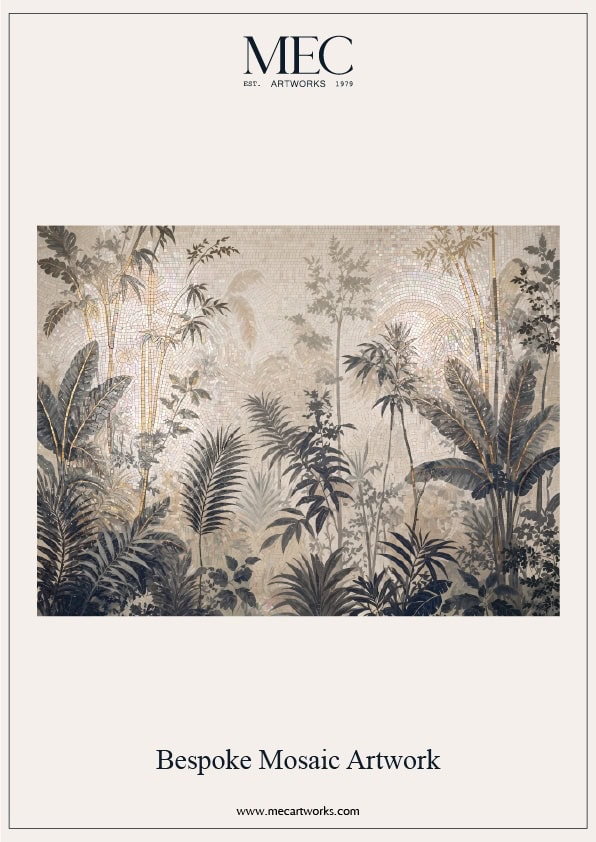
Climbing vines, wisteria, and blossoms are key elements in enchanted garden mosaic art. They help establish the garden setting while adding natural movement across the surface. Vines can weave around other motifs, wisteria can cascade from above, and flowering branches can fill open areas without making the scene feel rigid.
Color and tessera direction make these details more expressive. Shades of lavender, violet, green, and soft neutrals can create depth, while the tesserae can follow the natural direction of stems and petals. MEC’s Wisteria Haven bathroom mosaic wall shows how cascading botanical imagery can become part of a larger interior surface rather than behaving like a small decorative insert. For a denser botanical direction, The Herbarium also offers a useful reference for turning plant forms into decorative mosaic artwork.
Songbirds, Butterflies and Garden Wildlife
Another important feature of enchanted garden mosaic art is the use of birds, butterflies, and other small wildlife. Flowers help to set up the backdrop while wildlife gives personality to the scene. For example, an illustration of a bird sitting on a branch, butterflies flitting around from flower to flower, and koi fish under the pond make great focal points. The wildlife becomes a focal point while surrounding foliage provides context. Other garden wildlife can include:
- Dragonflies near water
- Koi beneath pond surfaces
- Hummingbirds around flowers
- Peacocks as major focal features
- Rabbits within low foliage
- Herons beside ponds
- Bees used as tiny discoveries within floral areas
Moonlit Ponds, Fountains and Water Features
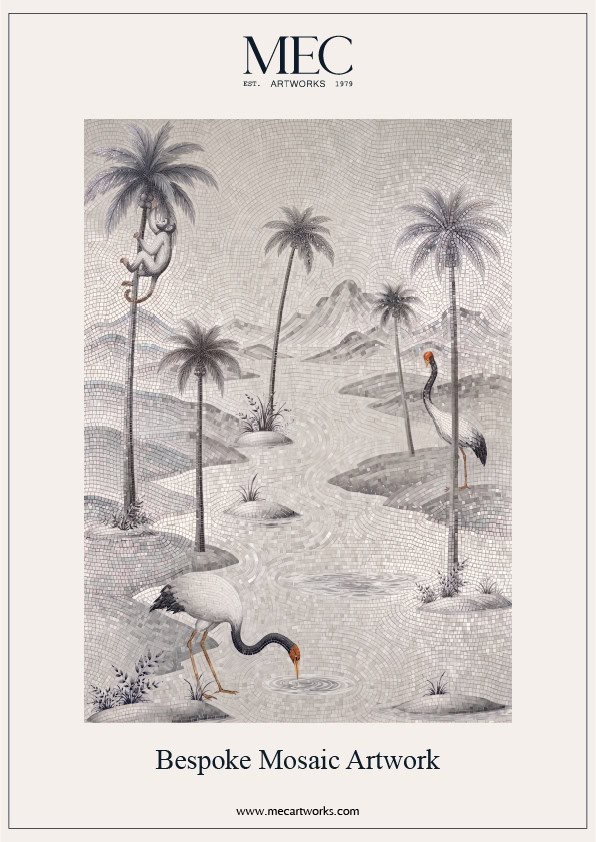
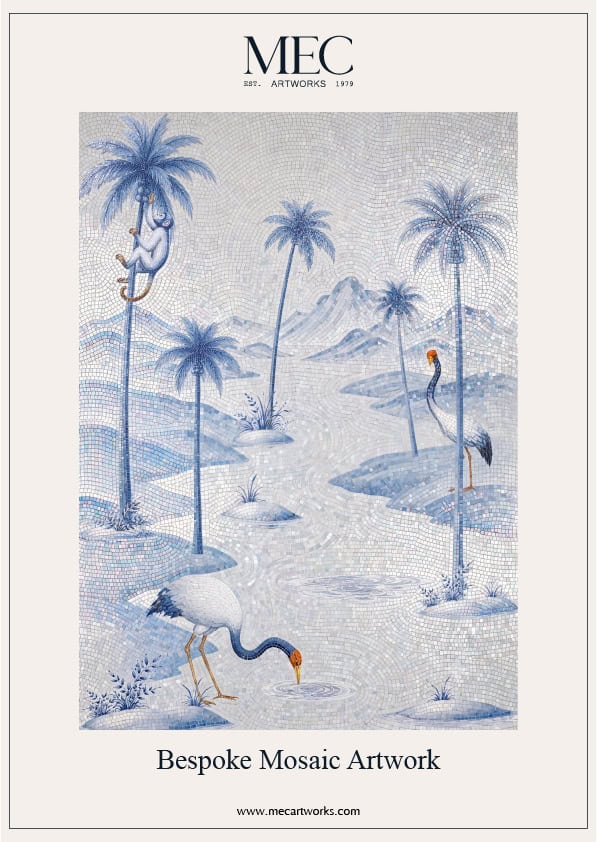
For clients who want more movement, we often suggest adding a pond, fountain, or other water feature. Water makes a natural barrier between densely grown flowers and leaves and provides an atmosphere of tranquility.
According to the desired effect, either dark blue and emerald colors could be used for shaded ponds, or turquoise and glass colors would go well with bright waters. Reflected flowers or greenery could be added to the water to link it to the rest of the garden elements. The Water Garden Bloom mosaic mural shows how these botanical and water motifs can work together as one scene. For more classical designs, a fountain can become the main focal point. For a softer or more dramatic mood, we may suggest a moonlit pond with midnight blue, violet, and subtle highlights.
Mythical Figures and Garden Statuary
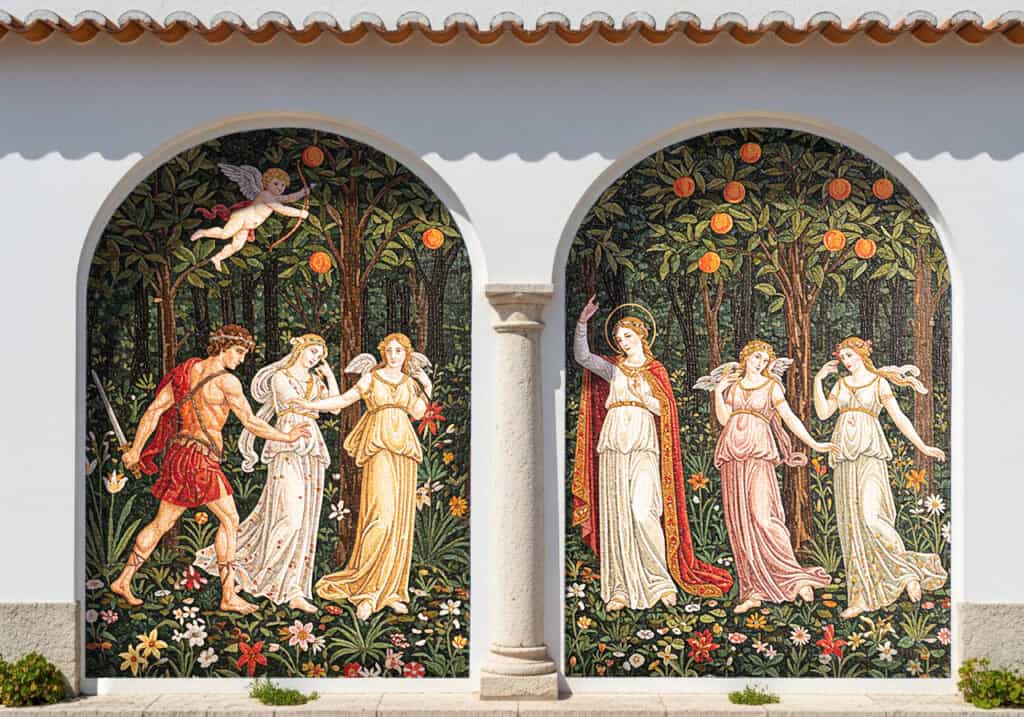
For clients seeking a classic or story-oriented feeling for their garden mosaics, we may recommend incorporating statuary and architecture into their design. Stone urns, fountains, arches, columns, benches, and statuary can provide contrast to lush planting while helping to define the garden space.
The classical theme garden mosaics can take further advantage of mythical characters like nymphs, horses, birds, or other characters from classical mythology. Where one particular figure is the focal point of the piece, we would use smaller tesserae to highlight the face, attire, and other features of the figure, while soft foliage adds depth behind the figure. The Neoclassical Garden mosaic mural shows how statuary and botanical imagery can work together within one composition. Not every design needs a dominant figure, though. Sometimes an urn or statue partly hidden behind leaves creates the sense of discovery that makes an enchanted garden mosaic art more interesting.
Choosing Materials for Enchanted Garden Mosaic Art
The materials that we usually recommend and employ for enchanted garden mosaic art include glass, marble, natural stones, as well as specific finishing materials. Nevertheless, we always select our materials based on the installation area of the mosaic and take into consideration such factors as the place of installation, environment, weather, moisture, and purpose.
Glass Tesserae for Dappled Light and Colour Depth
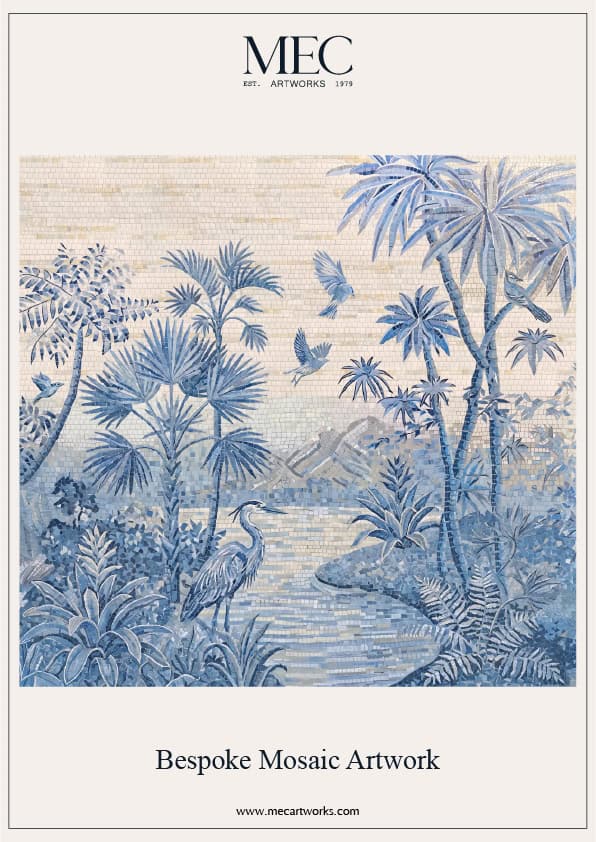
Glass tesserae are usually recommended by us if a garden mosaic requires more vivid colors, lighting, or movement. Glass is ideal for flowers, leaves, ponds, birds, and many other details for which small color changes can help bring depth.
If we want to achieve an effect of sunlight reflecting from greenery in a hand-cut glass mosaic garden design, we may combine emerald, olive, aqua, and teal colors along with lighter highlights. In the area near water, darker blues should move into turquoise and pale aqua. We also balance brighter glass with quieter tones. This keeps important flowers, birds, or water details from competing with the rest of the composition.
Marble and Natural Stone for Soft Foliage Texture
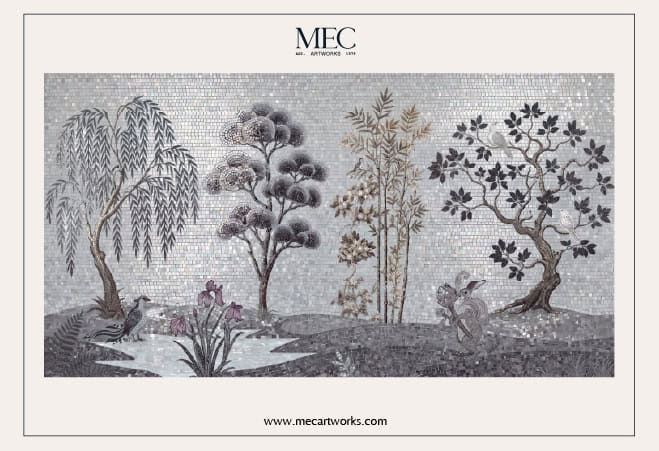
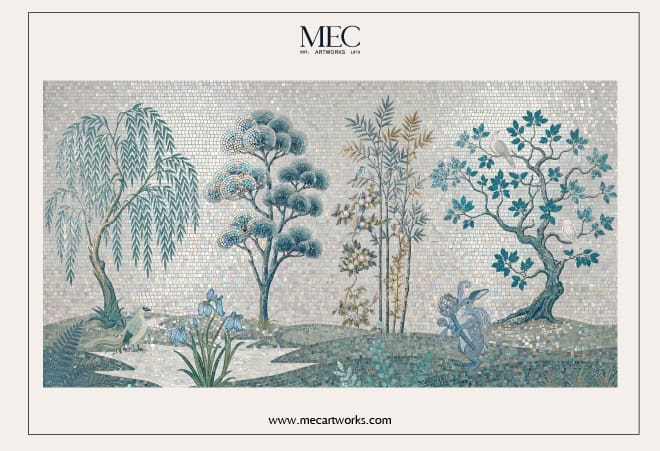
Generally, our recommendation is to go with marble and natural stones in case the enchanted garden mosaic art requires something a bit softer and more natural. The natural color and veining would be ideal in depicting foliage, trees, pathways, fountains, urns, and other architectural elements.
When working on floral mosaic wall art, we can apply muted greens, ivory, beige, warm gray, and other earth colors as a background for colorful flowers to create the right amount of depth without being too colorful. In classical garden scenes, natural stone will also make the columns, pathways, and statues look natural. The Willowmere Mosaic offers a useful example of how natural imagery and decorative details can come together within a mosaic composition.
Venetian Smalti for Shadow and Shimmer
For garden designs that need richer highlights or deeper shadows, Venetian smalti can introduce another layer of color and texture. Its slightly irregular surface interacts with light differently across individual tesserae, which can give selected details more visual energy. We may use it selectively around flower centers, water reflections, bird feathers, moonlit leaves, or other focal areas. Rather than adding shimmer everywhere, we prefer to place it where it can strengthen the composition.
Where an Enchanted Garden Mosaic Works Best
We customize each garden mosaic around your space, dimensions, design preferences, and intended setting. Whether you want it indoors or outdoors, the enchanted garden mosaic art can be developed to fit the architecture and installation area. Some of the most common places we create enchanted garden mosaic art are:
Wall Murals and Feature Walls
For larger walls, we can develop enchanted garden mosaic art as a complete scene rather than a single decorative motif. Trees, flowering branches, birds, pathways, ponds, and other details can spread naturally across the available surface.
We also design around the room itself. Viewing distance, furniture, doors, lighting, and fixtures on the walls give us a better idea of where to position focal points and how much detail to include so that the mural will appear complete at a viewing distance but reveal small tessera detail up close.
Kitchen and Bathroom Backsplashes
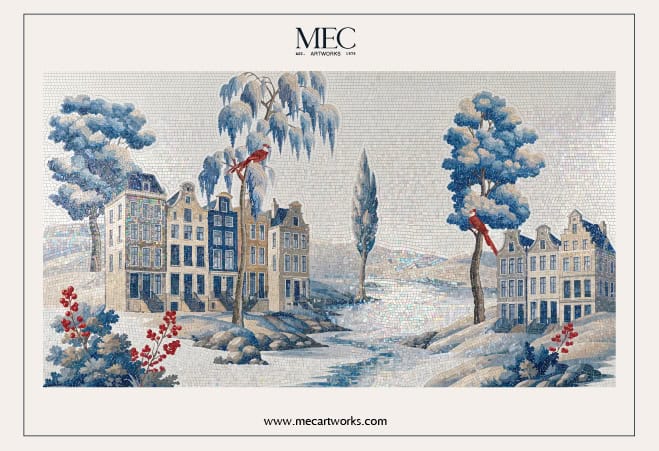
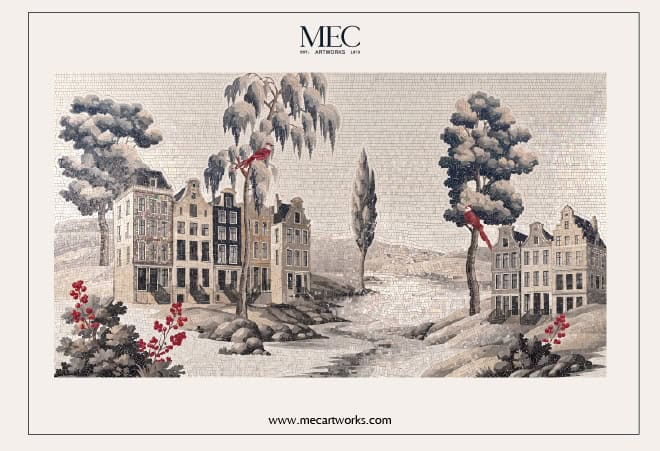
In kitchens and bathrooms, we usually modify the garden setting for a smaller or more focused surface. For instance, instead of a whole garden setting, the enchanted garden mosaic backsplash could be created by a flower-bearing branch, botanical borders, or a couple of birds. The Delftmark Mosaic shows how decorative imagery can work within an interior surface.
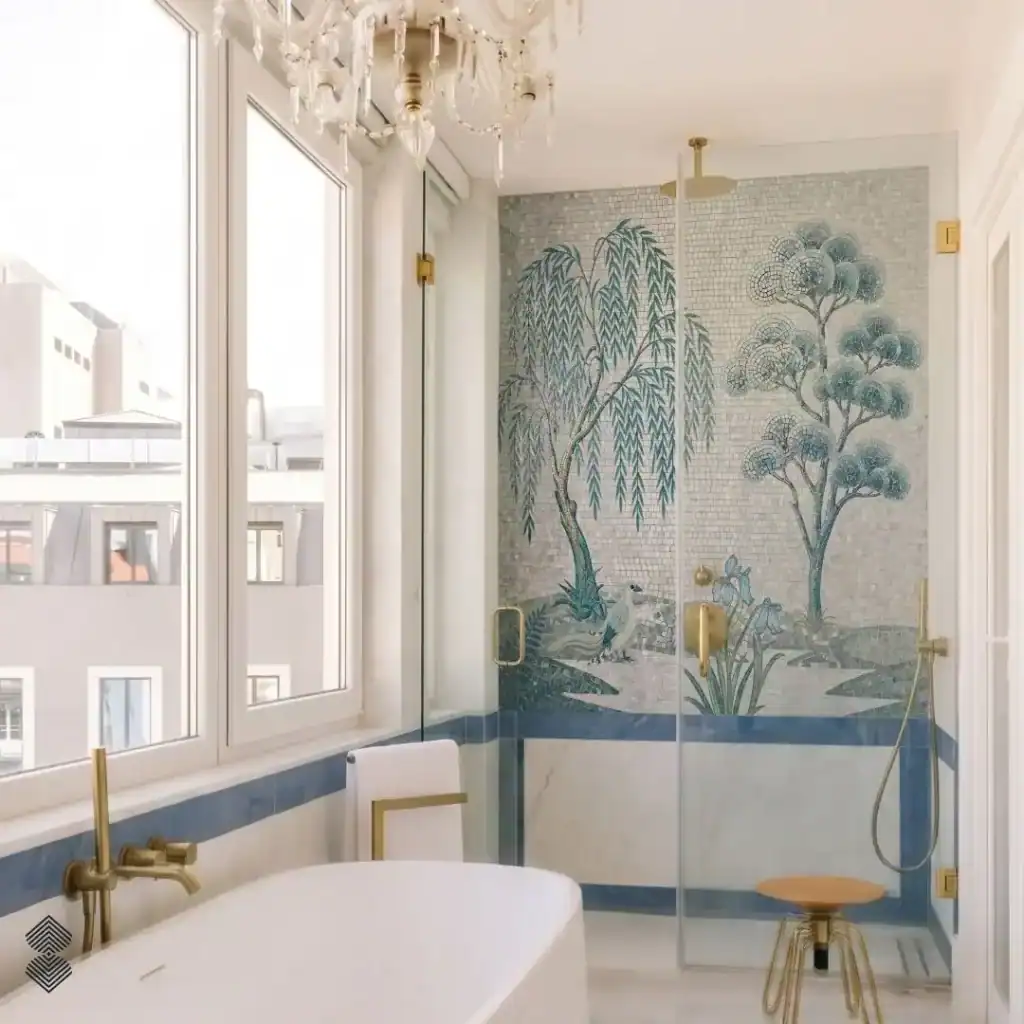
There is more room in bathrooms for experimentation. The custom garden mosaic for a bathroom wall can be created on a shower wall, vanity wall, niche wall, or even behind a freestanding bathtub. The composition of the artwork is customized around specific elements such as fixtures, corners, niches, and many others.
Pool Surrounds and Outdoor Water Features
When it comes to swimming pools and water gardens, we create the garden composition considering its appearance in the water and around the water. Plants, leaves, koi, water lilies, and botanical borders may cover the floor of the pool, steps, ledges, walls, and other elements.
Due to the optical effects of water and light, as well as the depth of water, we try to use clear images, gradient transitions, and sufficient contrast in our work. Botanical mosaics in outdoor fountains may be combined with the image of running water.
From Reference Image to Hand-Cut Garden Panel
Almost any garden inspiration can become the starting point for enchanted garden mosaic art, but it needs to be adapted for the material. We can work from your photo, painting, sketch, moodboard, or design idea, then customise its colors, shapes, and important details into a composition that works with individual tesserae. The goal isn’t simply to copy the reference but to make it work naturally as mosaic art.
Working From a Photo, Painting or Moodboard
A custom hand-cut garden mosaic can start with almost any visual reference. You can send us a garden photograph, painting, sketch, moodboard, architectural drawing, or even a collection of flowers, colors, and wildlife you want included.
Our design team then studies the reference and identifies what will translate best into mosaic. Instead of copying every leaf or small background detail, we refine the composition and give more attention to the features that matter most. You can share:
- Garden or landscape photos
- Paintings or botanical references
- CAD drawings or elevations
- Material and color samples
- Preferred flowers, birds, or wildlife
- Moodboards and design inspiration
From there, we develop the garden-themed mosaic design around your preferred style, colors, level of detail, and final space.
Mapping the Scene to Your Wall or Panel Size
Once the design direction is clear, we adapt the artwork to the exact dimensions of your space. A long backsplash, tall shower wall, large feature wall, or pool floor each needs a different composition rather than simply resizing the same image.
We also map important architectural details such as corners, niches, windows, fixtures, steps, and built-in features. This helps us position flowers, birds, figures, and other focal points in the enchanted garden mosaic art where they won’t be interrupted. Viewing distance and tessera size also guide the design. Smaller pieces can define petals, feathers, faces, and other fine details, while larger tesserae work well across broader backgrounds and foliage.
For larger projects, we can organize the finished mosaic into mapped sections or panels. This keeps the artwork aligned and helps the installation team reconstruct the complete garden scene accurately on site.
Previewing an Enchanted Garden Design With MEC AI Mosaic Studio
Not sure how your garden mosaic idea will look in your actual space? MEC AI Mosaic Studio can help you explore the concept before moving into detailed design and fabrication. You can preview different directions, such as dense or minimal foliage, light or dark palettes, flower scale, bird placement, classical or contemporary styles, and full-wall or framed compositions. This makes it easier to compare ideas and see how the artwork may relate to your room, pool, or feature wall.
The visualization also helps identify scale issues early. A flower that looks small in a reference image may feel oversized across a shower wall, while delicate details may disappear on a large exterior surface. The AI image works as a design preview rather than an exact representation of the finished mosaic. Real glass, marble, grout, tessera placement, lighting, and texture will influence the final appearance. Moreover, the preview gives clients, designers, and our mosaic team a clearer visual direction before the artwork moves into development.
Final Thoughts: Growing a Garden That Never Fades
The beauty of enchanted garden mosaic art lies in how personal the scene can become. Flowers, birds, water, foliage, and architectural details can all be arranged around your space, preferred colors, and the atmosphere you want to create. At MEC Artworks, we can develop the design from a photo, sketch, painting, moodboard, or original idea, then translate it into a hand-cut mosaic using materials suited to the project. Every detail, from tessera size and color to placement and scale, is considered around the final setting.
FAQs
What size wall or panel does an enchanted garden mosaic need?
There isn’t one required size. An enchanted garden mosaic art can work as a compact decorative panel, backsplash, shower feature, or full architectural mural. What changes is the amount of information the composition can carry. A smaller panel usually benefits from one clear subject, such as a flowering branch with a bird. A large wall can support foreground foliage, background scenery, water, architecture, and several secondary details.
Can an enchanted garden mosaic be used in a wet area like a shower or pool?
Yes, garden-inspired mosaics can work beautifully in showers, pools, fountains, and other wet environments when the entire assembly is properly specified for that application. Material selection is only one part of the system. The project also needs the correct substrate preparation, waterproofing where required, setting materials, grout, movement accommodation, and installation method.
Can the design match an existing tile or colour scheme in my home?
Yes. A custom garden composition can develop around existing finishes rather than forcing you to redesign the room around the mosaic. Start by identifying the dominant colors in stone, cabinetry, flooring, wall finishes, fabrics, or nearby tile. Those colors can become part of the mosaic palette while selected contrasting tones create focal points.
How is a hand-cut garden mosaic mural installed?
The installation method for enchanted garden mosaic art depends on the size, location, substrate, material, and project requirements. Large custom mosaics are commonly fabricated in manageable sections so installers can reconstruct the complete artwork on site. A clear mapping system helps maintain alignment between neighboring areas. Installers then set the mosaic using materials appropriate for the substrate and environment.
Does MEC Artworks ship an enchanted garden mosaic internationally?
Yes. MEC Artworks creates and ships custom enchanted garden mosaic murals worldwide. We carefully prepare and package each mosaic for international delivery and provide the necessary layout guidance to support installation at your project location.