
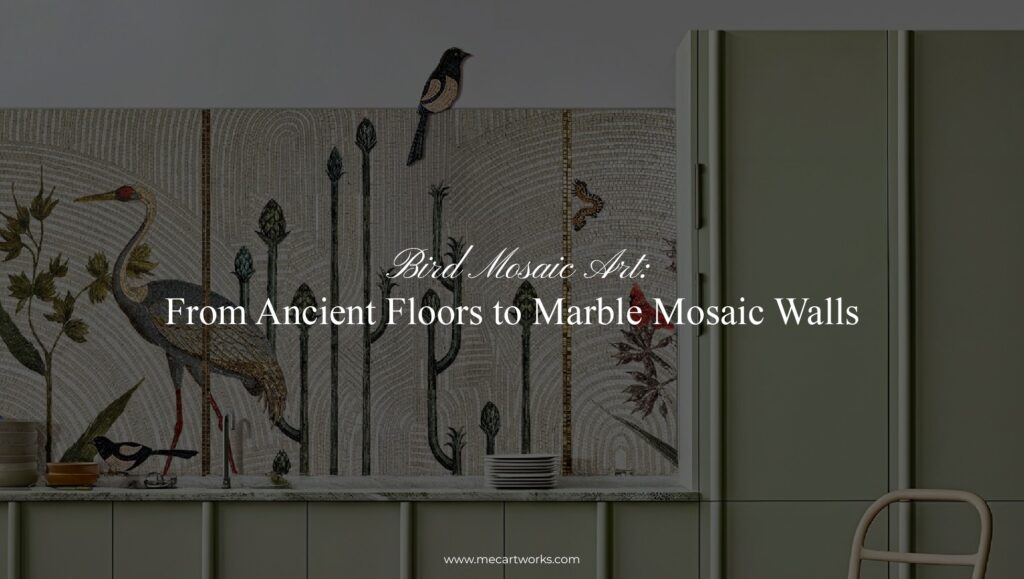
Modern bird mosaic art might include a panel of marble placed on the entrance floor, two cranes over a bathtub, or just one bird on the kitchen wall. The marble itself influences the design of the mosaic. The soft transitions from cream to grey colors can help depict the wings, and darker pieces create the beak and the eyes. This kind of precision can be seen in the doves depicted in the Roman mosaics of Hadrian’s villa.
At MEC Artworks, we bring back the ancient Roman bird mosaic patterns in a contemporary setting. The motif, color scheme, and proportion of the pattern are changed slightly so that we can produce a custom-made marble design for contemporary spaces. In this blog post, we will discuss the inspiration behind the bird mosaic art and how you can plan one for your home or any other place.
Table of Contents
What Is Bird Mosaic Art?
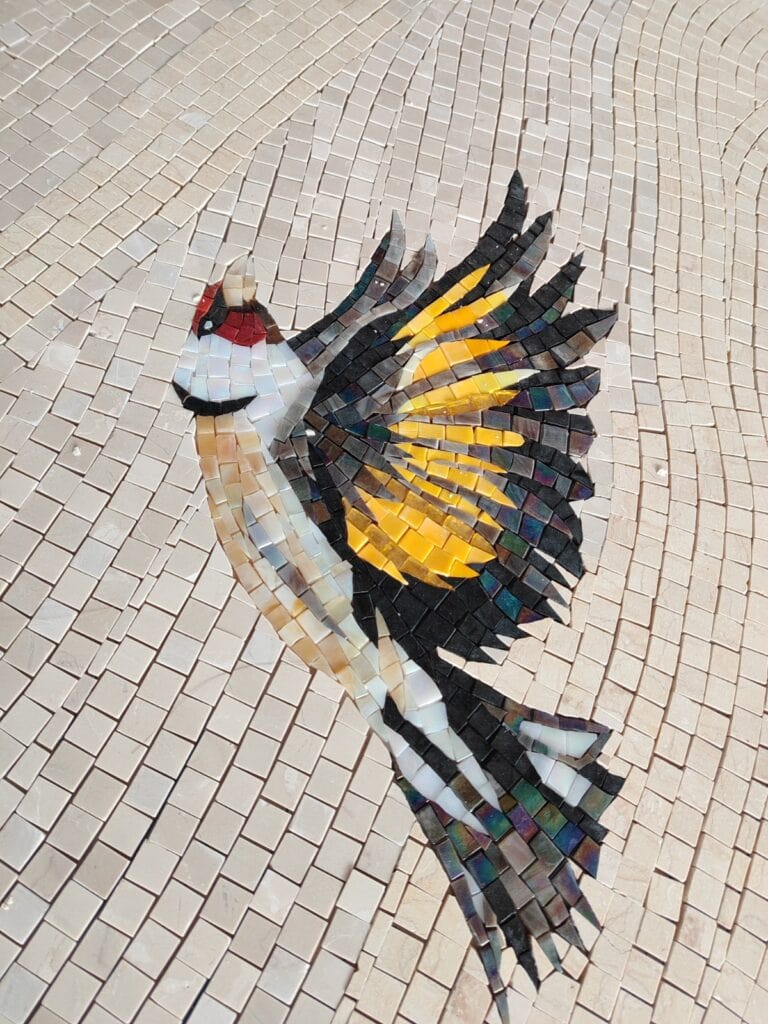
A custom-made bird mosaic pattern is any piece of art that represents birds through the use of colored pieces of stone, glass, or ceramics known as tesserae. The pieces are used to arrange details such as the curved beak, feathers, or spread-out wings of the bird by arranging them based on their colors, shape, and direction. Designs may include one hummingbird, two cranes, or a peacock displaying its feathers.
A bird mosaic art could be very simple or elaborate. It could include a design where there is an outlined silhouette of the bird with a plain background, or one where there are branches and flowers arranged. There are numerous examples of bird mosaic designs in ancient Roman mosaics. The motifs are even used in today’s modern mosaic art designs for both contemporary and luxury spaces.
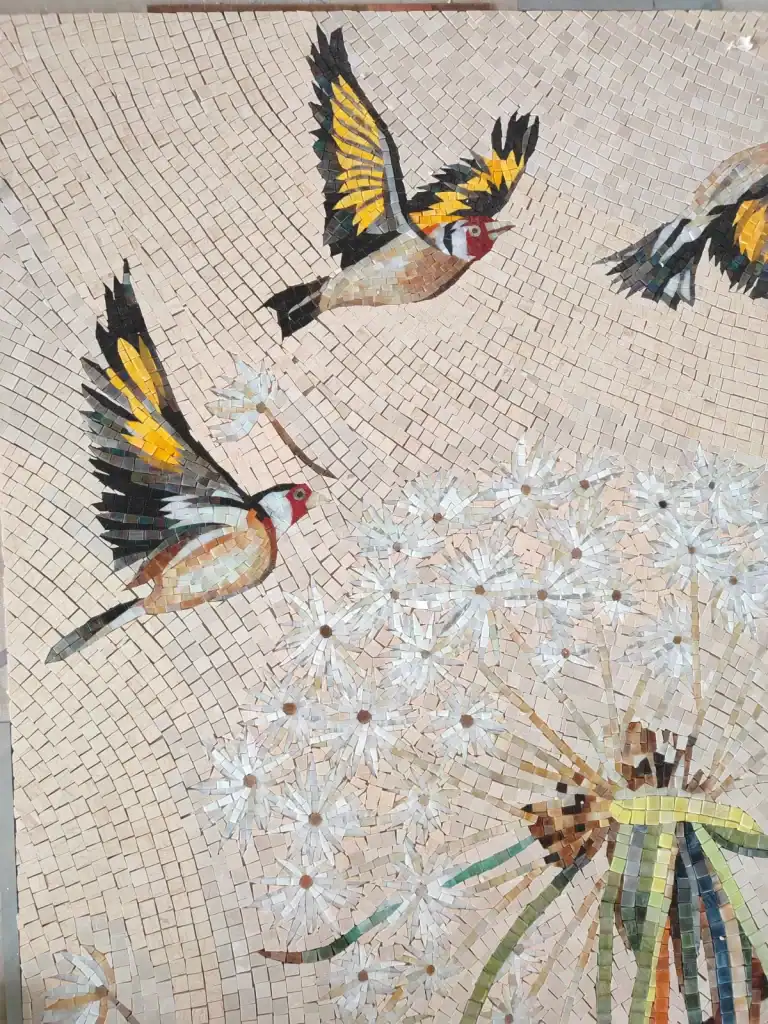
Roman Bird Mosaics on Ancient Floors
Roman mosaic floors usually included birds within the geometric frame. Some examples of the image panels, or emblemata, can be seen in the National Archaeological Museum of Naples. For detailed work, mosaicists used opus vermiculatum: a winding line of small tiles depicted wings and beaks.
The same concept we have used to make custom bird mosaic floors too. The frame surrounds the image when you step into the room, while small tiles show the feathered pattern up close. If your room has more entrances, you may use some motifs from ancient Roman mosaics such as two birds or a circular frame.
The Doves of Pliny From Hadrian’s Villa
The mosaic known as the Doves of Pliny or the Mosaic of the Doves was found at Hadrian’s villa in Tivoli in 1737. The mosaic is 33 x 39 inches. According to the Capitoline Museums, the panel was originally made according to a second-century BCE design by Sosos. In his book “Natural History,” Pliny talks about a dove in Sosos’s design which “casts the shadow of its head on the water.”
All four birds share one vessel, but the dove bending to drink gives the scene its focal point. It is an effective concept for designing a wall or floor panel. Have all the birds focus on one object and use the best tiles for the action of interaction with the object.
Bird Mosaics at Pompeii
The House of the Mosaic Doves is named after the doves that can be seen on a panel next to the basin. Nowadays, the panel is kept at the National Archaeological Museum of Naples’ mosaic collection that features mosaics from Pompeii and Campania from the second century BCE to the first century CE.
The House of the Wild Boar I presents another option. The ducks can be found in this mosaic along with lotus flowers and stems. These Pompeii mosaics provide two design options for a contemporary artwork. Place birds around the basin and make a compact center piece, or use repeated plants to connect birds.
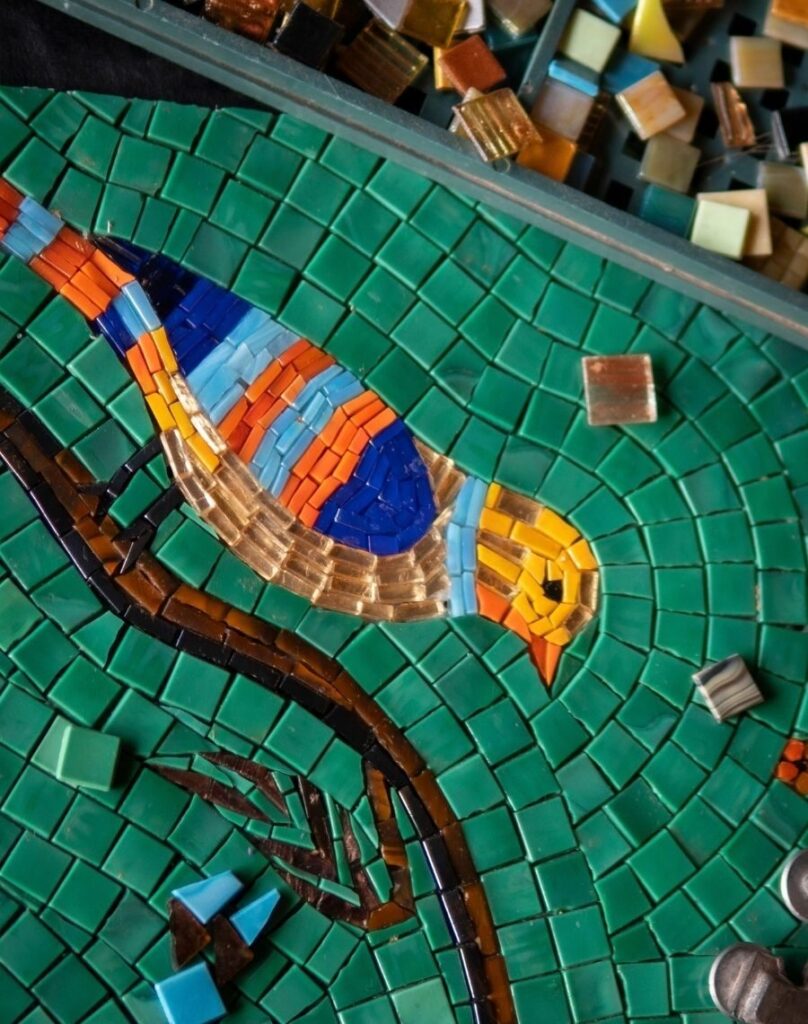
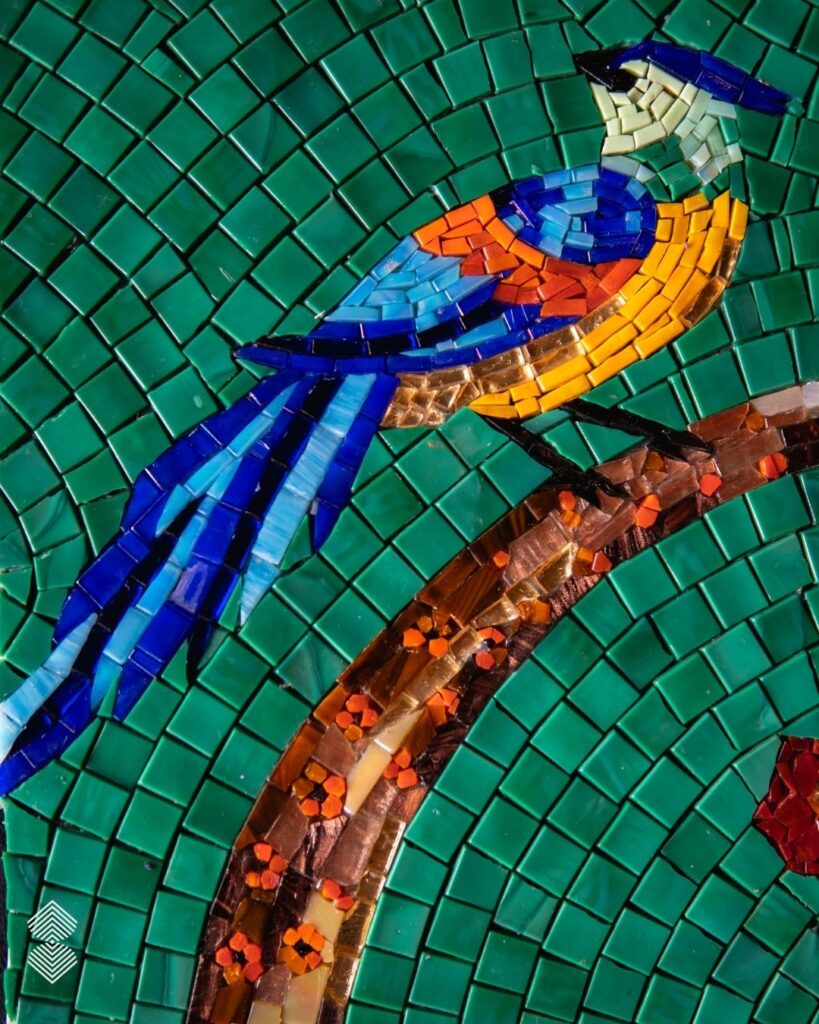
Byzantine Dove and Peacock Mosaics
Early Christian mosaics in Ravenna illustrate the application of bird patterns at a height. The Mausoleum of Galla Placidia and the Basilica of San Vitale are two structures included in the UNESCO site of Early Christian Monuments of Ravenna.
This particular placement creates different visual conditions for each Byzantine mosaic and early Christian composition. Being positioned high on the wall, the silhouette has to stand out from below. Contrast plays an important role here. A distinct outline, a definite separation between forms, and a solid background may help a bird mosaic art to be seen better than its detailed feathering.
The Doves of the Mausoleum of Galla Placidia
On the Galla Placidia mosaics, there are pairs of white doves sitting in front of bowls of water placed below the windows on both the eastern and western walls of the main tower. One bird drinks from the bowl while the other is looking somewhere else. The pale colors contrast sharply with dark blue. According to the mosaic heritage site in Ravenna, the doves in the funerary context represent the Christian souls finding solace in life-giving water.
This example echoes the old drinking doves’ theme. The context creates an entirely different meaning that one attaches to it. It can be used in a customized arched alcove. In this case, the pale bird is decorated with bright pieces near the head or upper wing to create an excellent contrast with the darker glass or stone.
Peacocks in Early Christian Mosaics
Peacocks are featured with many other birds and animals on the basilica of San Vitale mosaics. Some have spread out their tails among the garlands in the apse area. The tourist office of Ravenna associates the birds with the themes of resurrection and eternal life in Christian art. The repeated eyespots ensure a clear outline and rhythm of the birds.
The peacock mosaic art gives one an option to decide where to place the element. The fully opened fan can be placed on the large wall filled with curvy lines. The folded tail can be placed in a narrow niche, directing the viewer’s attention downwards. One should first decide on contrasting the bird and wall colors.
What Birds Mean in Mosaic Art: Doves, Peacocks and Cranes
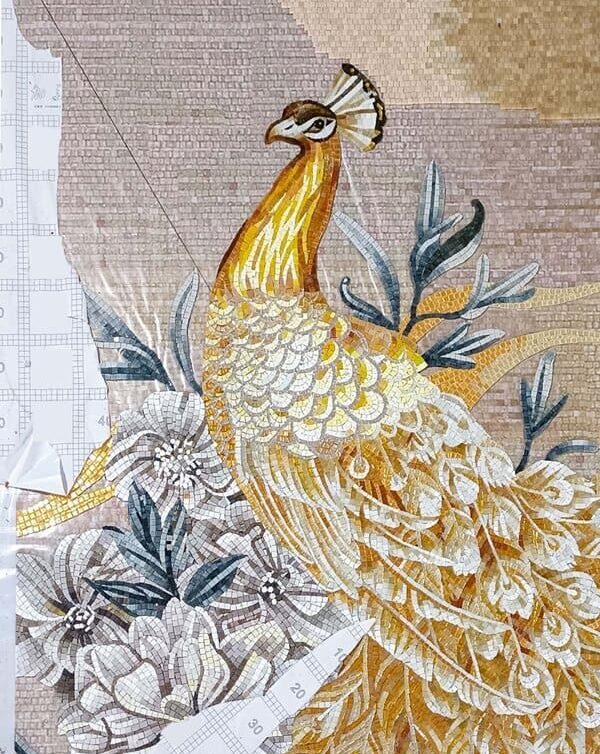
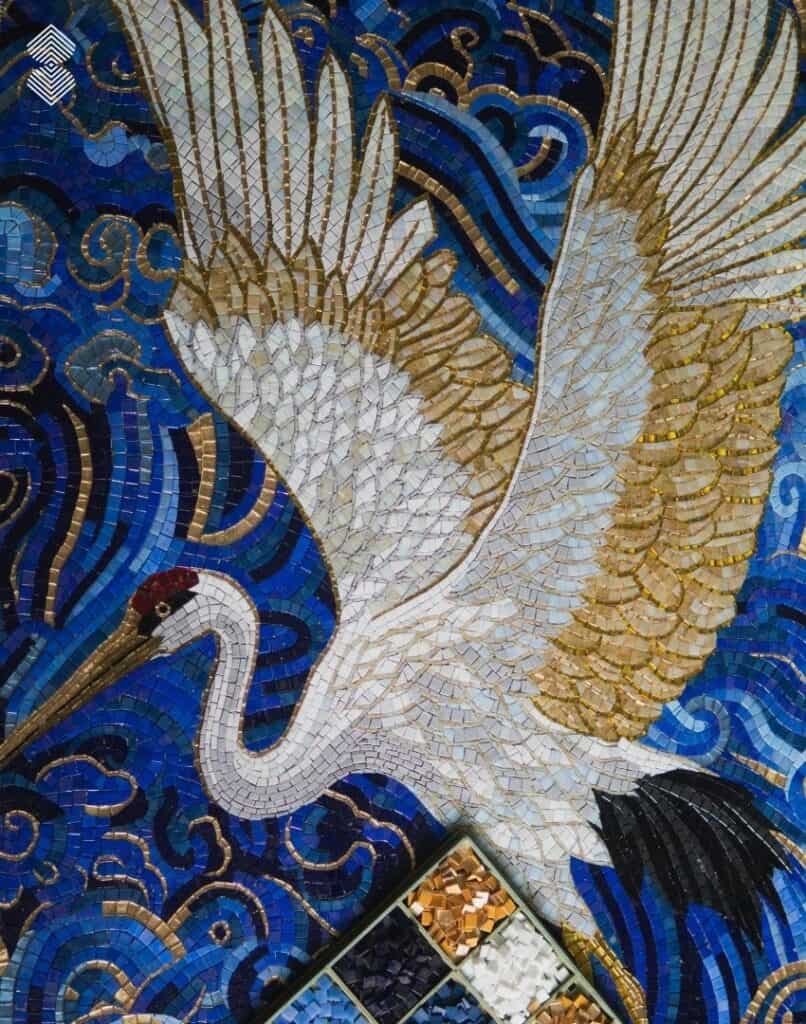
The significance of bird mosaic art is dependent on the tradition in which it is set within a particular environment. For example, the presence of a dove next to a basin would imply that it is part of a domestic image of the drinking bird. On the other hand, the same positioning of the bird would have a spiritual interpretation in the context of a Christian mausoleum.
| Bird | Meaning in a documented tradition | Design idea for a modern mosaic |
| Dove | In the Galla Placidia setting, drinking doves can represent Christian souls drawing comfort from the water. | Give a pair of birds a shared branch or basin. The poses can differ while the composition stays balanced. |
| Peacock | In early Christian examples at Ravenna, peacocks can refer to resurrection and eternal life. | Use the tail as the main pattern. Repeat a few blues, greens, or golds to carry the eye through the feathers. |
| Crane | In Japanese art, cranes are associated with happiness and longevity. | Leave open space around the neck and wings. Give reeds, or lotus stems a quieter role so the pose reads first. |
In bird mosaic art, the bird you choose can help tell a story. Family memories, favorite landscapes, or the birds you see outside your window can all inspire the design. You might choose a crane for its association with longevity or place two birds in different poses along a low wall to give the scene movement.
Bird Mosaic Floors vs Bird Mosaic Walls
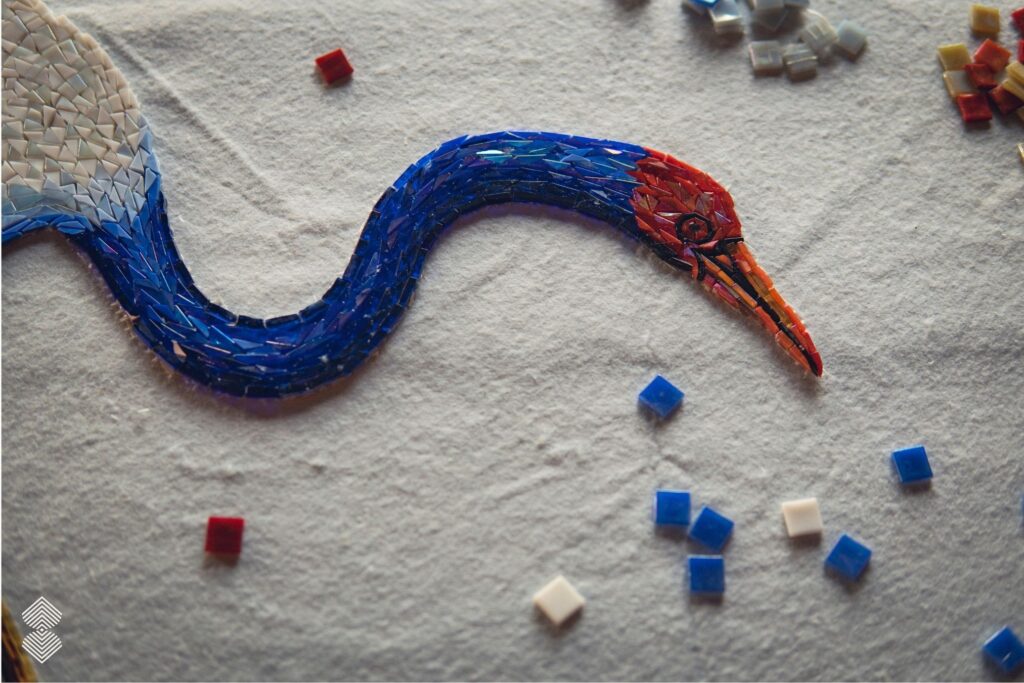
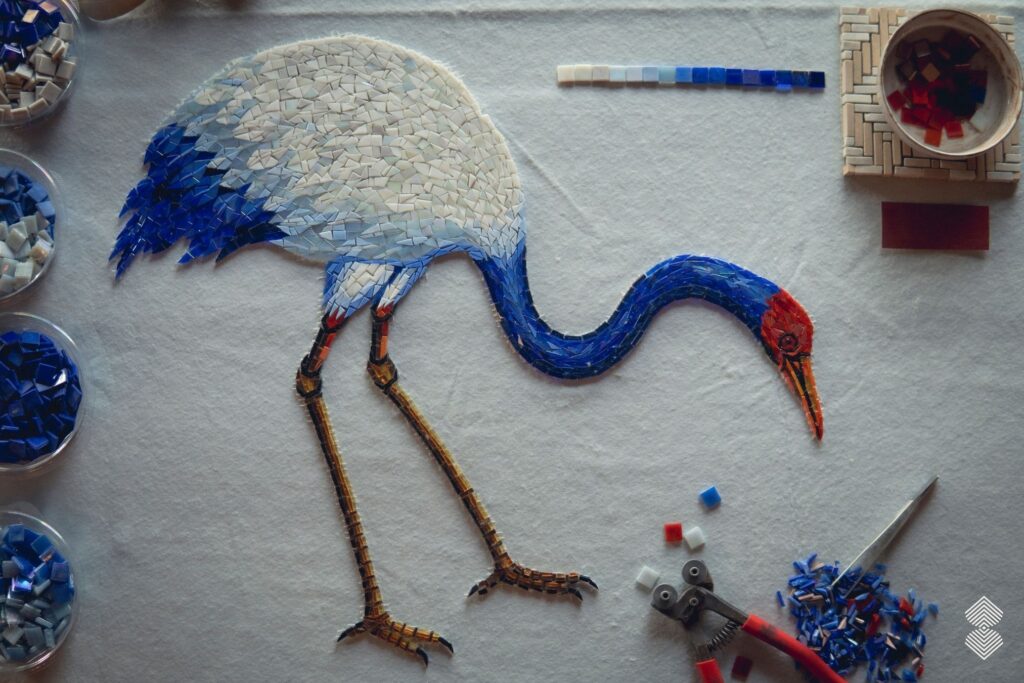
The floor offers a space that allows one to move around an image, while a wall provides one with a predictable point of view. This will influence the position of the bird, its markings, and the background.
| Design decision | Bird mosaic floor | Bird mosaic wall |
| Main viewing angle | Check the image from the room’s entrances and the usual walking route. | Check it from the doorway and the spot where people will pause or sit. |
| Composition | A centered scene, symmetrical pair, or medallion can organize an open area. | A tall niche can suit a long-necked bird. A wide wall can give a flock room to spread. |
| Detail | Use a confident outline and put fine markings where the panel stays visible. | Place the eye, feathers, or other details near the height viewers will see them best. |
| Finishes and placement | Check suitability for traffic and the intended floor conditions. Mark furniture and rugs on the plan. | Study reflections and plan around mirrors, switches, shelves, and other wall fittings. |
Or else, you can upload a photo of your room to the MEC AI Studio to get a sense of what the bird mosaic art will look like installed on your wall or floor.
Marble Bird Mosaic Wall Art Today
Variations in the stone itself determine the design of marble mosaics for our artists. Two blocks of cream-colored marble can vary from each other in veins or base colors. They can be divided into groups depending on the color in order to balance the wing or provide contrast to a light bird on its background. The same bird can look delicate in gray and cream or more contrasting in black and white. Glass can be added to emphasize feathers or waves in the water. In a marble mosaic tile, such details are made through variations in the color of stone.
Roman-Style Marble Bird Mosaic Panels
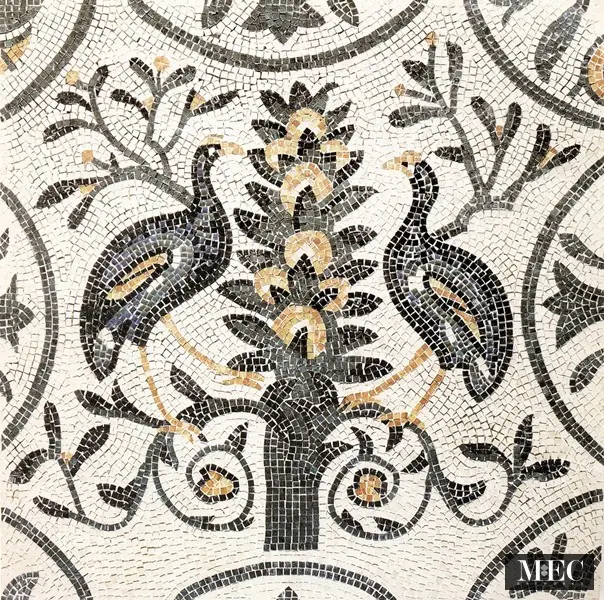
In our Polli Sultani Roman marble bird mosaic, there are two stylized birds positioned symmetrically on either side of a plant with foliage. There are round designs and a geometric pattern used to frame the scene in accordance with the composition of Roman floor mosaics. The birds are in dark shades set against the white background of the pale marble. Up close, the small pieces used for the birds’ bodies and the branches of the plants provide a hint of shading. The beige and yellow shades make for accent colors for the black, white, and gray mosaic.
There is enough flexibility in the floor design to transform it into a wall design without changing the symmetry, which makes it unique. It will be possible to use a wider or narrower border in accordance with the size of the niche where the mosaic will be installed.
Marble and Glass Crane Mosaics
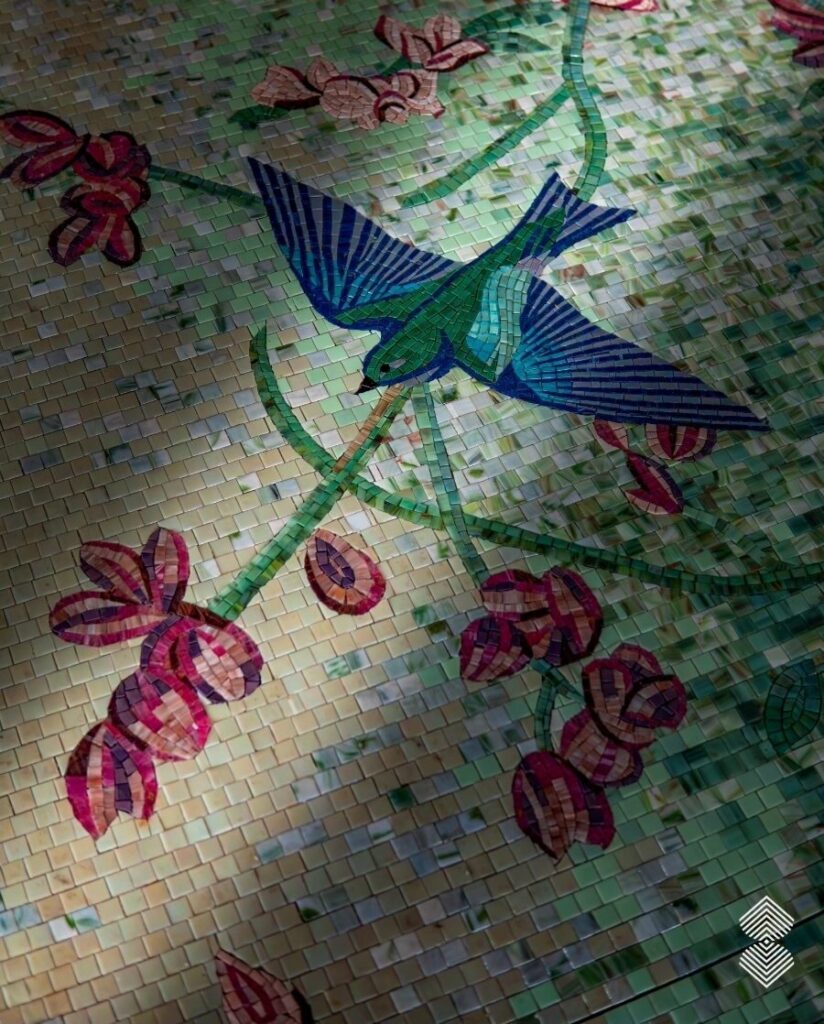
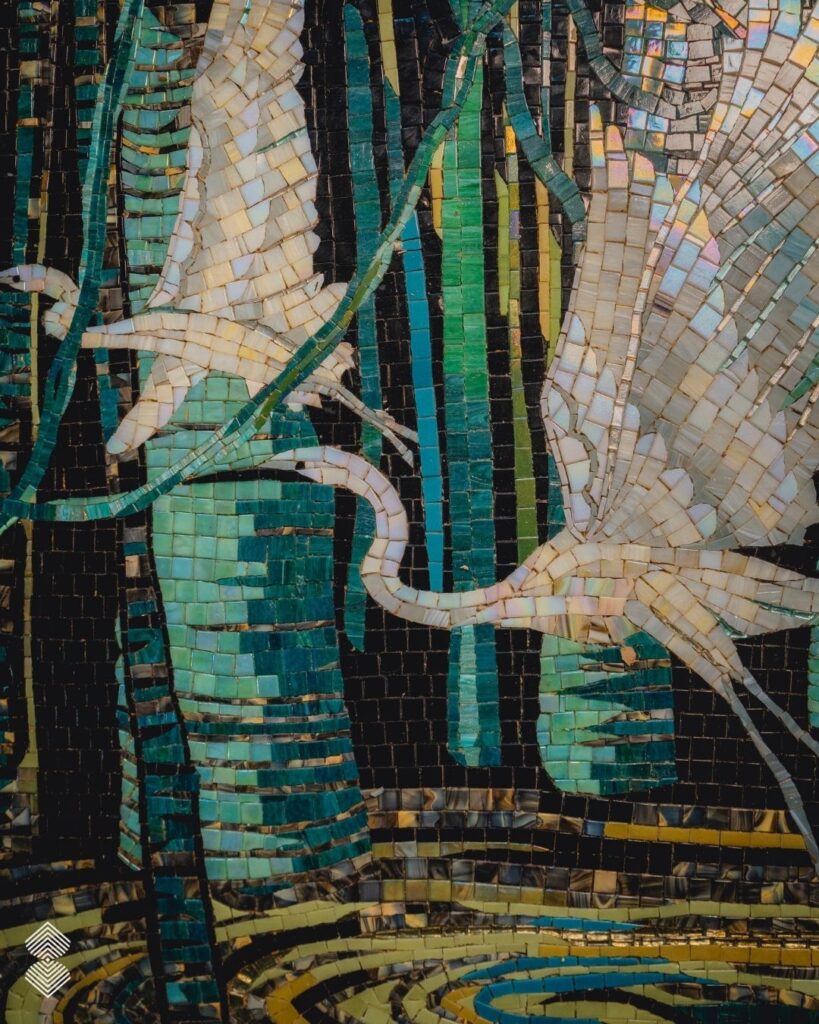
A crane has an extended neck and delicate legs that require attention to be placed properly. It would be better to place such shapes on a quiet background to allow a light-colored body to become visible. A couple of dark tiles on the tips of the wings will create a certain outline of the pose. Branches and stems of lotuses should also go in this way without neglecting the free space near the neck.
Our design combines two light-colored birds and some light pink and green elements of lotuses. In case of creating an individual marble and glass mosaic with cranes, marble should cover their bodies and glass should decorate the water or the edges of the wings. If the bird mosaic art is to be put into an alcove, it would be good to adjust the cranes’ poses and move lotus stems.
Coastal Bird Mosaic Walls in Marble and Glass
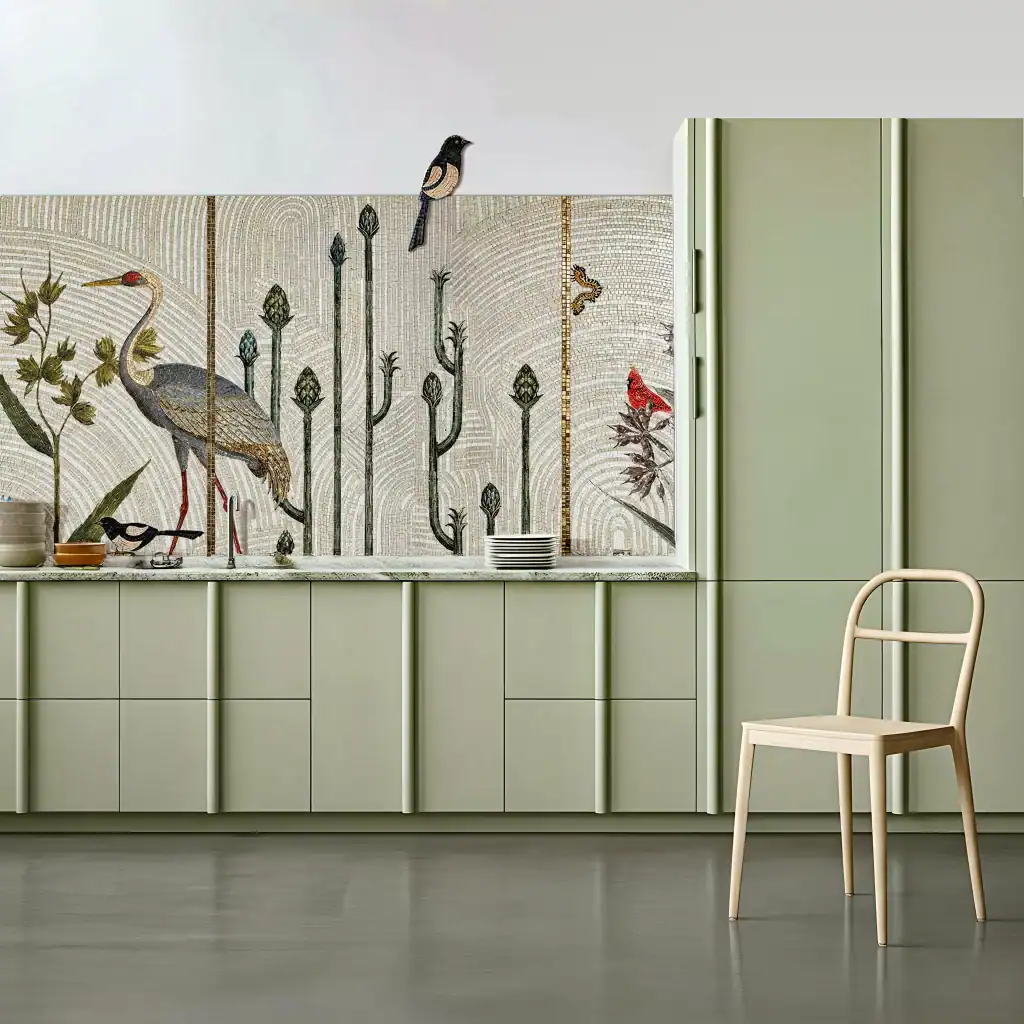
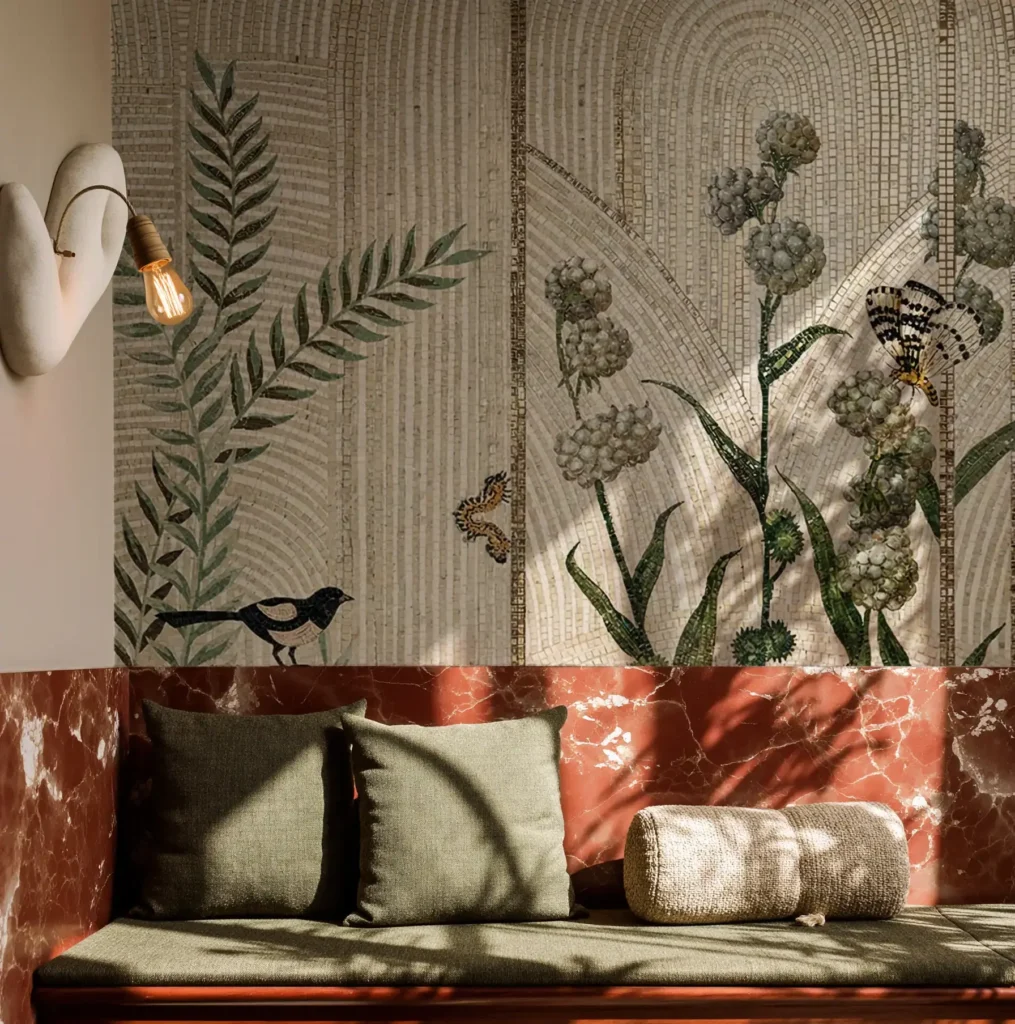
A seagull can show you more about the coast than a whole wall filled with all kinds of boats, shells, and waves. Allow enough room for the bird to move freely in the composition. Leave the reeds low while keeping the sky empty. This will create some balance and allow you to have a distinct line to follow up.
We offer hand-cut glass coastal seagull mosaics that involve flying birds along with some reeds, sun, and sky elements. Our design can be modified to fit the new dimensions or color palette of the wall. In the case of stone and glass mosaic, we can incorporate pale marble in the areas of the shore and sky, along with some glass for catching the reflection of the water.
Glass or Marble for a Bird Mosaic Wall?
Pick the right mosaic material based on how you wish to design your room. Below is a chart comparing the differences between glass and marble for any bird mosaic art project.
| What matters | Marble and Stone | Glass Mosaic Tiles |
| Color | Review several pieces to see the range within the stone. | Compare solid, translucent, and reflective options for the colors in your room. |
| Light | Veining can give a quiet area detail. A polished finish can bring out more reflection. | Check highlights under daylight and the fixtures you’ll use at night. |
| Pattern | Stone variation can support soft feather shading or a clear geometric frame. | Distinct colors can help define markings, eyespots, flowers, or water. |
| Care | Review cleaning guidance for the stone, particularly near splashes and acidic foods. | Confirm cleaning instructions and check suitability for the specific location and assembly. |
Where to Put a Bird Mosaic Wall at Home
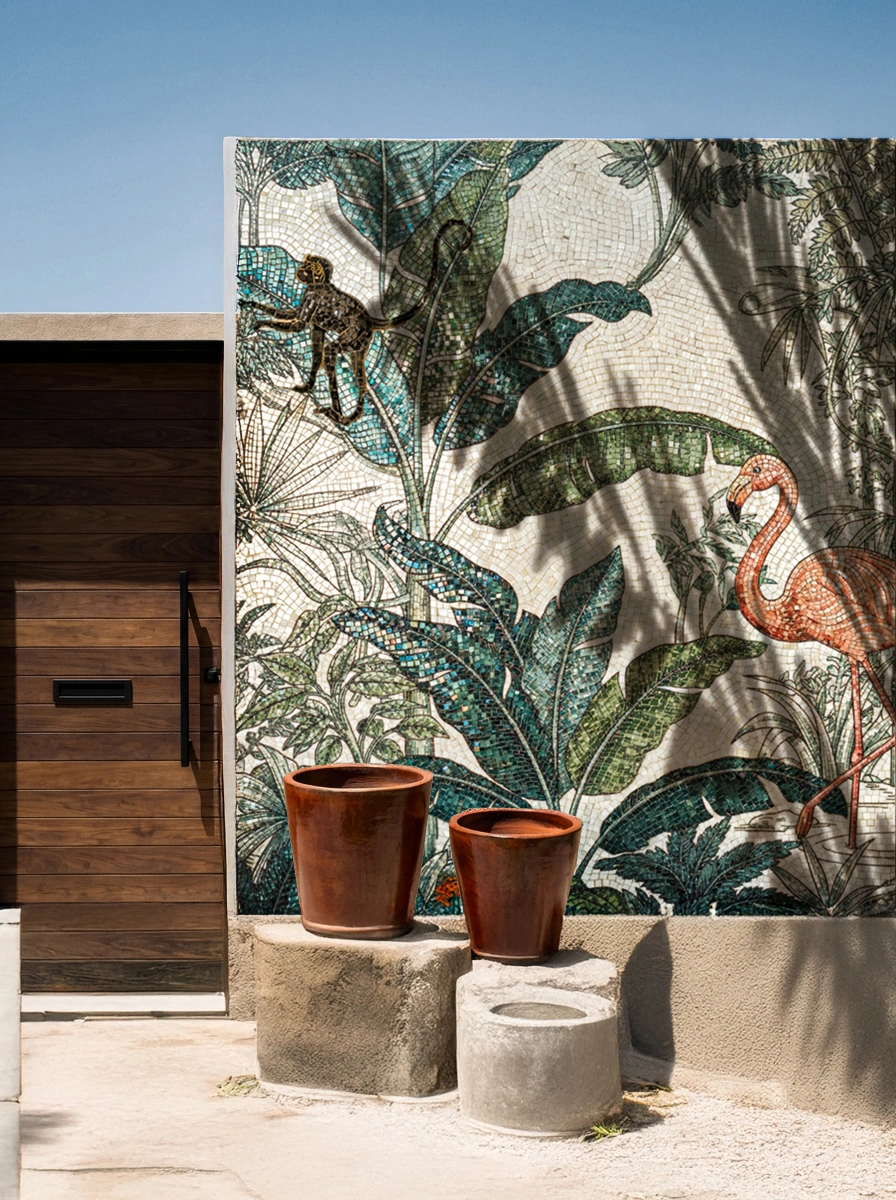
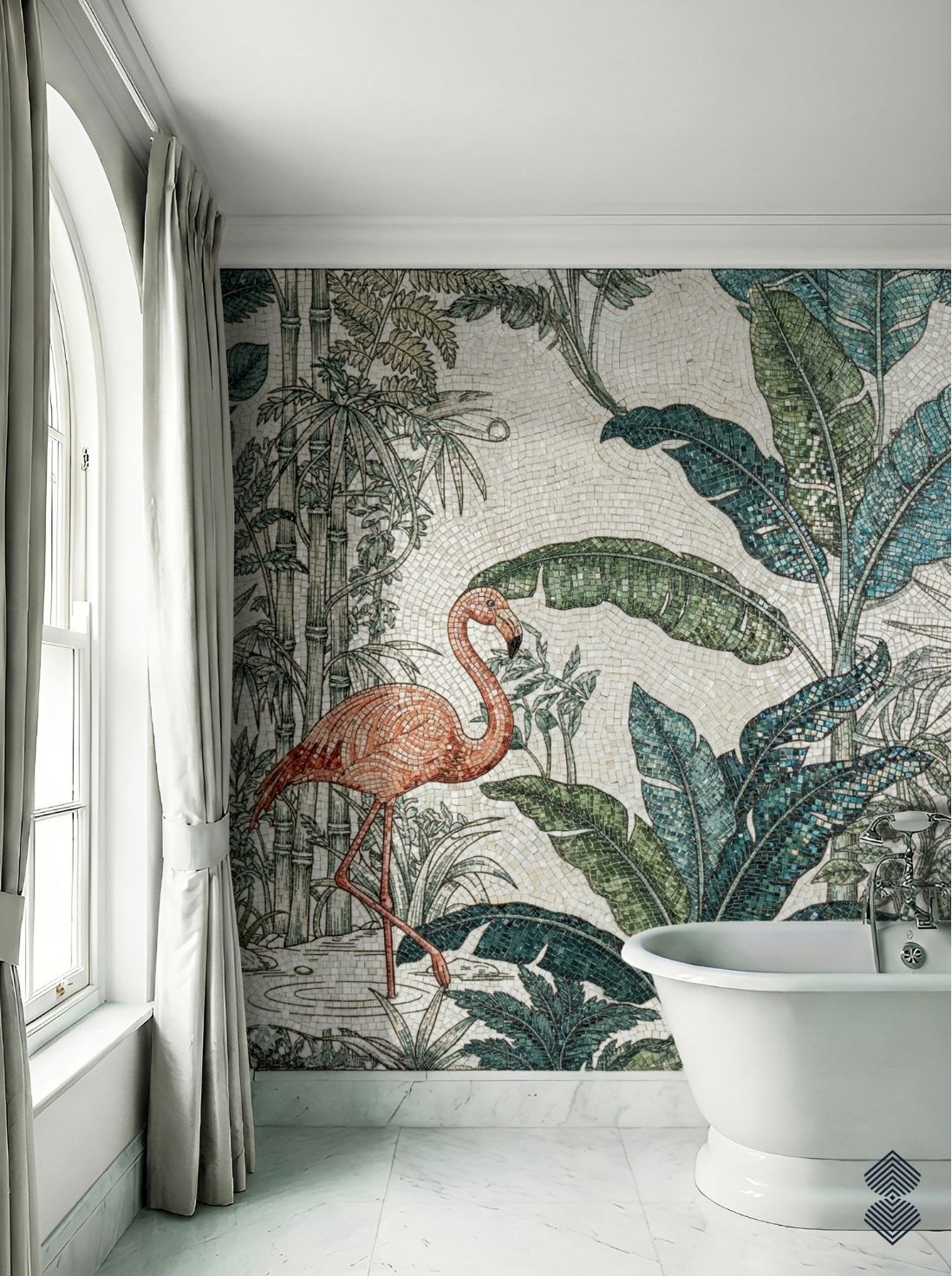
Our mosaic bird wall niche art can be customized to match your interior design ideas and available space. You can select a specific species of bird, a certain color scheme, or an image that we have used previously as your idea for the mosaic wall niche art.
- Entryway: We can place the bird’s head and wings above the console so that the important details of the image are visible when entering the house.
- Bathroom Wall: We can create a crane or heron mosaic following the contours of the bathtub alcove and designing the image around mirrors and other fixtures.
- Kitchen Backsplash: We can make the branch with birds’ nests on it long enough to cover the whole backsplash or a separate bird below the range hood that leaves key details untouched by electrical sockets.
- Living or dining room: We can make the birds large enough to see from a distance and create the background in accordance with your furniture and other interior design ideas.
For a peacock mosaic wall niche, we can make the tail image correspond to the dimensions of the alcove and position feather details around shelving and other lighting fixtures.
Commission Custom Bird Mosaic Art
Your personal bird mosaic art may be made from an existing photograph of your favorite bird, your sketch, or one of our samples. Let us know what elements you would like to highlight, including the shape of the tail, coloration around the eyes, etc. Please provide us with your wall measurements, color preferences, and a photograph of the interior so that we can make allowances for any curvatures, shelving, and other objects on the walls.
Final Thought
A mosaic bird artwork will add color, texture, and movement to any place. One bird is sufficient to bring life to a small niche, while a flock in motion gives a full wall the necessary perspective. In our company, we have the ability to tailor the mosaic bird design to your preference in terms of birds, colors, material, and placement.
FAQs
What is the oldest bird mosaic?
An early example that is definitely cataloged safely would be the Parrot Mosaic of Pergamon, dated between the early and mid-2nd century BCE. The older dove motif by Sosos also dates back to the 2nd century BCE. See the Pergamon parrot in the Staatliche Museen zu Berlin collection.
What does a peacock symbolize in mosaic art?
As for the early Christian mosaics like those of Ravenna, the peacock is an emblem of resurrection and immortality. When creating your own composition, it can be chosen for the beauty of its feathers. In a wide wall, the whole tail makes a good repetition. In a narrow niche, only the tail can suit. See Ravenna’s peacock examples.
Why are doves common in ancient mosaics?
The dove was suitable for all kinds of pictures in bird mosaic art. Several birds can be around the drinking receptacle and yet retain their different positions. It can be found in domestic scenes like Pompeii as well as in a Christian funerary context in Galla Placidia. In the mausoleum, the doves and water have a symbolic significance because of the setting.
Can a bird mosaic be made in marble?
Yes. Marble can be used for fine lines as well as strong outlines. Choose marble tones in such a way that the breast, wings, and background remain separate. Small stones can outline eyes and beaks. Large stones can provide a more subtle texture to the background area. Glass pieces can make a colorful highlight near the eye or feather outline.
Can I commission a bird mosaic from a photo of my own garden birds?
Certainly. Please send us your clearest image and let us know which marks you would like to keep. Getting a second angle may assist us in seeing the contour of the crest or other marks on the wing. We can modify the posture for the wall, add the branches or background, and use an image of the room to determine the right size.