

Hand-Cut Roman Mosaic Technique: Why Old-World Craftsmanship Still Wins
What the Hand-Cut Roman Mosaic Technique Actually Is
The hand-cut Roman mosaic technique builds an image or pattern from individual tesserae. Traditionally made from marble, natural stone, terracotta, and glass, each piece contributes to the shape, color, shading, and movement of the artwork.
The Roman technique depends on more than hand cutting. The size, shape, spacing, and direction of each tessera help create curves, figures, borders, and detailed scenes. Modern tools may have changed the fabrication process, but the principle of carefully placing individual pieces by hand remains the same.

Opus Tessellatum and Opus Vermiculatum: Two Roman Mosaic Techniques
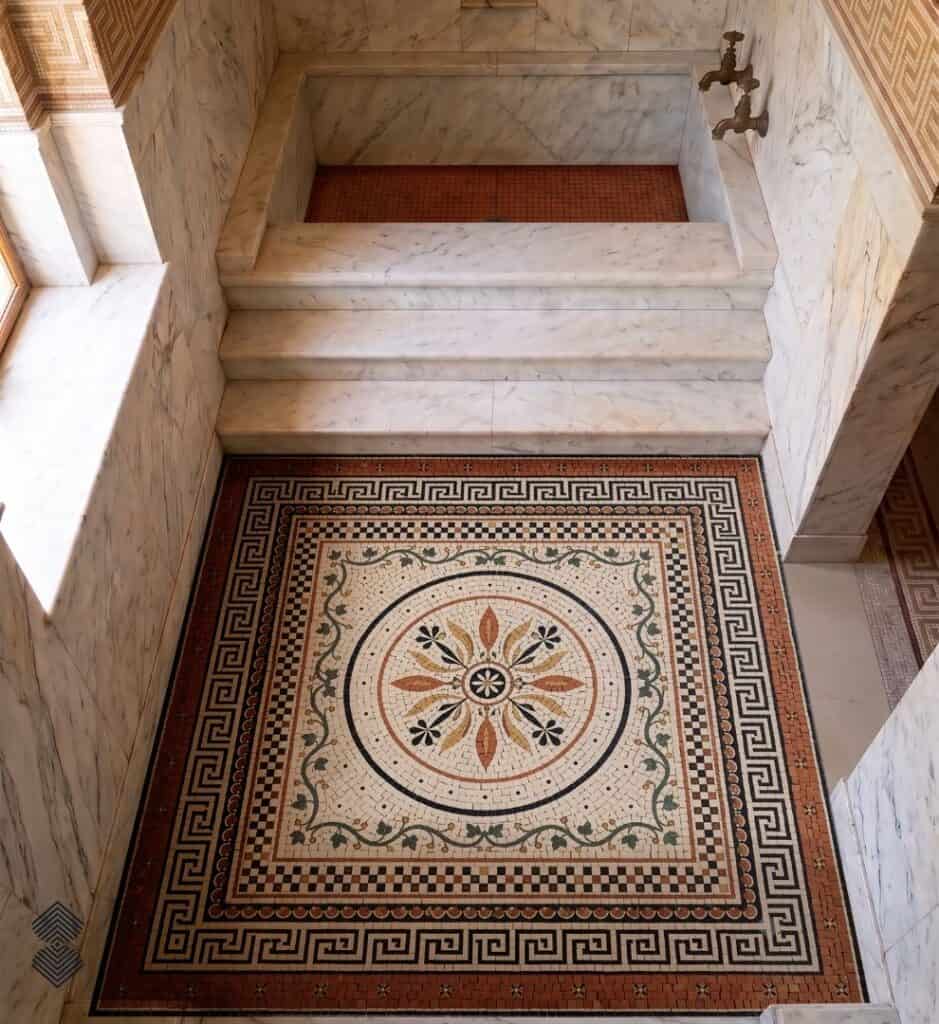
Opus tessellatum uses regular tesserae to create larger patterns, figures, and borders, as seen in the Eubea Bruno Roman Mosaic Floor. Opus vermiculatum uses much smaller tesserae, sometimes 4 mm or less, to achieve finer curves, shading, and detail. These Roman techniques still influence modern mosaic making, with larger pieces creating structure and smaller tesserae adding precision to detailed areas.
How Andamento Gives a Hand-Cut Roman Mosaic Its Movement
In traditional Roman mosaics, tesserae often follow the curves and contours of figures, leaves, animals, and other forms rather than sitting in rigid rows. This directional flow is known as andamento, and it helps control movement and artistic details within the artwork. Andamento technique can be used to:
- Follow the contours of figures and objects
- Define curves, outlines, and fine details
- Separate one form from another
- Create natural visual movement
The Roman Temple Scene Mosaic Mural shows how Roman-inspired composition and detailed tessera placement work together. At MEC Artworks, tessera size and direction are carefully considered when translating an approved design into a hand-cut mosaic.
How Artisans Cut and Set Tesserae the Roman Way
Cutting Marble and Stone Tesserae by Hand
Hand cutting allows our artisans to shape each tessera around the artwork rather than forcing every piece into a standard format.
- Follow curves and outlines
- Adjust tessera size for detail
- Work with natural marble veining
- Create precise borders and motifs
- Use smaller pieces for fine details
For example, in Gianna Roman Floor Mosaic Marble Floor, individual tesserae build a detailed Roman-inspired composition.
Setting Tesserae Tight for a Seamless Roman Finish
Careful spacing helps the mosaic design read as one continuous composition while maintaining the flow of the artwork.
- Maintain tight, controlled spacing
- Adjust pieces around curves
- Keep andamento flowing naturally
- Reduce inconsistent gaps
- Organize finished mosaics into labeled panels
This careful setting process helps the finished mosaic maintain its detail and visual continuity across the architectural surface.
Where the Roman Mosaic Technique Is Used Today
Roman mosaic techniques began centuries ago, but they are not limited to museums or archaeological sites. The same technique of hand-cut tesserae, controlled spacing, andamento, and material variation can be adapted to contemporary architecture. For instance:
- Entrance and statement floors
- Living rooms and formal interiors
- Feature walls and murals
- Swimming pools and water features
- Courtyards and outdoor spaces
- Borders, medallions, and mosaic rugs
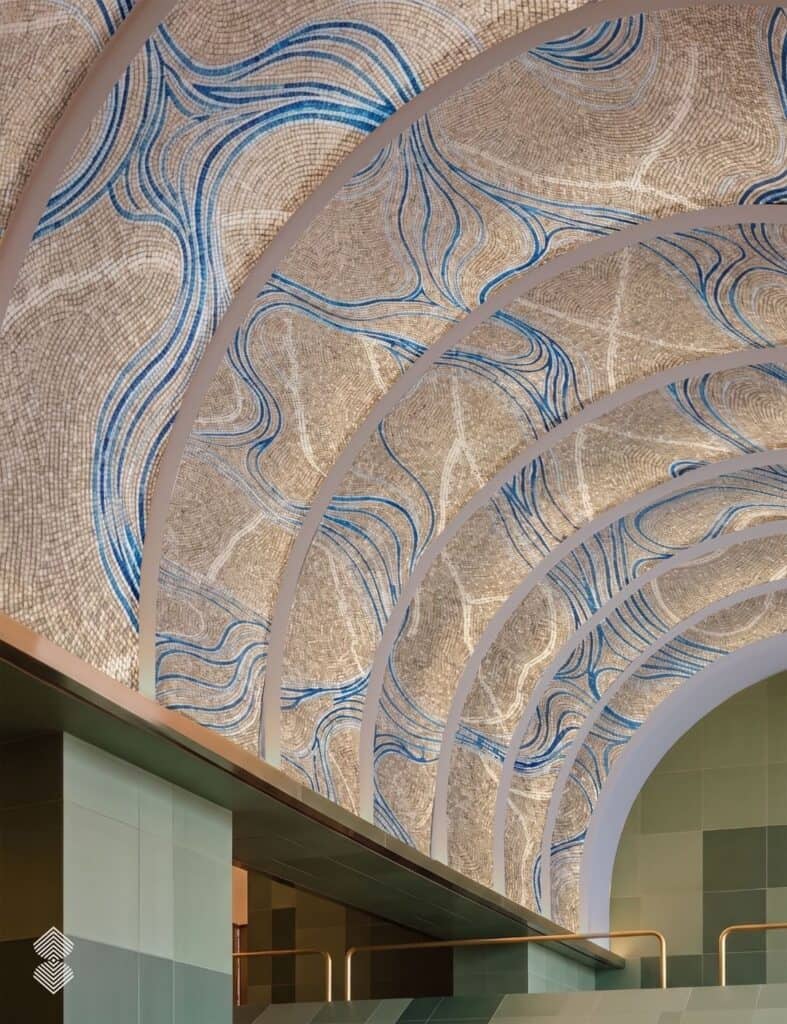
The application may change, but the craft remains centered on the individual tessera. For example, the Roman Flair Custom Mosaic for Pool by MEC Artworks takes a visual language associated with traditional Roman mosaic and extends it into a modern water application.

Roman Technique Mosaics in MEC Artworks Projects
Roman mosaic techniques are not limited to one type of surface or setting. At MEC Artworks, we can adapt hand-cut tesserae, andamento, materials, and detailing to almost any space, from floors and walls to pools, entrances, borders, and other architectural features. Like:
- Eubea Bruno Roman Mosaic Floor: Uses Roman-inspired composition across the floor so the mosaic becomes part of the architecture rather than a separate decorative feature.
- Gianna Roman Floor Mosaic Brings individual marble tesserae together through controlled spacing and detailed placement to create a rich floor composition.
- Silvio Roman Marble Rug Mosaic: Uses detailed borders and central ornament to recreate the visual effect of a decorative rug in marble mosaic.
- Perseo Roman Floor Mosaic: Demonstrates how Roman-inspired craftsmanship can be adapted into a bespoke composition developed around a specific space and design brief.
The Materials That Carry the Roman Technique Best
Marble and natural stone are especially useful in Roman-style mosaics because their natural tonal differences help our artisans build shadows, outlines, borders, and depth directly from the tesserae. Since each piece is hand-cut, its size and shape can be adjusted around faces, figures, curves, and detailed motifs rather than following a fixed tile grid.
Glass gives us another level of control, particularly when a Roman-inspired design needs brighter color, stronger contrast, or reflected light. We can use it for pools, water features, and murals, or combine glass with marble when a composition needs both the natural variation of stone and the richer color of glass.

40 Years of Applying an Ancient Technique to Modern Commissions
The craftsmanship involved in Roman mosaics is not simply picking a design that has been used historically. Rather, it is in how each tessera is cut and placed in order to achieve curves, outlines, shadows, and detail work. MEC Artworks has had a dedication to this level of craftsmanship for almost forty years in modern architectural applications.
This craftsmanship has also been showcased at events such as the Mosaic Artistry Exhibition at Dubai INDEX 2024. While modern tools have evolved, skilled hand placement remains at the heart of our Roman-inspired mosaics.
FAQs
What makes a mosaic "Roman technique" rather than just hand-cut?
A hand-cut mosaic simply means that individual pieces are shaped by hand. This is more advanced when you use a Roman design that considers the size of the tesserae, their closeness, the materials to be used, and the andamento. Other techniques like opus tessellatum and opus vermiculatum have some historical background on how tesserae of different sizes can be used. It is all about building your mosaic by moving and placing individual pieces of work.
Can the Roman technique be used on a swimming pool floor?
Yes. Mosaic has a history involving water architecture, whether it involves the old Roman baths, fountains, or pools. Currently, Roman-like designs could be used in designing a floor and other submerged surfaces such as walls and steps in a swimming pool. Yet, apart from the artwork, it would still require the right choice of materials that can withstand the water conditions as well as the proper installation process.
Does a hand-cut Roman mosaic cost more than machine-cut tile?
It can. A bespoke hand-cut mosaic requires design development, material selection, individual cutting, detailed tessera placement, fabrication, and preparation for installation. Cost also changes according to size, material, tessera scale, level of detail, pattern complexity, and application. A simple geometric Roman border, for example, will have different production requirements from a highly detailed figurative scene.
What materials work best for an authentic Roman mosaic finish?
Marble and natural stone are ideal for designs that seek to recreate the traditional look of Roman style. The varied texture of the natural stone suits well for floor, border, medallion, geometric field, and figural art. Glass can also be added to create brighter colors and reflection effects if required. MEC Artworks creates mostly using marble and glass, choosing the material depending on the design.
Can a Roman mosaic pattern be adapted to a modern floor plan?
Yes, a mosaic inspired by the Roman style does not necessarily have to replicate the same dimensions as the original. The border, medallion, geometric field, figural art, and other aspects can be created depending on the dimensions and proportions of the present-day room. The design may start either from an existing piece of work or from an entirely new brief. Drawings, dimensions, architectural plan, images for reference, and materials palette will then follow.