
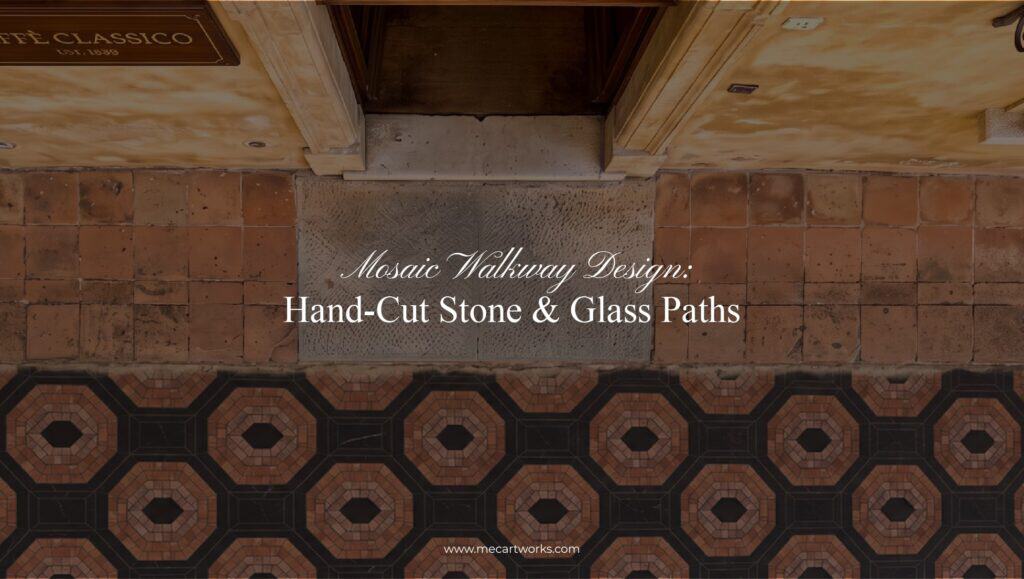
Most outdoor paths rely on concrete, brick, stone slabs, or manufactured pavers. These materials work well, but they usually start with a fixed product size and a repeated laying pattern. But here we are going to see how mosaic walkway design takes a more custom approach by creating the artwork around the path itself.
Instead of forcing a predetermined pattern to fit in the allotted space, the mosaic can conform to the curves, architecture, garden, pool, or entry itself. Whether made of marble, stone, or glass, tesserae can create a border, geometrical patterns, botanicals, and medallions.
An outdoor path can be kept low-key with a marble border, while an entry to a villa may demand more attention with a special focal point. By selecting the correct material, texture, drainage, and planning, the mosaic walkway design will serve both as art and a functional surface.
Table of Contents
What Is a Mosaic Walkway Design, and How Is It Different from a Paver Path?
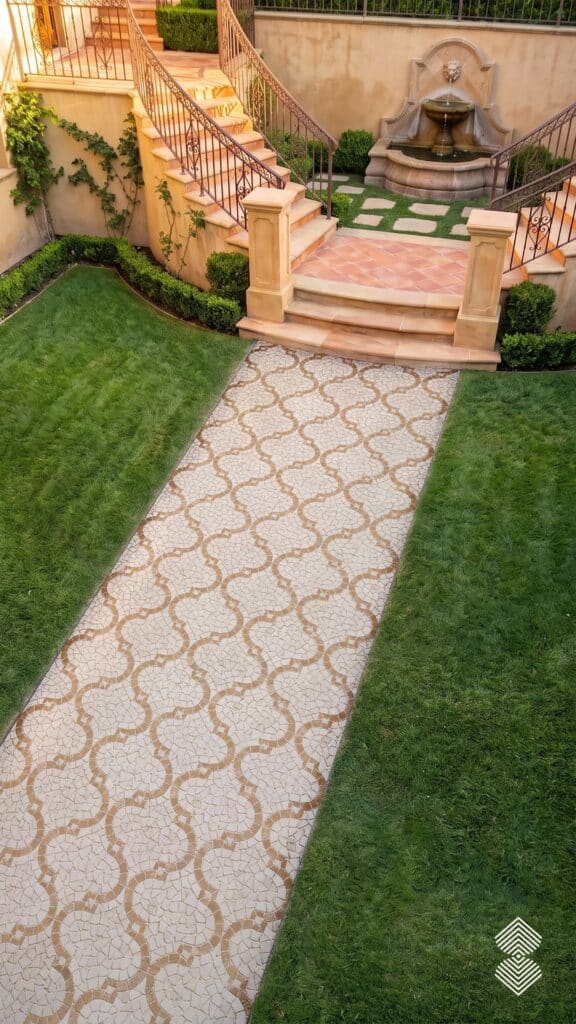
In laying a path with tiles, one would use a typical paver with a set size and design. With a custom mosaic walkway design, on the other hand, one would first consider the space. One would analyze the layout of the pathway, its contours, surrounding architecture and materials, and even the direction in which the eye is supposed to flow.
From then on, marble, stone, or glass tesserae can be laid according to the architecture. Mosaic tiling can be curved according to the space, a pattern can grow wider as one reaches the entrance to a home, or a medallion can highlight the juncture between the pathway and the entry point. That is how mosaic transcends the concept of paving material. It allows the user to use the pathway as part of the whole design scheme, just like Romans and Greeks did with mosaic flooring.
Where a Mosaic Walkway Works: Entrances, Gardens, Courtyards, and Pool Decks
A mosaic walkway design doesn’t need to cover every outdoor surface. In many projects, it works best in areas where people naturally arrive, pause, turn, or transition between spaces. These are some of the areas where our clients most often ask us to design custom mosaics for their outdoor spaces.
Entrance Walkway Mosaic
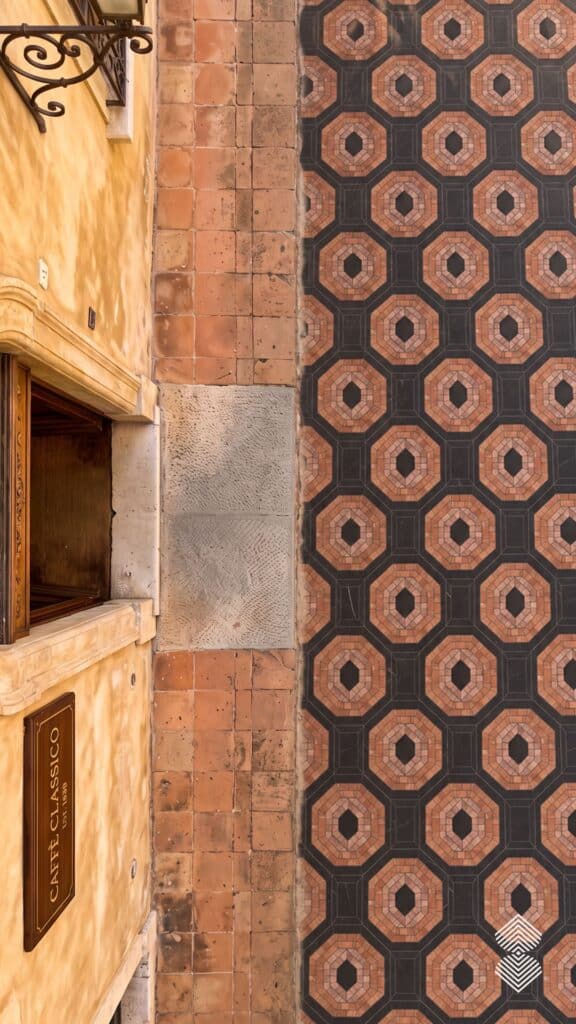
An entrance walkway mosaic can set the character of a property before you reach the front door. We usually look at the entrance alignment, facade materials, columns, steps, and landscape before developing the pattern. For a custom mosaic walkway for a luxury home entrance, the design might use borders to guide the eye or a medallion as a focal point. Even details such as an arch, metal finish, or doorway geometry can inspire the artwork.
Garden Walkway Mosaic
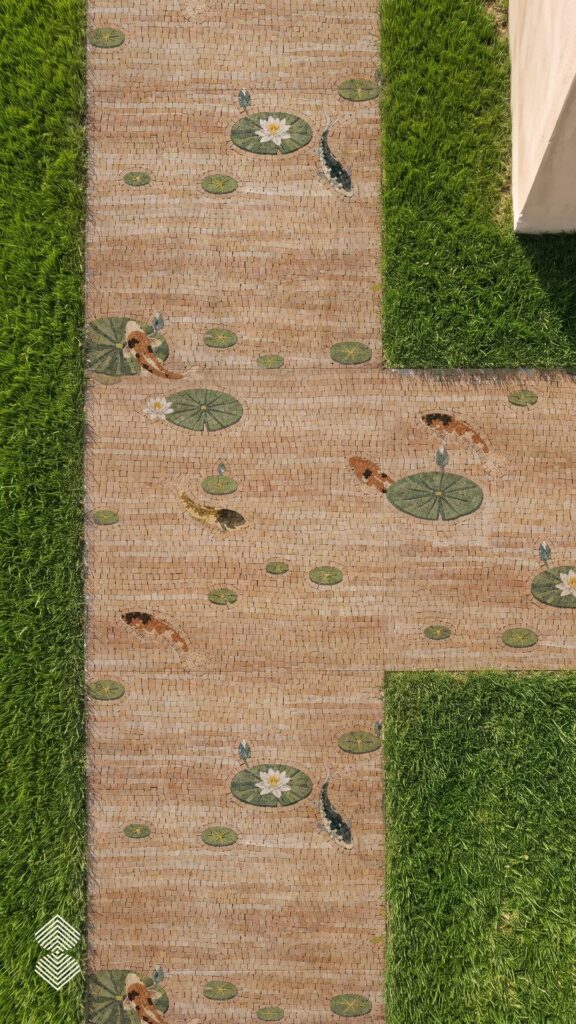
The garden path will most probably need to be fluid in nature and should respond to its surroundings. Curved botanical designs, organic shapes, and hand-cut stones could easily flow in curved lines without being too inflexible. The use of a plain stone field along with a colored edge can create an easy mosaic walkway design, while elaborate leaves or flowers could emphasize some key areas.
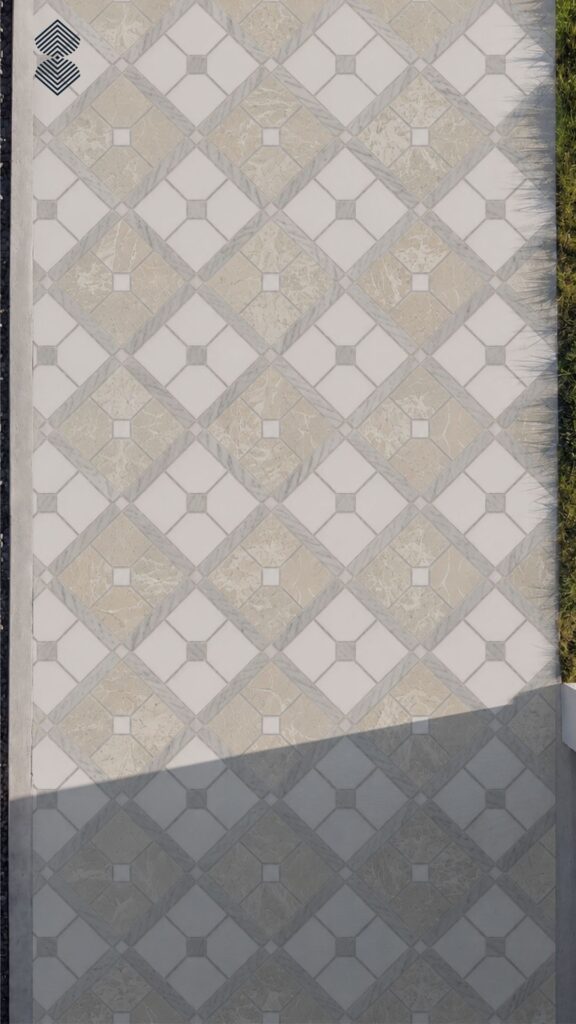
Courtyard Walkways
Courtyards give you more freedom to connect mosaic with architecture, planting, fountains, and seating areas. We might keep the main walkway simple and introduce stronger artwork where different paths meet. For example, four bordered paths could lead toward a detailed central medallion around a fountain. This creates a clear focal point while keeping the overall courtyard balanced.
Hospitality and Resort Walkways
Hotels, resorts, spas, and restaurants can use mosaic walkways to connect different guest areas. A pattern might move from a terrace toward a pool, garden, lounge, or spa while maintaining the same design language. Borders and directional patterns can also help define routes and transitions. This allows the mosaic walkway design to work as both an architectural feature and part of the guest experience.
Choosing Materials and Fabrication for an Outdoor Mosaic Walkway
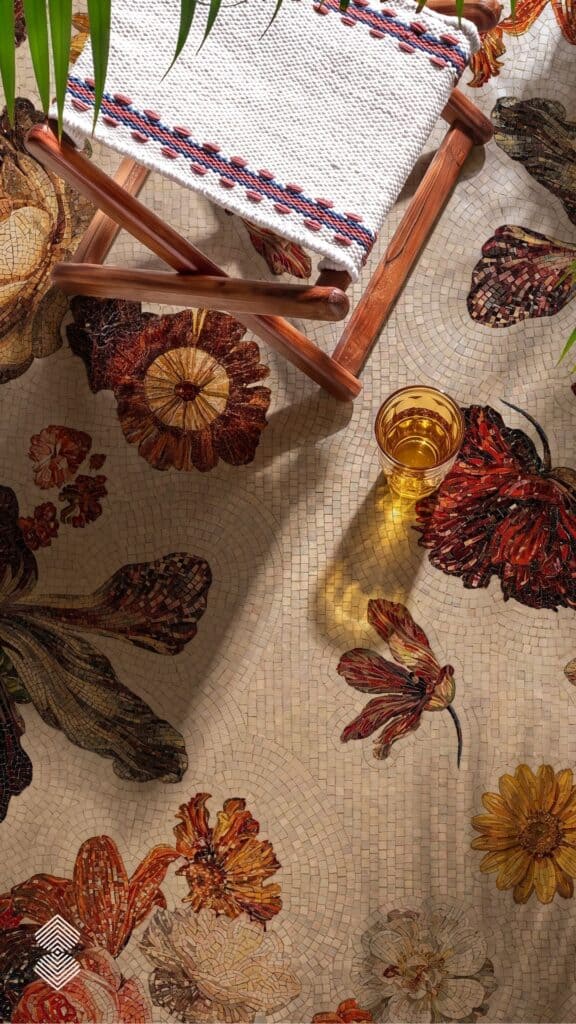
The most attractive material isn’t always the right one for outdoor use. Walkways face foot traffic, water, heat, dirt, and changing weather conditions. Material selection should therefore happen alongside the mosaic walkway design process.
| Option | Best For | Design Benefits | What to Consider |
| Natural Stone & Marble | Main walking surfaces, entrances, gardens, and courtyards | Wide range of natural colors and textures. Works well for a hand-cut stone walkway and detailed patterns. | Surface finish, porosity, foot traffic, moisture, climate, and freeze and thaw conditions. |
| Glass Mosaic | Accent bands, borders, motifs, and poolside transitions | Adds rich color, reflection, and contrast against marble or stone. | Wet conditions, surface finish, placement, and suitability for the specific outdoor application. |
| Waterjet Cutting | Geometry, logos, lettering, medallions, and sharp architectural patterns | Creates precise curves, clean edges, fitted pieces, and repeated geometric forms. | Pattern complexity, material choice, scale, and how the cut pieces connect with surrounding tesserae. |
Pattern Styles for a Mosaic Walkway Design
The term mosaic walkway design encompasses quite a few different visual styles. While some pavements consist only of a border made up of two colors, others turn into real works of art.
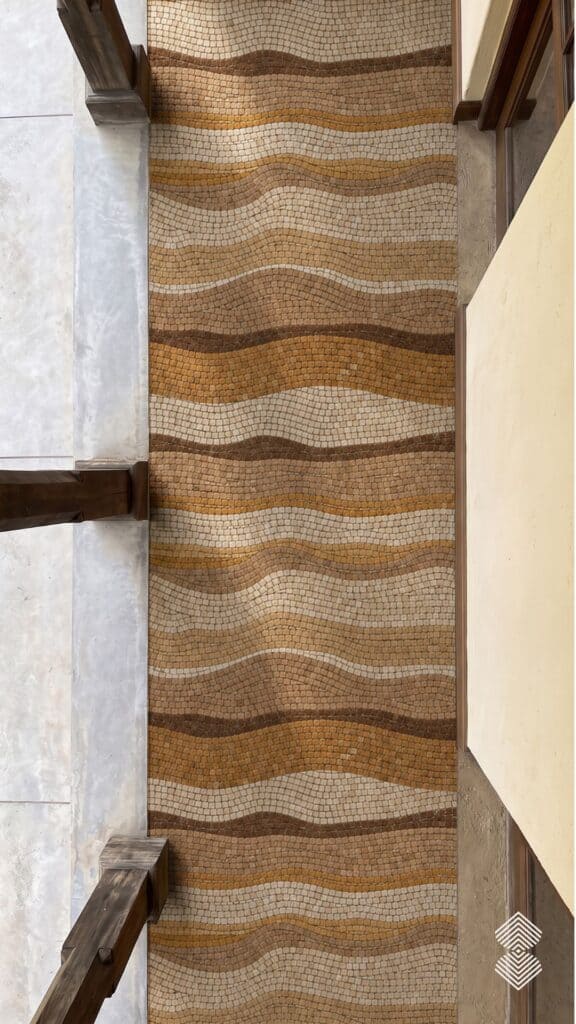
Roman and Greek Mosaic Pathway Patterns
There are many mosaic walkway design ideas for contemporary pavements that can be gleaned from Roman and Greek mosaics. Geometric grids, waves, Greek key borders, flowers, and medallions can all be used on villas, courtyards, and entrances. The design does not necessarily have to look historical; even a monochromatic border or geometric composition can appear modern.
Geometric and Modern Walkway Layouts
Modern architecture often works better with clean geometry than detailed artwork. Lines, circles, arches, grids, and abstract forms can create movement while keeping the outdoor mosaic path visually simple. Popular options include:
- Offset lines
- Repeated circles
- Arches
- Chevron layouts
- Broken grids
- Monochrome gradients
- Pixel patterns
- Asymmetrical bands
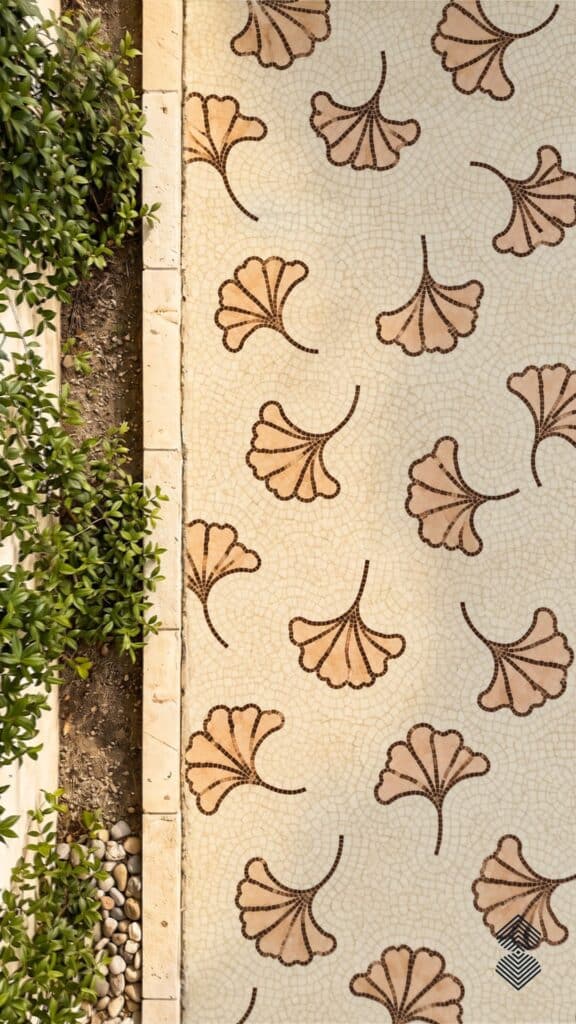
Floral and Organic Garden Walkway Mosaic Motifs
It is natural for garden walkways to work well with leaves, flowers, vines, and other organic forms. This mosaic walkway design can take inspiration from the surrounding vegetation without copying it precisely. Olive leaves, palms, lotus flowers, jasmine, and even local vegetation can help determine the color and form of the mosaic.
A Medallion as a Walkway Focal Point
Medallion placement will be ideal at places where people slow down or where there is an architectural element on the walkway. The surrounding design can remain simple so that the medallion is still the focal point. Suitable places include:
- Entrance gates
- Front door approaches
- Walkway intersections
- Courtyard centers
- Fountain approaches
- Pool entries
- Surface transitions
Engineering a Mosaic Walkway to Survive Outdoors
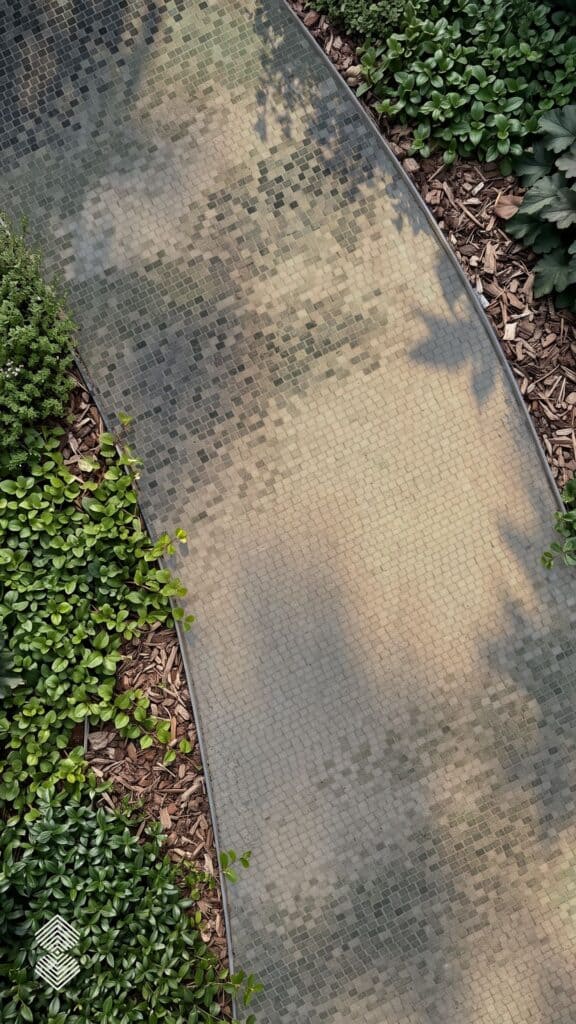
Artistic beauty alone is not enough if the substrate is poor. A mosaic walkway design is one aspect of an overall construction system that involves the substrate, adhesive, grout, movement joints, slope, and adjacent paving. All layers have an effect on durability.
Slip-Resistant Mosaic Tile for Outdoor Walkways
Resistance to slipping is particularly significant around swimming pools, fountains, gardens, and other damp areas. The performance of slip-resistant mosaic tile for outdoor walkways will depend on the surface finish, the size of tesserae, grout joint sizes, slope, and exposure to moisture. Take into account:
- Material finish
- Tessera size
- Grout joints
- Slope and drainage
- Wet exposure
- Cleaning conditions
- Local safety standards
Smaller tesserae create more grout joints and surface texture, but proper material specification and testing are still important for each application.
Weathering, Frost, and UV Exposure
Outdoor mosaics have varied environments based on geographical differences. Projects in Dubai may require mosaics that are resistant to heat, ultraviolet rays, and dust, while mosaics in New York might have to survive freezing temperatures and snow. Coastal environments will bring in moisture, humidity, and salt.
The mosaic walkway design and materials chosen should thus fit the real climatic environment. In addition, the use of various materials like marble, glass, grout, and the surrounding pavements may vary in reaction to moisture and temperature.
Setting Systems and Grout for Foot Traffic
A durable mosaic walkway depends on grout more than the visible artwork. The substrate, mortar, grout, drainage, and movement planning all contribute to long-term performance.
Important considerations include:
- Stable substrate
- Suitable mortar and grout
- Full support beneath tesserae
- Proper slope and drainage
- Movement accommodation
- Connections with surrounding paving
Good coordination between the designer, mosaic fabricator, and installer helps ensure the finished mosaic walkway design handles foot traffic, moisture, and changing outdoor conditions.
Mapping a Mosaic Walkway Design to Your Own Site
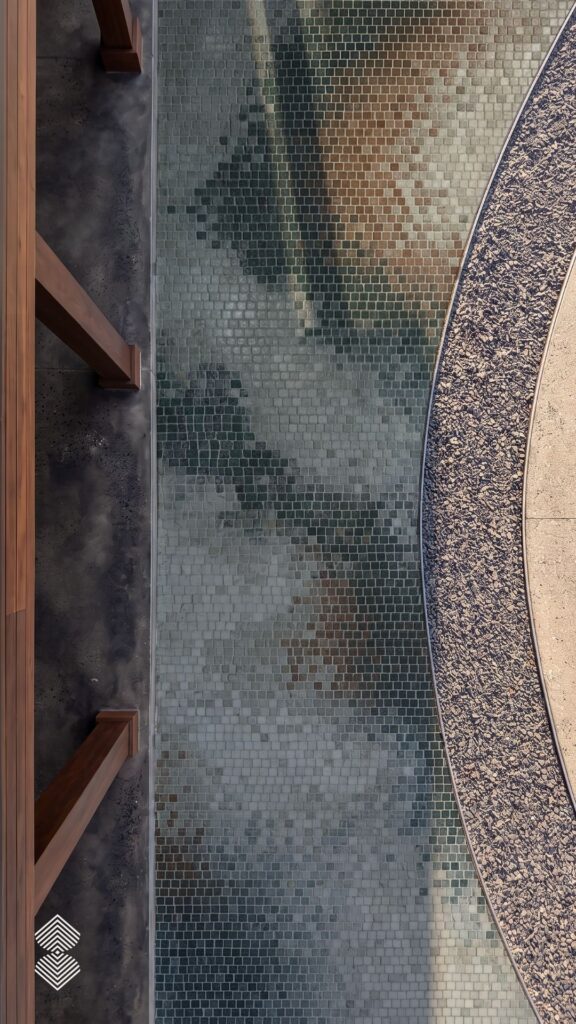
Custom mosaic walkway design works best when it starts with the property itself. Instead of fitting an existing pattern into the walkway, we look at the architecture, dimensions, materials, and surrounding landscape to develop the design.
You can start with:
- Architectural or landscape drawings
- CAD files and dimensions
- Site photos
- Pool plans
- Material samples
- Facade elevations
- Moodboards and references
- Color palettes or sketches
Working from Landscape Drawings and Site Photos
Landscape drawings help us understand the walkway shape, dimensions, planting areas, pools, fountains, and nearby architecture. Site photos show the actual colors, materials, lighting, and surroundings that drawings may not fully capture.
Using both, we can develop an outdoor mosaic design that follows the path naturally and connects with the property. It also helps us decide where borders, pattern changes, and focal details will have the strongest visual impact.
Previewing a Walkway Pattern with MEC AI Mosaic Studio
It can be difficult to imagine how a custom mosaic will look on an empty walkway. With MEC AI Mosaic Studio, you can upload a site photo and explore different borders, colors, motifs, medallions, and pattern scales within the actual space. You can quickly compare a classical marble border with a modern geometric pattern or see how a focal design might look near the entrance.
This gives you a clearer visual direction for your mosaic walkway design before detailed design begins. However, the AI image should be treated as a design preview, not a fabrication drawing. Exact dimensions, materials, tessera size, grout, surface conditions, and installation details are developed later by the professional design and production team.
Caring for an Outdoor Mosaic Path Over Time
Even an excellently executed mosaic walkway design requires regular maintenance. It is important to choose the best method of maintenance based on the materials used, finish of the surface, grout, and conditions of the environment. Stone and glass may require different ways of cleaning. For routine outdoor mosaic maintenance, include:
- Sweep away grit and loose debris.
- Clean spills before they settle.
- Use products suitable for the selected stone or glass.
- Avoid harsh acids on sensitive natural stone.
- Watch grout and joints for damage.
- Keep drainage routes clear.
- Address loose areas early.
- Follow sealing guidance where required.
Pressure washing also needs care. Excessive pressure can damage grout or vulnerable edges if used incorrectly. Gentle, regular cleaning is usually safer than occasional aggressive treatment.
Final Thoughts: Design the Path, Not Just the Surface
A walkway does more than connect two spaces. It shapes how people approach, move through, and experience a property. Mosaic walkway design allows you to create a pattern that is based upon the structure, landscape, curves, and environment surrounding it rather than using repetitive patterns on the surface itself. Be it a hand-carved stone walkway, garden path, poolside mosaic, or entrance medallion, some of the best mosaics have an intrinsic relationship with their surroundings.
FAQs
What size walkway can be made as a single custom walkway mosaic commission?
Custom mosaic projects can range from small entrance features to large architectural pathways. The overall design doesn’t necessarily need to arrive as one rigid piece. Large mosaics can be divided into organized panels or numbered sections for transport and installation. The correct panel strategy depends on the artwork, dimensions, material, shipping method, and site access.
Which materials work best for a wet or shaded outdoor mosaic path?
There is no single material that will serve best as a medium for an outdoor wet or shaded mosaic walkway design. Natural stone, marble, and selected glass may all be used outdoors in mosaic designs provided they are properly specified.
Can a mosaic walkway be matched to existing paving or a pool surround?
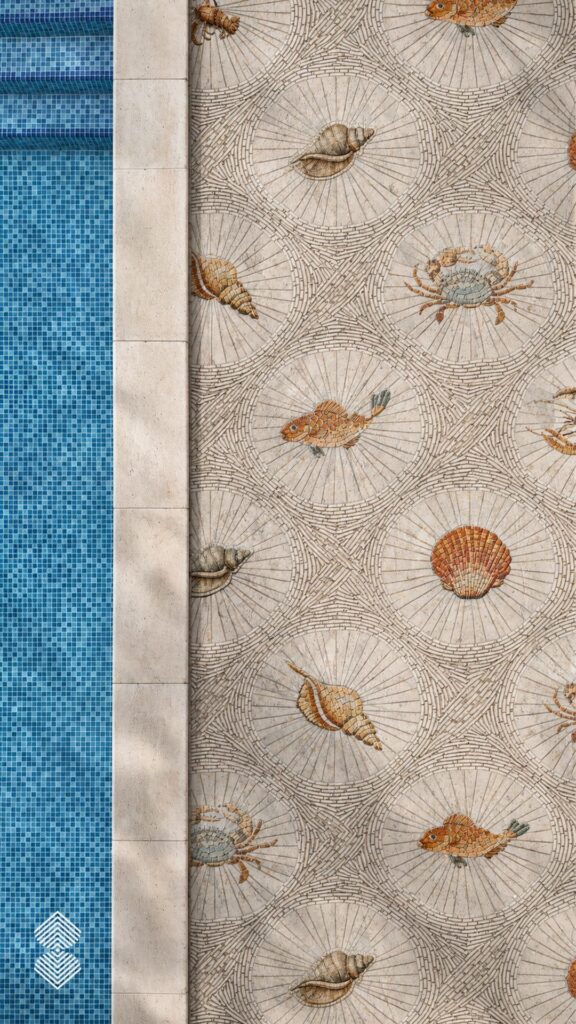
Yes. The matching does not necessarily have to involve the use of identical materials. Some of the ways designers can achieve continuity include color, border, geometry, proportion, and motifs. For instance, an off-white stone surface on the pool area can relate well to a marble mosaic walkway through an almost identical base color but having a blue glass border on the mosaic.
How is a mosaic walkway installed on site?
The installation will be determined by the location, climate, substrates, and type of mosaics. Custom-made mosaics come marked with panel names so installers can correctly assemble the full mosaic walkway design. Before installation, the team should evaluate the substrate, slope, drainage, setting materials, joints, and alignment with neighboring surfaces.
Can a custom mosaic walkway be shipped internationally for installation?
Indeed. A custom mosaic walkway design may be produced away from the construction site and then shipped wherever it is needed. Proper labeling helps the installation crew assemble it correctly upon delivery. The package may also include numbered sections and their exact locations.
Can a hand-cut mosaic walkway be designed for slip resistance?
Yes, but slip resistance should be treated as a performance requirement rather than assumed automatically. Material finish, tessera size, grout joints, water exposure, slope, and maintenance all influence the final surface. A pool deck will have different needs from a covered entrance. The safest approach is to choose and test the material according to the intended application and local requirements.