

The PIXL Advantage: Seamless Gradients Without Grids
The PIXL Technique: Perfecting the Glass Mosaic Gradients for Interiors and Pools
When most people think of pixel mosaic art, they imagine small square tiles forming an image. While that approach works for basic visuals, it often creates visible steps between colors. The result feels digital and fragmented.
The PIXL technique removes that limitation.
At MEC Artworks, we treat each tile as part of a gradient system rather than a fixed pixel. Instead of repeating identical colors in blocks, we introduce subtle tonal shifts across the surface. This allows the design to transition smoothly from one shade to another for any custom mosaic art piece.
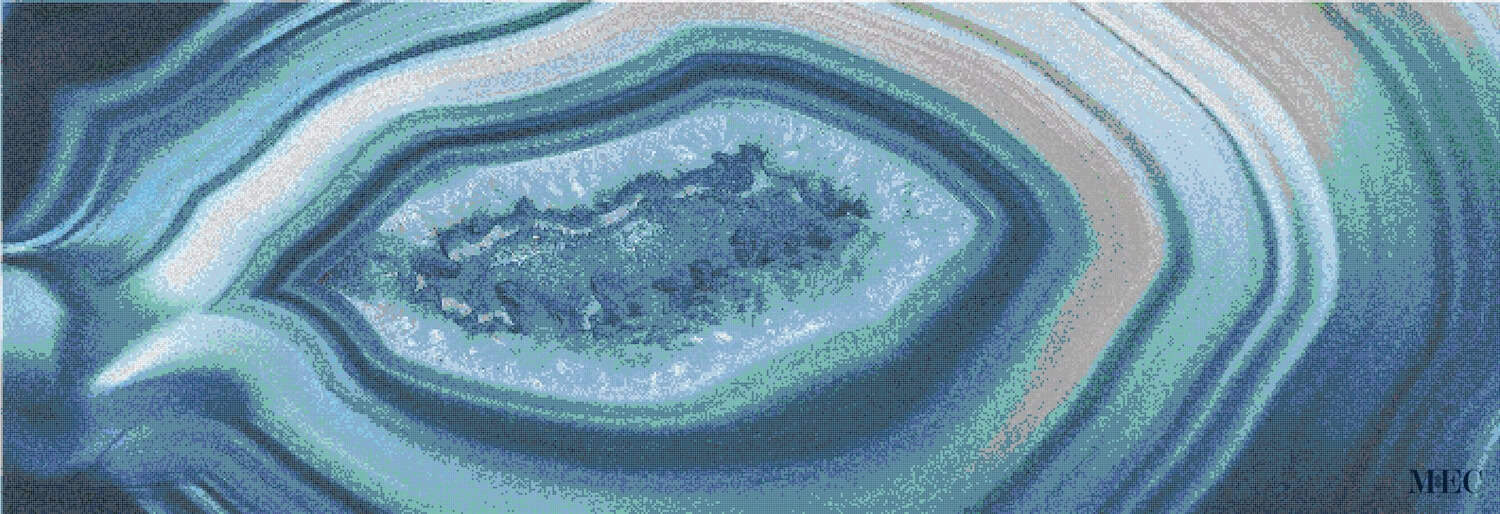
No Blocky Images, Only Flow
Traditional pixel art tile layouts rely on repetition. You’ll often see: hard edges between colors, visible square clusters, and abrupt tonal jumps. With the MEC PIXL technique, those issues are eliminated. We carefully position each tessera to soften transitions. Colors overlap visually. Edges dissolve into gradients. What you get is a glass mosaic gradient that feels continuous rather than segmented.
How We Eliminate Straight Line Artifacts in Large-scale Mosaics
One of the biggest problems with standard mosaics is the grid. Even when the design is complex, the installation reveals straight lines where sheets meet. That’s because most mosaics are: pre-mounted on mesh, installed in square sections, and limited by sheet alignment.
These grids interrupt the design. They break the illusion.
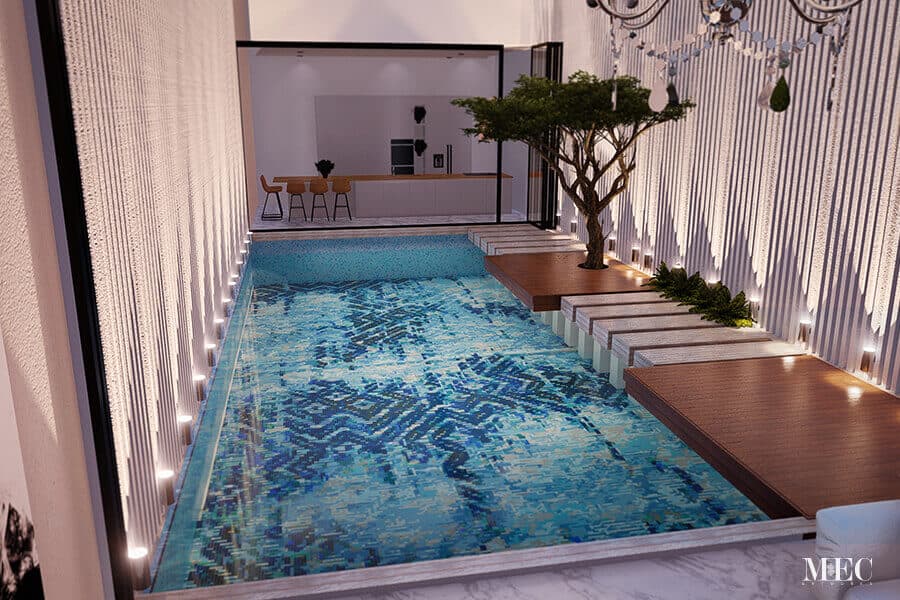
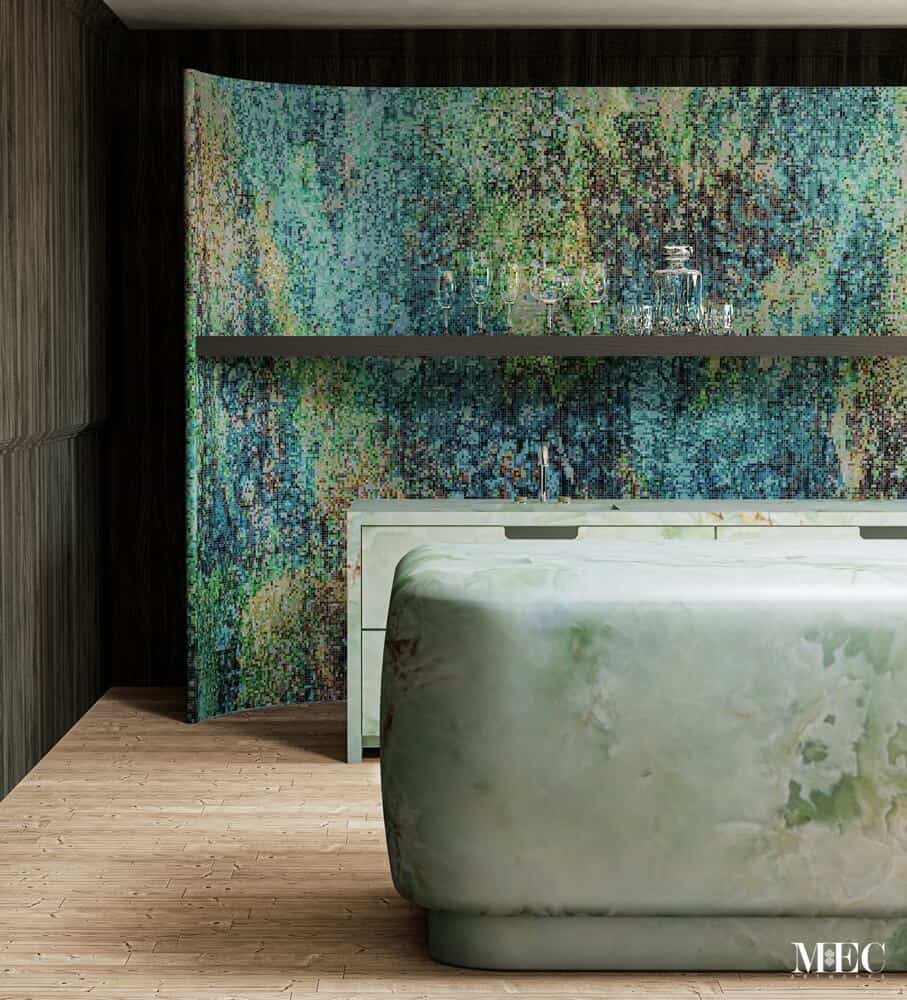
But the PIXL technique solves this at the fabrication level. And for this, we use a face-mounted approach that allows full control over placement. Tiles are not locked into rigid sheets. Instead, they are arranged to follow the flow of the design. This removes: visible seams, repeating square patterns, and alignment breaks during installation.
The result is a truly abstract mosaic tile pattern, where the surface reads as one continuous composition, giving a seamless glass tile installation
Our Premium Color Library: Expanding the Gradient Range
Standard Glass Mosaics
- Limited color palette
- Stepped color transitions
- Harsh shade jumps
- Flat visual depth
MEC Advanced Glass Library (Vertex)
- 100+ tonal variations
- Smooth gradient blending
- Subtle tonal transitions
- Layered depth and realism
Comparing Mesh-Mounted Sheets vs PIXL Face-Mounting Mosaic Fabrication
Not all mosaics are fabricated the same way. The method directly impacts the final result. Standard Mesh-Mounted Mosaics:
- Tiles fixed in square sheets
- Limited flexibility during installation
- Visible grid lines between sections
- Repetitive patterns
PIXL Face-Mounted Mosaics:
- Tiles positioned individually for gradient flow
- Full control over placement and spacing
- No visible seams or grid breaks
- Continuous, painterly finish
This difference is critical when working with pixel mosaic art. Mesh systems prioritize speed. PIXL prioritizes visual precision
Why PIXL Technology Creates More Realistic Mosaic Surfaces
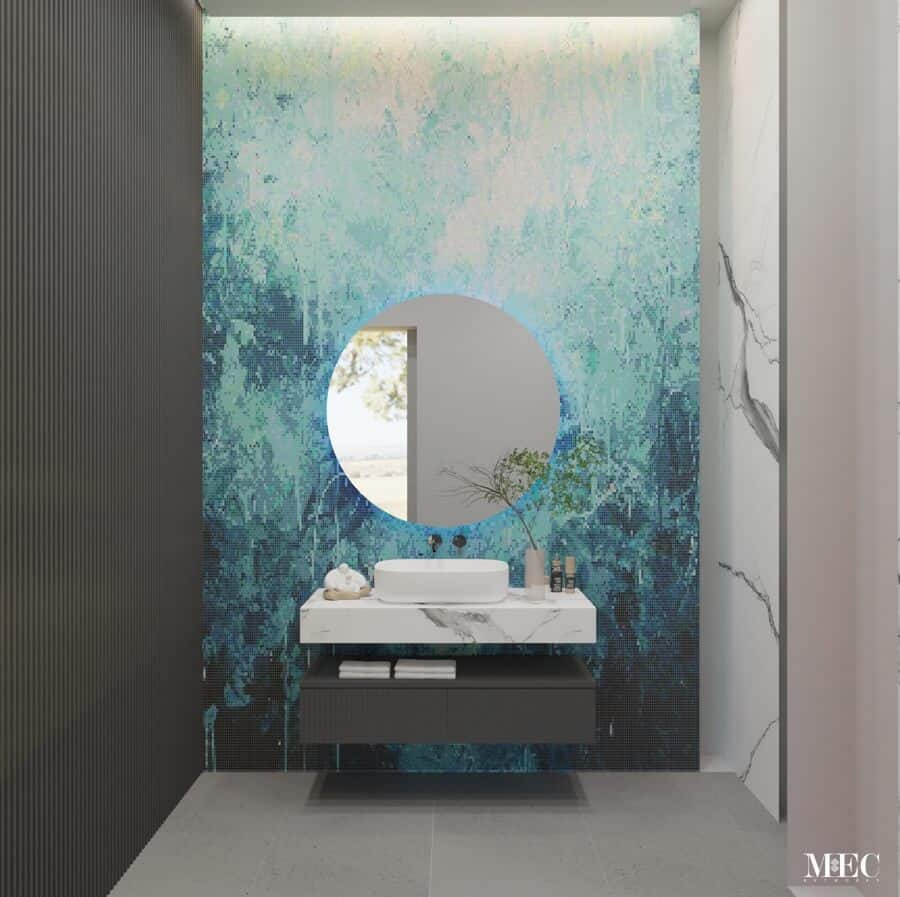
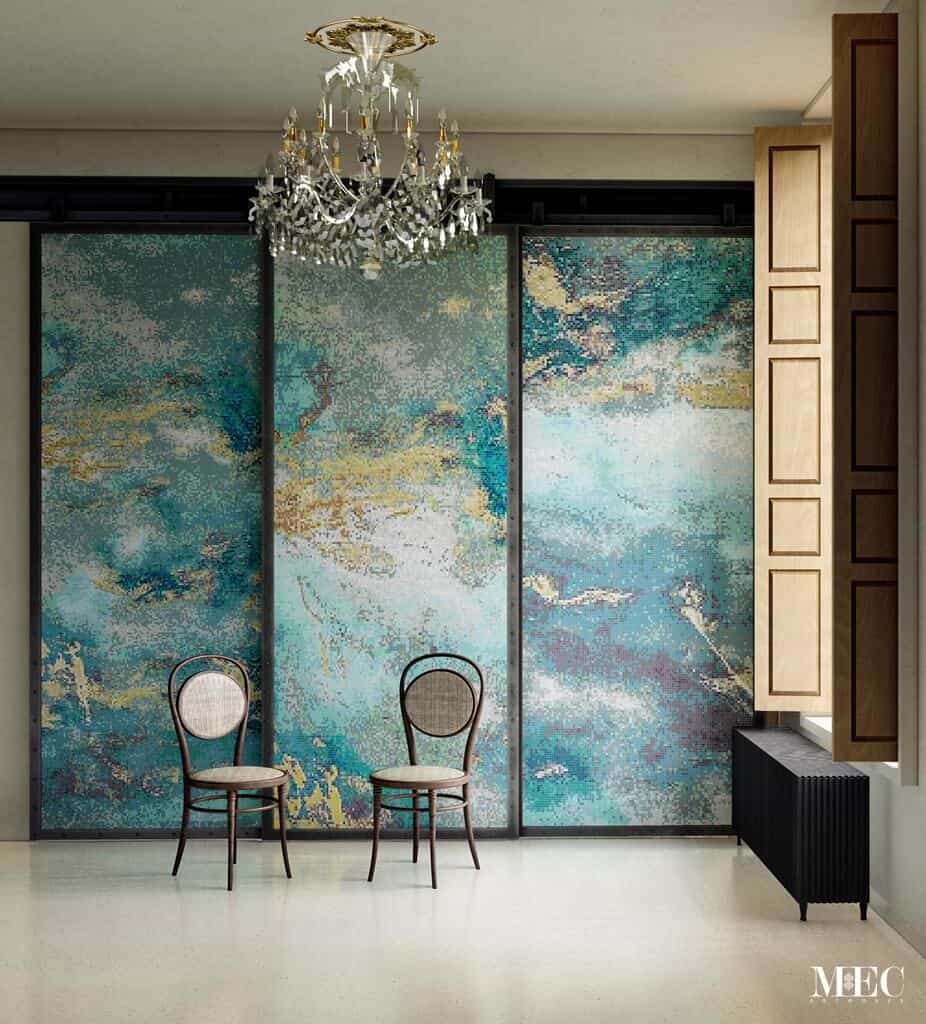
Realism in mosaic comes from transitions, not shapes. A realistic surface requires:
- Gradual color blending
- Directional placement
- Controlled variation
Standard mosaics struggle with this because they rely on repetition. PIXL introduces variation at every level. Each tile contributes to the overall gradient. No section feels duplicated. No area feels flat. This is especially important for:
Instead of seeing individual tiles, you see the image as a whole.
Why the MEC PIXL Technique Matters
There is a clear difference between standard mosaics and PIXL. With MEC Artworks, you get:
- Seamless Gradients (No visible steps)
- Expanded Color Range (100+ glass tones)
- Grid-Free Surfaces (No sheet lines)
- Architectural Integration (Designed for real spaces)
The MEC PIXL technique transforms pixel mosaic art into something refined, fluid, and architectural. This is not about placing tiles. It’s about controlling light, color, and perception.
Why the PIXIL Technique is Best for Luxury Pool Mosaics: Creating Water Effects
PIXL technology is especially powerful in pool environments. Water naturally distorts light. It shifts color. It creates movement. A rigid mosaic cannot replicate that effect. With PIXL, we design gradients that respond to water conditions. You’ll see: soft transitions that mimic depth, tonal variations that enhance reflections, and natural blending that changes with light. This makes PIXL ideal for:
Instead of looking like tiled graphics, the surface feels alive. The glass mosaic gradient interacts with water to create a dynamic visual effect.
FAQ’s
What makes PIXL different from standard pixel mosaic art?
PIXL focuses on creating smooth gradient patterns rather than relying on fixed pixel grids. In standard pixel mosaics, colors often shift abruptly from one shade to another, which creates a blocky or stepped appearance. With PIXL, multiple tonal variations are used to blend colors gradually. This results in a softer, more natural visual effect that feels closer to a painting than a tiled surface.
How does PIXL achieve seamless mosaic patterns?
Seamless mosaic patterns are achieved by avoiding rigid mesh sheets and instead using controlled, face-mounted placement. This allows each tile to be positioned based on the flow of the design rather than a fixed grid. By removing the limitations of square sheet alignment, PIXL eliminates visible seams, repeating patterns, and straight-line artifacts, creating a continuous and cohesive surface.
Is PIXL only for pool mosaics?
No, PIXL is not limited to pool mosaics. While it performs exceptionally well in underwater environments due to its smooth gradients and visual depth, the technique can also be applied to walls, floors, and large-scale architectural murals. This flexibility makes it suitable for both interior and exterior applications where a seamless mosaic effect is desired.
What is Vertex glass, and why is it important?
Vertex glass is a specialized mosaic material known for its wide range of tonal variations. It offers over 100 shades, which allows designers to create finer gradients and more precise color transitions. This expanded palette is essential for achieving the smooth blending effect that defines PIXL mosaics, especially in designs that require depth, realism, and subtle shading.
Does PIXL improve durability or just aesthetics?
PIXL enhances both aesthetics and durability. Visually, it creates seamless gradients and eliminates grid lines, resulting in a more refined finish. At the same time, it uses high-performance glass mosaic materials that are designed to withstand environmental factors such as water exposure, UV light, and chemicals. This ensures that the mosaic not only looks better but also performs reliably over time.