
Translating Iznik Florals into a Custom Bar Feature for the Adrak Restaurant Bar
“The digital render was only the beginning. The true character of the mosaic emerges through the handcrafted process, where each glass piece contributes depth and texture that cannot be fully captured on screen.”
— Nada from Client Relations
The design team wanted a blend of historical and modern touch for the Adrak Restaurant in Toronto. The aim was to transform classic Ottoman artwork into a modern statement feature.
Here is the story of how MEC Artworks worked across three continents to create this unique, handcrafted mosaic artwork.
Client Brief
The development process of the custom mosaic feature bar at Adrak Restaurant in Toronto started in early 2025 and continued for a year. While searching for bespoke designs for a custom curved bar mosaic, the Dubai-based interior design firm LW Design approached the MEC studio for a possible collaboration.
From there, the design study between Dubai’s LW Design and the MEC Artworks initially revolved around exploring numerous design concepts, working on presentations, as well as holding meetings, to draft the visual direction for a custom bar feature at 360 Bay Street.
For this project, the interior designers from the Middle East, contractors in North America, and MEC artworks’ design and production teams in Asia were required to navigate through a complex cross-continental workflow. This included ensuring strong coordination and managing schedules across different time zones. This initial push was met with a prolonged pause.
In 2026, MEC Artworks was contacted by the Canadian contractor managing the site, Frontier Group, with regards to resuming the project plans. The aim was to move forward with the approved design and transition it into production.
Owing to the extensive break between the initial drawings and the final production, the design got substantial room to develop. Therefore, when the time to cut the glass arrived, all the teams had full clarity on the technical requirements for the 93-square-foot project.
Inspiration Moodboard
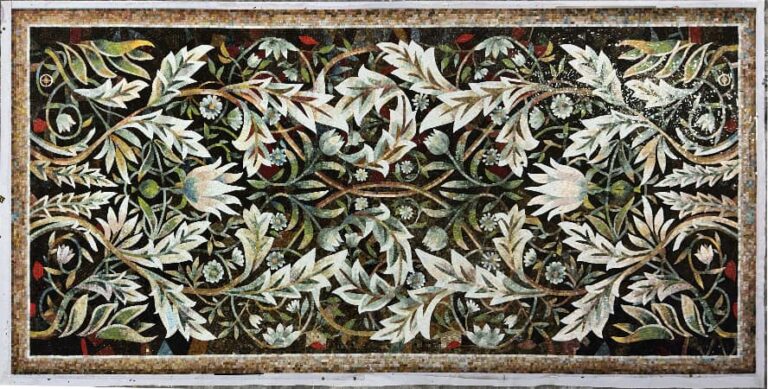
This intricate design got its inspiration from the traditional Ottoman and Iznik floral patterns, showcasing:
- elegant tulips,
- carnations, and
- woven leaves.
In the past, these patterns were painted onto smooth ceramic tiles, with sophisticated brushstrokes. Recreating this classic design and translating that vision of soft, painted fluid lines, to thousands of small hard glass mosaic pieces, was certainly challenging.
As a result, the team carefully mapped each stem and petal onto a functional grid. Sequentially, they proceeded with precisely scaling the artwork, for it to work as a hand-cut mosaic. Their goal was to retain the gentle look of the flowers while simultaneously keeping the design bold and clear from across the space.
Design Development

Initial Sketches
When the initial phase of designing was going on, our team was focused on making sure that the final artwork could fit around the curved custom bar effortlessly. In their initial sketches, the team incorporated some alterations to the color palette, and wanted to ensure that the pattern had a natural flow upon being installed on a curved bar.

2D & 3D Visualizations
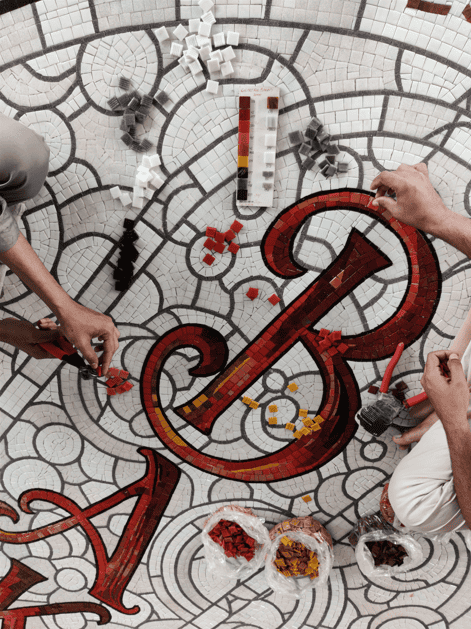
Turning the historical flower paintings into an actual mosaic pattern was such an interesting point during the project. We relied on computer models in order to assemble the hard glass pieces. The team was focused on making the floral shapes simpler, as that would allow the designers to build them by hand in the studio.

Color Palette & Materials
Digital images cannot accurately capture how the entire design would look under actual lighting. To get the colors right, LW Design analyzed physical Murano glass samples.
Initially, the design choice included bright reds and vibrant oranges however, the team decided to tone it down. Therefore, an earthy look with softer shades like pinks, subtle maroons, and olive greens was opted. This palette naturally blended with the custom wood furniture and lighting.
Working With Tiny Glass Tesserae
“We had to eventually alter the size of the flowers on the pattern. In this way, we could actually cut them from the glass while ensuring that every piece was cut perfectly and prevented the distortion of the final look.”
— Production Supervisor
In the beginning of the drafting process, the client asked for very tiny and fine details in the tulips. Although such intricate designs seem great on a digital monitor, that is not always the case in reality.
As this project involved the use of glass mosaic pieces that were 10-15 millimetres wide, the designers are unable to cut the glass with the same level of precision if the design becomes too delicate. Hence, the final look ends up being messy and blurry, with the botanical details losing clarity.
MEC Artworks had to come up with a sweet spot to solve this issue. The details of the pattern were stretched as far as the glass mosaics physically allowed, without the floral design losing its distinct appearance.
The next couple of weeks were spent tweaking the size of the tulips and bringing them closer. This evoked a rich, fuller feeling that was going to be hand-crafted by artisans soon. It was important to make sure that this elegant digital design could be turned into reality.
The Curve Challenge & Continuous Mesh Strategy
“Our biggest challenge was definitely placing the mosaic pattern around the custom bar while making sure we didn’t mess up the floral design. The flexible mesh support was honestly so helpful in this situation.”
— MEC Design Team
The core struggle in the entire project was essentially the bar’s curved shape. This technical aspect was a big hurdle because mosaics are generally created for flat, plain walls or simple pool floors.
In the context of the Adrak bar however, the custom mosaic feature bar had a tricky, curved base. Careful consideration is required upon covering a repeating floral pattern around a curve without making the pattern look stretched.
To make sure that the end result did not look awkwardly stiff and unnatural, the design team had to constantly change the spots of the carnations and the flowers, so that the art could flow in a natural, fluid way, around the bends of the bar.
In this process, the team had to form very detailed instruction plans that exhibited the exact size of the curve. This was needed by the builders in Canada to follow the design perfectly and to make sure everything flowed around the whole bar.
Towards the end, another challenging part which was faced by the team, was the installation strategy. Hand-cut mosaics are mainly transferred in tinier, structured panels that are eventually put together by the contractors on site.
The Adrak bar being curved and irregular, meant that assembling fixed panels together would result in a glaring visual error. The entire elegant illusion of the artwork would look distorted in this case.
In order to avoid this problem, the entire 93-square-foot artwork was created in a continuous large-scale rectangular panel on a flexible mesh grid by MEC Artworks. Therefore, upon its arrival at 360 Bay Street, the custom-made mosaic bar did not have to be aligned in a complicated way by the installation team.
The mesh could be easily trimmed and wrapped around the artwork and bar curve directly in a singular fluid direction. The design of the floral pattern was intentionally kept quite dense, and so any required cuts that were made, were small and fully disappeared into the foliage.
With the implementation of this technique, the flow of the pattern was professionally preserved with no interruptions from the beginning to the end of the bar.
FAQs
How is a mosaic installed in a curved surface without showing lines?
To prevent the presence of obvious lines that you can see upon the usage of stiff boards on round shapes, the entire design is created on a huge flexible, bendable net. Therefore, when it is being installed, it just needs to be wrapped smoothly around the curve all at once. Any micro-cuts that are made during this process remain hidden in the dense floral pattern and are not noticeable. In this way, you achieve a smooth and seamless final look.
Why is it recommended to check the physical glass samples rather than just relying on digital images?
Computerised images are helpful only to a limited degree, as these images cannot show you how the actual reflective glass would look like, under natural lighting. When you have a look at the physical glass samples, such as Murano glass samples, you can see whether the colours will match your walls, floor and furniture. In this way, you can make sure that the actual colours fit in your space and do not seem completely out of place.
How are sophisticated historical motifs converted into a hard glass mosaic?
Translating traditional Ottoman or Iznik ceramic patterns into a glass mosaic requires converting delicate painted strokes into thousands of hard, geometric pieces. The design is mapped out on a functional grid while balancing the scale to make sure that the design is clear and noticeable from across the room..
Verified Client Reviews & Experiences
Posted on GoogleTrustindex verifies that the original source of the review is Google. I found MEC online searching for a mosaic Persian rug for my bathroom. I found the Este Custom Marble Persian Mosaic Rug and loved it the way it was but the sizing needed to be tweaked a little. Nada got back to me right away and was extremely helpful with making the necessary adjustments to maintain the integrity of the rug to fit the space. Nada sent samples, videos and a thoughtful presentation of of the piece with mock ups of how it would look in the space. We were so thrilled with how the rug turned out. I am still waiting for the full install but could not be more pleased with the whole process, communications and quality of MEC's work. I would highly recommend MEC to anyone who is thinking about a mosaic piece. Nada, Zeeha and team were a true pleasure to work with. (Pictures to come!)Posted on GoogleTrustindex verifies that the original source of the review is Google. Wonderful communication and sent samples in a timely manner! Can't wait to see our design installed!Posted on GoogleTrustindex verifies that the original source of the review is Google. It has been a wonderful and fun experience to work with MEC on the design and execution of our kitchen mosaic. Nada was prompt and thorough with her replies, always giving us in-depth understanding and explanation when needed. We felt reassured throughout the whole process. Nada made sure that the end mosaic met our complete expectations. We were looking for more than a backsplash, and the mosaic created by MEC is truly a piece of art. This was an investment that not only pulled the room together, but also highlights a stunning piece of creativity. Very reasonably priced for the quality, beauty, and piece of art made with unique composition and creativity. Would do this again and again with MEC!Posted on GoogleTrustindex verifies that the original source of the review is Google. We have now completed two projects with MEC. The results on both a large bath and full kitchen were outstanding. The design team was a pleasure to work with, they completed and delivered ahead of schedule, and the quality of the murals truly added a unique and high-quality to the rooms. I will look forward to working with them again.Posted on GoogleTrustindex verifies that the original source of the review is Google. We had one of our favorite paintings made into a mosaic to be featured above our stove as part of the backsplash. Bespoke Luxury Mosaics provided several options and customized the work to our liking. We are looking forward to the install!Posted on GoogleTrustindex verifies that the original source of the review is Google. I started the ordering process with MEC a couple months ago and the whole process was amazing. I worked with Nada and she was so helpful. I went through so many design revisions and the whole team was responsive and patient. It started with me sending in my concepts ideas, going through their site and looking at designs that matched my vision. From their they sent me some images that were in line with my vision and we narrowed it down. They then created a few concept images. I selected my favorite and we then spent a few weeks tweaking the design until it was absolutely perfect. They sent over renderings of what it would look like in my kitchen. They matched the dimensions of my shelves, rangehood, and drew up it up to the exact look of my kitchen. Once we got the design down, they created the mosaic. The mosaic looks way more stunning than the concept. I am still waiting on the product and will update with images once it is received.Posted on GoogleTrustindex verifies that the original source of the review is Google. We had a VERY specific vision to see a painting by one of our favorite artists translated into a tile mosaic as a whimsical wow factor for our kitchen renovation. I searched Pinterest for mosaic styles similar to what I was envisioning, and realized that every mosaic I was saving had been produced by MEC Artworks. I promptly reached out with our vision to the MEC team and received a response back right away. Nada and the design team invested a great deal of time and personal care communicating and working with us to get the mosaic design exactly how we wanted it. While constructing the mosaic, Nada and the MEC team worked tirelessly to ensure that every detail was as true to the original artwork and our vision as possible. One aspect of the process I really appreciated was MEC providing us regular photo updates of the construction progress, allowing us to see in real time the mosaic coming together, and give feedback if we saw something we wanted adjusted. We are BEYOND THRILLED with the finished product! Nada and the team at MEC are true artisans. Professional, inspired, and deeply caring for their customers and every piece they create. MEC provides an exceptional high quality product and the team are of the highest quality people you could ever hope to work with! I cannot possibly express how phenomenal our experience was. We knew we were in good hands every step of the way. Once our mosaic is installed I will provide an update with photos!Posted on GoogleTrustindex verifies that the original source of the review is Google. We had a wonderful experience working with MEC. We found a design we liked and inquired about changing a few things to fit our space, and the process was so pleasant. We were provided multiple high quality rendering options and Nada, our consultant, was very attentive and communication was great. I highly recommend getting any custom mosaic project from MEC.Posted on GoogleTrustindex verifies that the original source of the review is Google. The sales and customer support team were absolutely amazing. They were so patient through revisions and very communicative during the process. Highly recommend!Verified by TrustindexTrustindex verified badge is the Universal Symbol of Trust. Only the greatest companies can get the verified badge who has a review score above 4.5, based on customer reviews over the past 12 months. Read more
Start Your Custom Mosaic
Inspired by this transformation? Share your vision with our studio — and let MEC Artworks craft a bespoke mosaic that reflects your style, space, and story.