
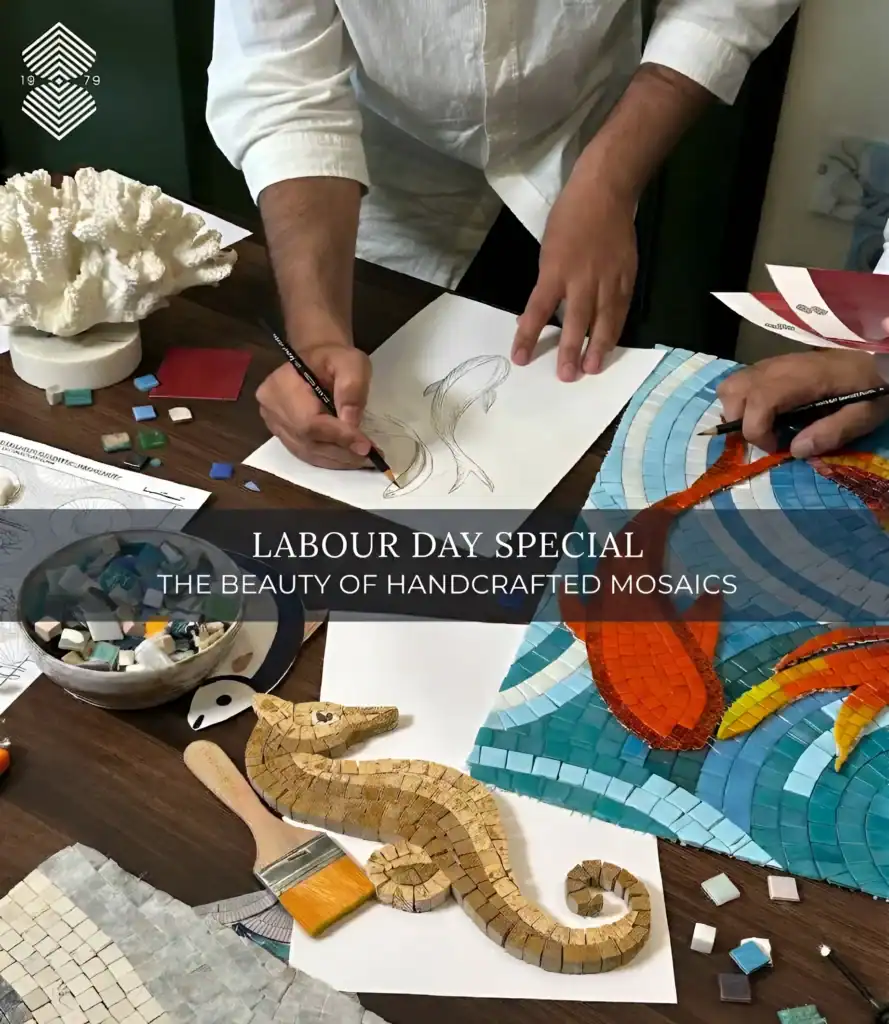
This Labor Day, we celebrate the calloused hands, the focused eyes, and the decades of bespoke craftsmanship that allow us to create mosaics for clients all over the world.
It felt only fitting to reflect on our process, and the many hands behind it, through one of our most recent explorations: the under-the-sea collection.
As we continue to build new collections, explore different perspectives, and push our design language forward, days like today give us a reason to pause and acknowledge what makes it all possible.
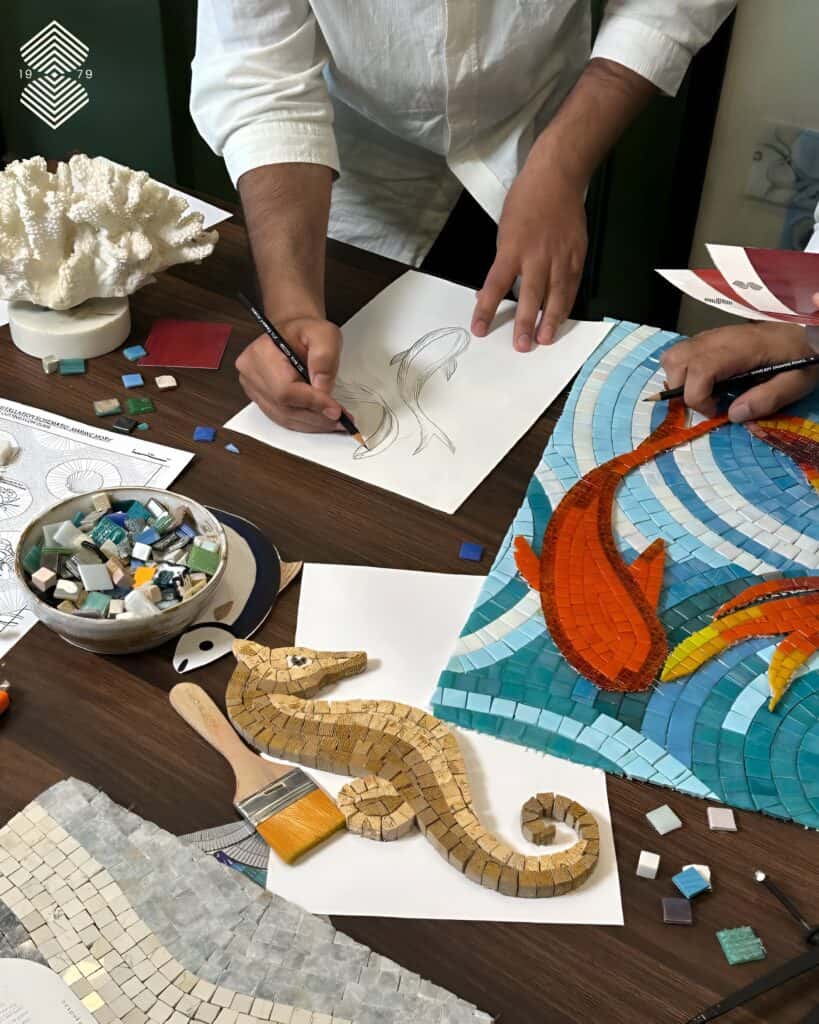
In this special edition blog, we look closer at not only the art of mosaic itself, but the people who bring it into being.
Table of Contents
The Artisans Behind Handcrafted Mosaic Work
Behind each mosaic in our Under the Sea collection, a close-knit team of creative designers, sketch artists, illustrators, and fabricators worked together to shape ideas from early drawings into material studies and finished pieces.
Each role contributed to different stages of the process, from visual exploration and composition to hands, on fabrication in the workshop.
Alongside this internal body of work, our external commissions are supported by a wider network of people—client relations leads, design consultants, and skilled artisans—working across North America, Asia, and the Middle East.
“The highest reward for a man’s toil is not what he gets for it, but what he becomes by it.”
John Ruskin
But beyond roles and coordination, the work is defined by how materials are shaped by hand.
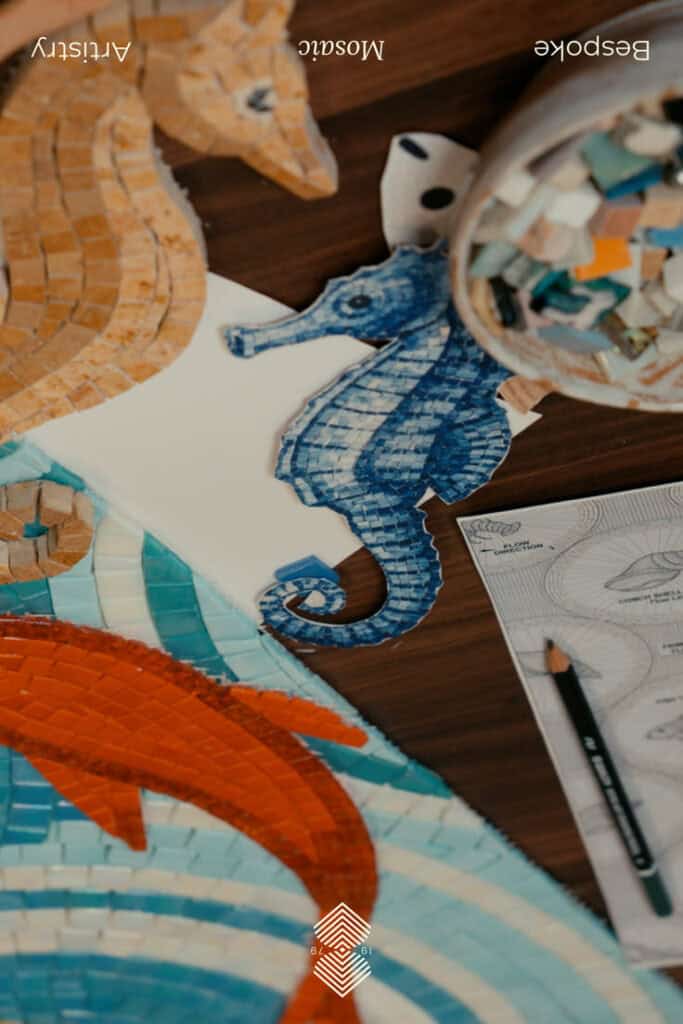
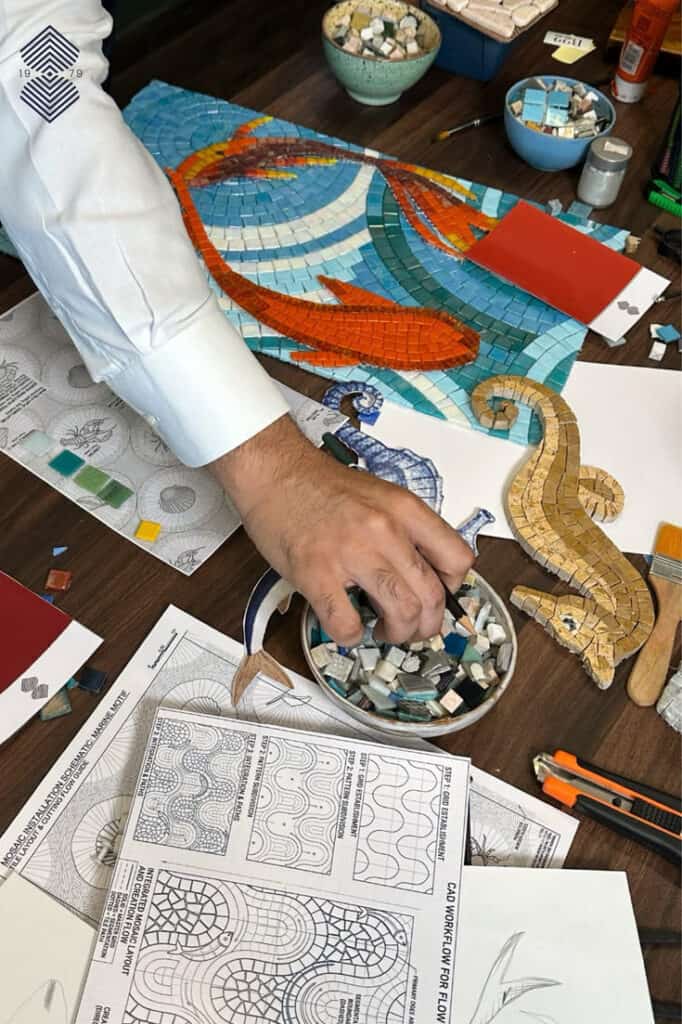
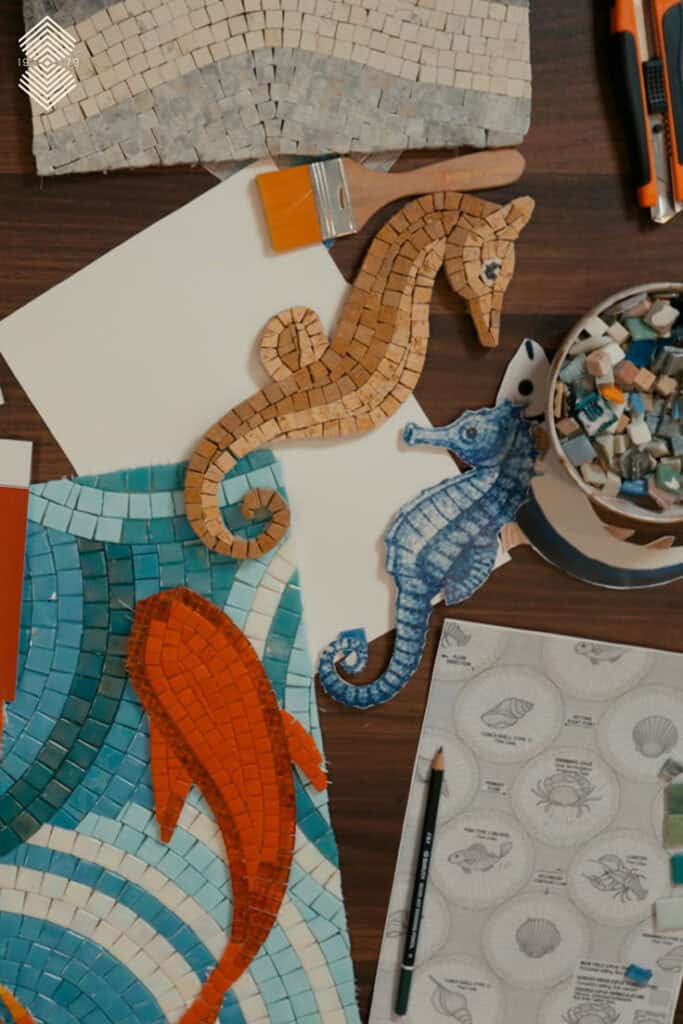
Similar to stone setting, textile weaving, or hand inlay work, the maker is constantly negotiating between intuition and material resistance.
Unlike automated or purely digital processes, this kind of work cannot be separated from the body that performs it. The hand learns through repetition, and the eye refines through exposure.
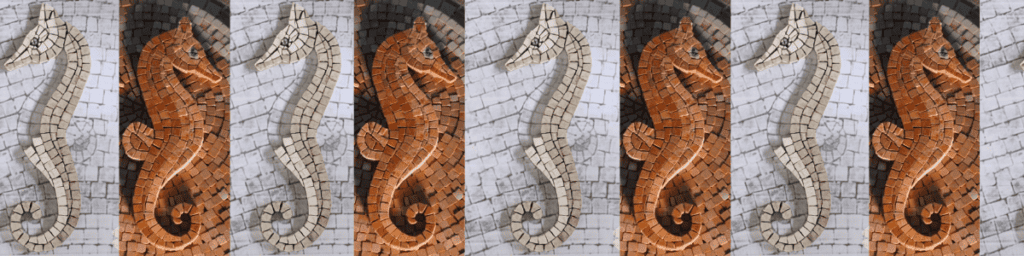
Over time, labor becomes a form of expertise that cannot be fully documented or transferred through instruction alone.
Here’s some insight into what actually goes on behind the process.
Mosaic Making Process: Design Interpretation and Fabrication Workflow
A large part of the process is also mental labour, especially in aligning with design collaborators.
Being on the same page is rarely straightforward; external commissions means working through abstract references, translating digital visuals into material reality, and making sure the original intent holds steady as it moves into something tangible.
Within this collection, that sense of flow, almost like a school of fish moving in quiet coordination, extends beyond what’s visible on the surface.
A designer might describe a “warm neutral field,” but within the context of these underwater scenes, that could influence everything from the softness of a background current to the subtle shifts within a single fin or form.
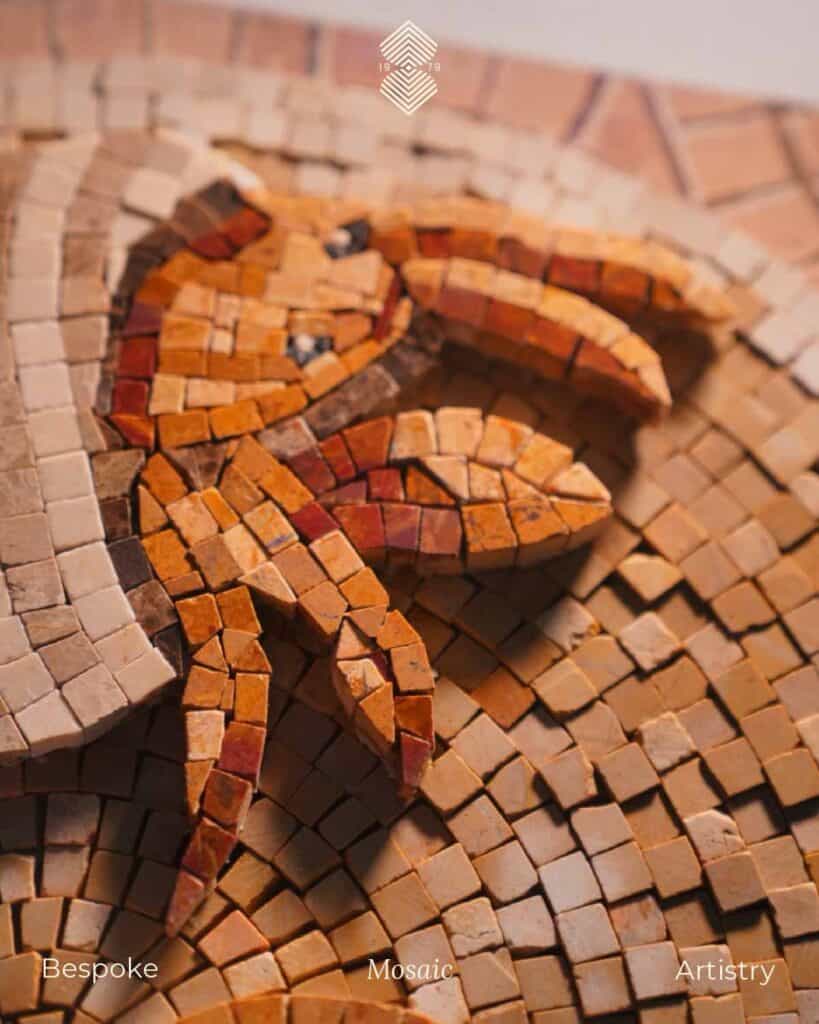
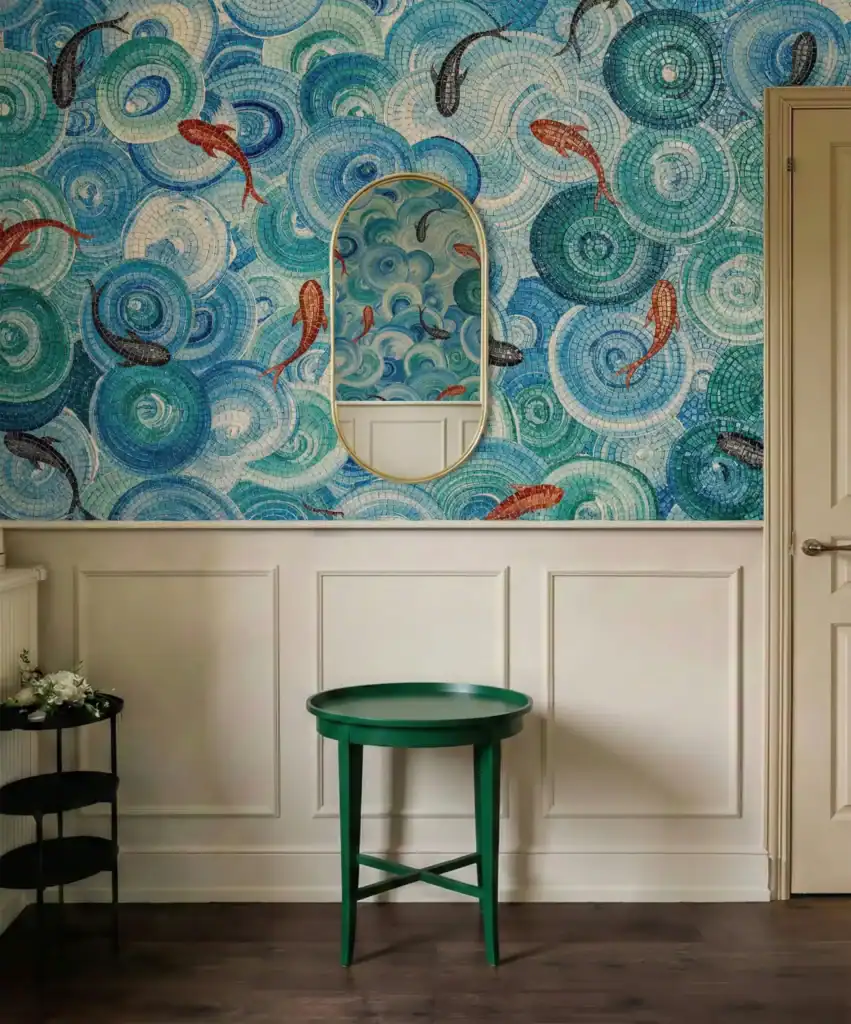
While this collection is part of our internal catalog, we also love working with external artists. Working with creatives and their work such as Alex Proba and Geoff McFetridge, we’ve translated expressive, often deeply personal works into mosaic.
These collaborations are a celebration of the shared effort between designer and maker, honoring the intensive manual fabrication required to turn a singular creative vision into a tangible, handcrafted reality.
This ongoing exchange has allowed our work to travel globally, finding homes in galleries, architectural spaces, and collections around the world, each one carrying forward a shared commitment to human connection.
See more in our artful project features, where we share collaborations with artists, designers, firms, and homeowners.
Mosaic Work in the Age of AI
AI is increasingly used in early design stages like concept development, layouts, and visual planning. It can speed up decisions and support exploration, and we do use it selectively in that part of the process.
But mosaic work still depends on decisions that only happen in real space, in real time.
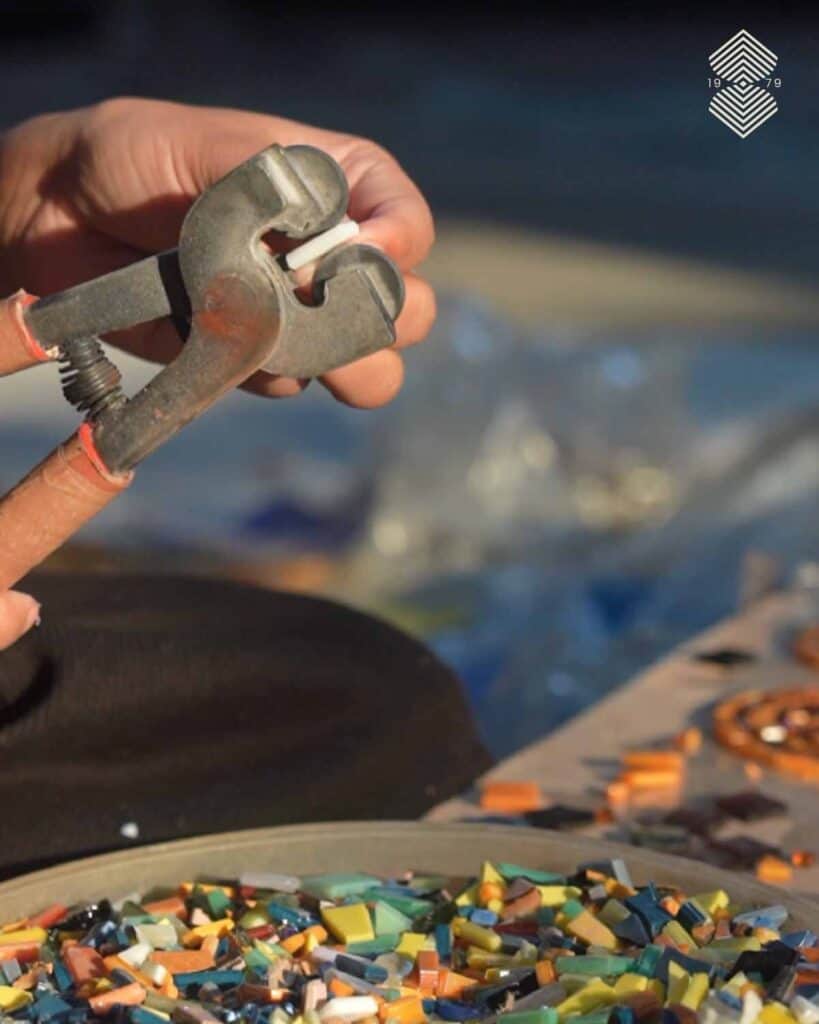
In the workshop, fabricators make these calls constantly. A tile is placed, stepped back from, and re-evaluated. A joint that feels too tight is opened slightly. A colour field that feels too flat is broken with subtle variation.
These are micro-decisions based on eye, touch, and experience.
The mosaic artists who translate ideas into intricate hand-laid detail, the designers who shape form, the design consultants who bridge vision with environment, and the brand, sales, and marketing teams who carry those stories outward, connecting each piece to the people and places it’s meant for.
AI cannot replicate this level of material reading. It cannot feel when a surface needs more depth or when repetition becomes too mechanical. It cannot respond to the unpredictability of glaze, stone, or glass once they are cut and installed.
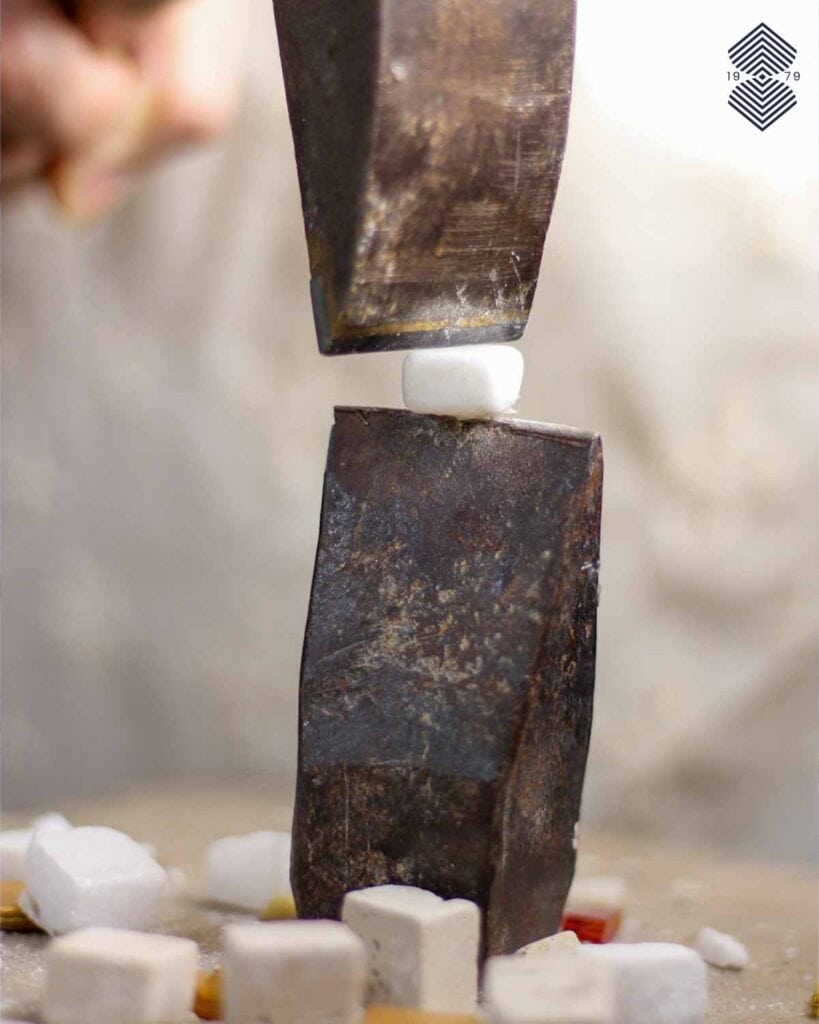
This is why human labor remains essential in mosaic. For interpretation at the smallest scale.
On Labor Day, this becomes especially clear. It is a reminder that the value of work is not only in the idea or the design, but in the steady, physical labor required to turn ideas into something real and built by hand.
Our Mosaic Portfolio: Applications Across Surfaces and Spaces
The categories below outline the primary ways we work across surfaces and environments, and how each application allows mosaic to take on a different role within architecture and design.
Pool Mosaics
Designed for submerged environments where light refraction, water movement, and chemical exposure constantly alter perception. Material selection focuses on glass and high-density stone, with careful control of tone shifts so patterns remain stable and legible underwater.
Explore MEC’s pool tile/mosaic collection on our website.
Wall Murals
Large vertical compositions that balance narrative detail with architectural scale. These works depend on controlled variation in colour fields so they read clearly from a distance while still revealing detail up close. Ranging from large-scale installations to border elements, we have done a multitude of wall mural mosaic projects.
Floor Mosaics
High-durability surfaces designed for constant foot traffic. Fabrication prioritizes structural integrity, slip resistance, and long-term wear performance while maintaining visual depth through tightly managed tesserae placement. From entry aprons to grand medallions, we’ve explored it all.
Architectural Façade Mosaics
Exterior-facing installations exposed to weather, UV, and thermal movement. These require precise joint planning and material testing to ensure long-term stability across large building surfaces.
Feature installations
Integrated mosaic works within lobbies, hospitality spaces, and private residences. These are closely aligned with lighting conditions and interior material palettes, often acting as focal design elements within a space.
Public Art Mosaics
Large-scale civic or site-specific works developed in coordination with architects and municipalities. These projects combine fabrication precision with logistical planning for transport, installation, and long-term public exposure.
Frequently Asked Questions (FAQs)
How does your mosaic design consultancy process work for architectural and interior projects?
Our process starts with dedicated design consultancy, where we work directly with architects and interior designers to translate concepts into buildable mosaic systems. This includes reviewing spatial intent, material direction, and scale requirements, especially for high-demand regions like California, New York, and Florida where mosaics are frequently used in luxury residential and hospitality projects. We then develop technical drawings and material studies to ensure the design is fully resolved before fabrication begins.
Do you provide physical mosaic samples before full production and installation?
Yes, sample delivery is a critical part of our workflow. Before production, we create physical mosaic samples to test colour accuracy, texture, reflectivity, and how materials respond to different lighting conditions. This step is especially important for projects in sun-exposed environments such as Dubai or coastal U.S. states, where light intensity can significantly alter how mosaics are perceived.
Can your mosaic work be customized for large-scale luxury residential and hospitality projects?
Absolutely. All our mosaics are fully bespoke, tailored to the architectural context and design intent. We frequently work on high-end residential villas, hotels, and spa environments in regions such as California, Texas, and the Middle East, where design expectations are highly specific. Each project is adjusted in terms of pattern density, material selection, and installation method to align with the space.