

There’s a moment in the jungle when everything goes quiet. Leaves stop rustling. Birds freeze mid-call. And somewhere in the shadows, a leopard watches.
A leopard mosaic mural captures that exact moment. Not the leap. Not the chase. The stillness before it. The calm tension feels almost electric. When you bring that image into stone, into a wall that will stand for decades, you don’t just decorate a room. You anchor it.
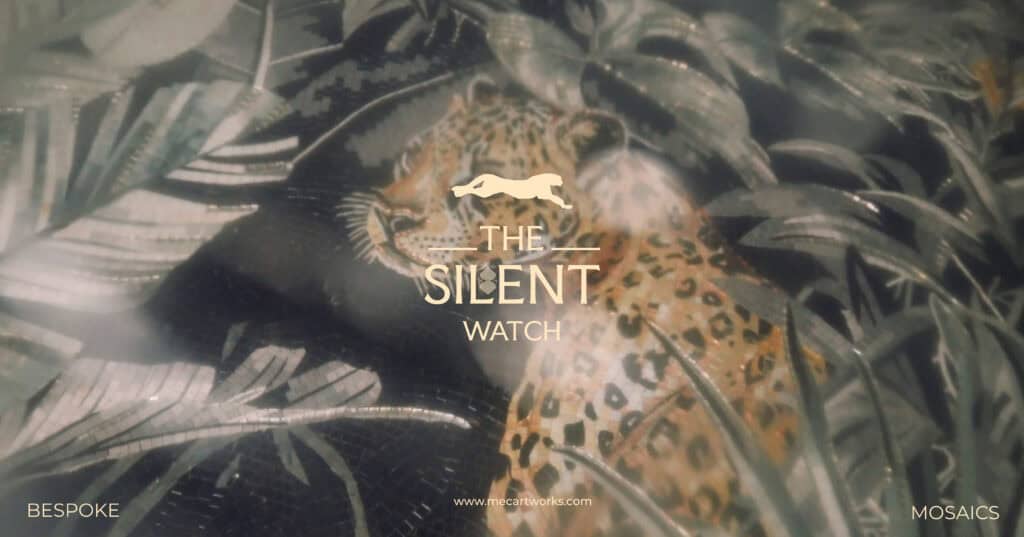
This blog explores how a leopard jungle mosaic mural design becomes more than surface art. It becomes architectural identity. You’ll learn how composition, craftsmanship, material science, and scale transform a wildlife mosaic mural into a permanent work of art.
Table of Contents
The Concept Behind The Silent Watch Leopard Mosaic Mural
A leopard doesn’t roar to prove power. It doesn’t need to. Its authority comes from restraint. That’s why the leopard mosaic wall mural works so well in refined interiors. It represents control, elegance, and quiet dominance. Across cultures, leopards symbolize:
- Precision
- Independence
- Adaptability
- Strategic patience

The Symbolism of the Leopard Mosaic Mural and Design
In decorative mosaic tile design, those traits translate beautifully. A leopard image feels powerful without being loud. It commands attention yet never overwhelms the space. The reason lies in balance. A leopard mosaic glass tile mural carries inherent visual authority because of the animal’s posture, gaze, and pattern. However, when translated into hand-cut glass mosaic tiles rather than bold paint or glossy print, that authority becomes refined.
Capturing the quiet intensity of a jungle predator
Luxury leopard mosaic mural design often revolves around tension. Clean architectural lines paired with organic movement. Hard marble floors next to soft textiles. Structure against wildness. A wildlife mosaic mural featuring a leopard bridges those contrasts. It gives you:
| Design Element | Emotional Effect | Architectural Impact |
| Direct eye contact | Psychological engagement | Creates a focal point |
| Hidden body within foliage | Mystery | Adds depth |
| Still posture | Calm tension | Stabilizes bold spaces |
| Organic fur pattern | Texture | Breaks linear rigidity |
You’re not just adding an animal mosaic image. You’re adding narrative. And narrative is what separates decoration from art.

How Jungle Elements Shape the Mural’s Composition
A custom jungle mosaic wall mural doesn’t scatter leaves randomly. Every frond. Every shadow. Every negative space serves a purpose. Designers often divide the mosaic mural into three spatial layers:
- Foreground foliage
- Midground leopard focus
- Background atmospheric depth
This layering prevents the jungle leopard mosaic mural from feeling flat.
Tropical Foliage and Layered Botanical Forms
A tropical mosaic mural relies on controlled complexity. The jungle should feel immersive yet readable. Too many overlapping leaves can create chaos. Too few can weaken the overall impact. Strong compositions for nature-inspired mosaic ideas usually rely on:
- Broad-leaf framing elements
- Directional leaf movement guides the eye
- Dark tonal anchors behind the leopard
- Lighter highlights in outer foliage
When you stand ten feet away, the leopard or any other animal feature should be dominant and clear. When you step closer, it reveals itself piece by piece. The overall layered discovery keeps viewers engaged.

Creating Depth through Contrasting Leaves and Shadows
Depth in a jungle mosaic wall mural doesn’t come from perspective lines alone. It comes from contrast. By layering darker foliage behind lighter leaves, the mural creates natural visual separation. Deep charcoal and slate-toned leaves recede into the background. Warmer greys and muted beige tones move forward. That tonal shift mimics how light behaves in a real jungle canopy.
Moreover, Shadow placement is just as important. Instead of filling every space with detail, controlled dark areas act as visual pauses. These shadow pockets push the leopard forward. They also prevent the composition from feeling crowded. Also, the leaf direction plays a role in leopard mosaic mural design. Overlapping angles and curved silhouettes create movement. When some leaves arc across the leopard’s body while others fall behind it, the illusion of depth strengthens.
The Role of Mosaic Craftsmanship in Wildlife Murals
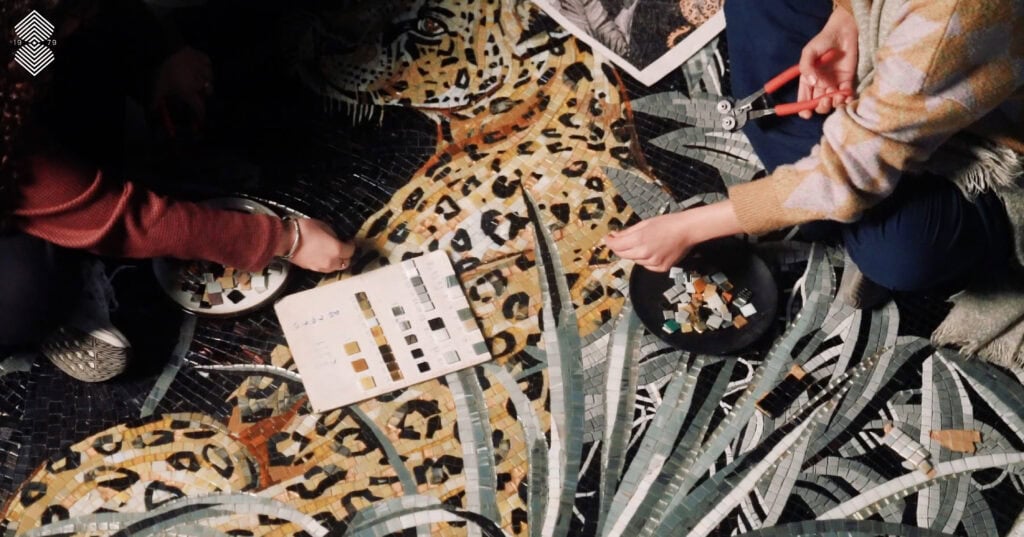
Marble and natural stone don’t behave like paint. You can’t blend colors with a brush. You shape texture through thousands of individual tesserae. That’s where expert mosaic craftsmanship defines the difference between average and extraordinary work.
Precision Placement of Tesserae for Organic Patterns
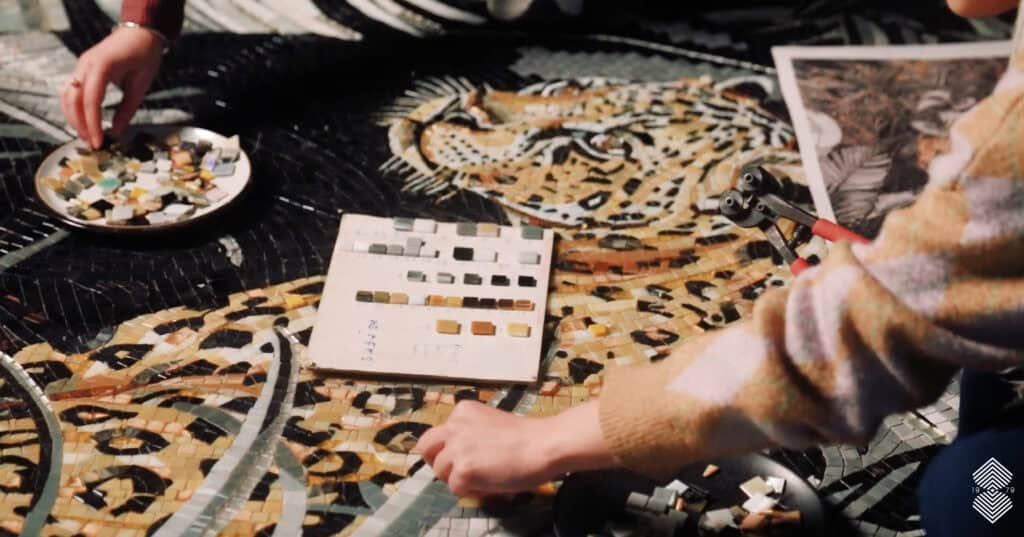
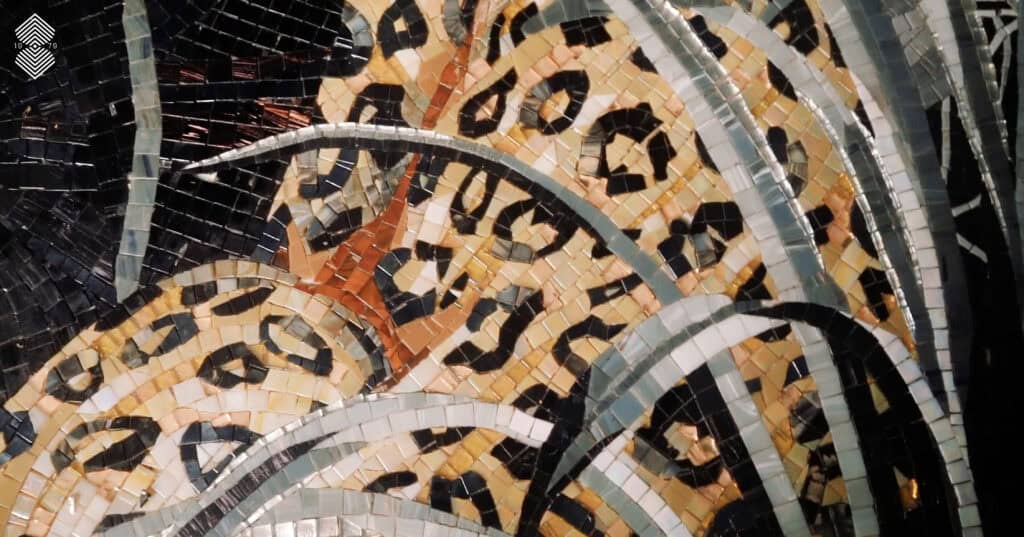
In a high-quality custom wildlife mosaic wall mural, artisans use the andamento technique. That’s the directional placement of pieces that mimic movement. Instead of laying tesserae in straight, repetitive rows, they follow the natural flow of the subject. For example, around the leopard’s shoulders, pieces curve along the muscle lines. Along the spine, they stretch horizontally to suggest strength and structure. Near the face, the direction tightens and shifts subtly to capture delicate contours.

Using Natural Stone Tones to Depict Animal Fur
For example, animal mosaic fur, tesserae follow muscle lines. Around the eyes, pieces radiate subtly outward. In foliage, cuts shift direction to reflect natural leaf veins. The effect feels organic. Not mechanical. Compare the two approaches:
| Technique | Result |
| Machine sheet mosaic | Flat, repetitive texture |
| Hand-cut marble placement | Fluid, natural surface movement |
| Random tessera alignment | Visual noise |
| Directional andamento | Realistic depth |
You’ll notice it immediately. One feels printed. The other feels alive.
Micro-Detailing the Leopard’s Expression
The eyes make or break the mural. In a refined animal mosaic wall art installation, artisans often use smaller tesserae around:
- The tear ducts
- The iris ring
- Whisker pads
- Nose shading transitions
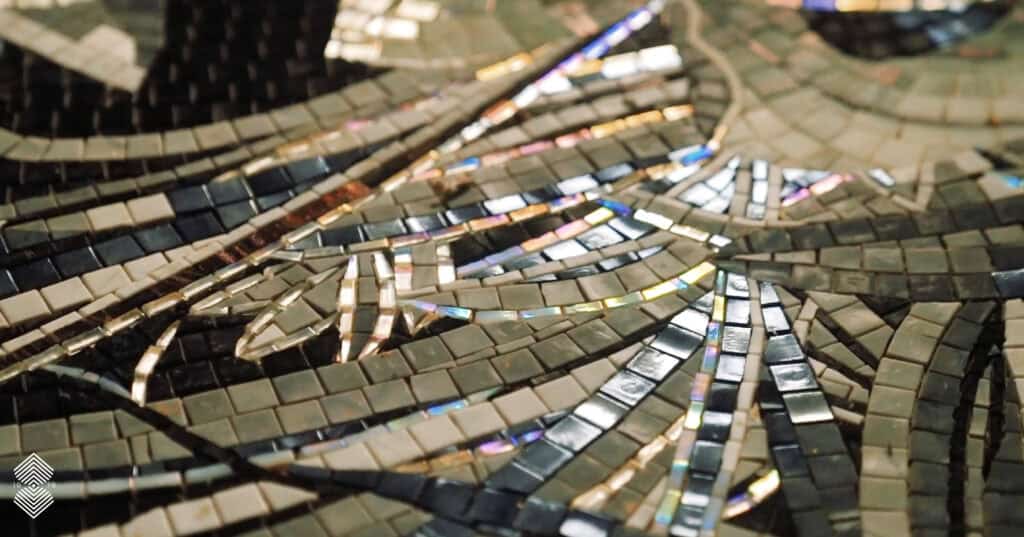
That precision allows tonal transitions within millimeters. Moreover, slight shifts in polish level control light reflection. Honed marble reduces glare. Polished glass mosaic tile pieces create subtle sparkle. Glass accents add pinpoint highlights. When light hits correctly, the leopard’s gaze feels almost animate.
Materials Used in a High-End Jungle Mosaic Mural
Mosaic tile materials aren’t just aesthetic decisions. They’re structural commitments. For a high-end leopard jungle mosaic mural design, mosaic designers typically use:
- Natural marble
- Limestone
- Smalti glass
- Onyx accents
- Occasionally, semi-precious stone inlays
Each mosaic tile material brings distinct characteristics.
Durability and Longevity of Handcrafted Mosaic Tiles
- Mohs hardness: 3–4
- Lifespan indoors: 100+ years with maintenance
- UV stability: Excellent when properly sealed
- Heat resistance: Stable beyond 1,800°F
Glass smalti, by contrast:
- Offers vibrant color retention
- Resists chemical exposure
- Adds luminosity in shadowed areas
The mosaic tile material choice depends on the desired mood. Marble gives warmth. Glass intensifies drama.
Why Wildlife Mosaic Murals Create Powerful Interior Focal Points
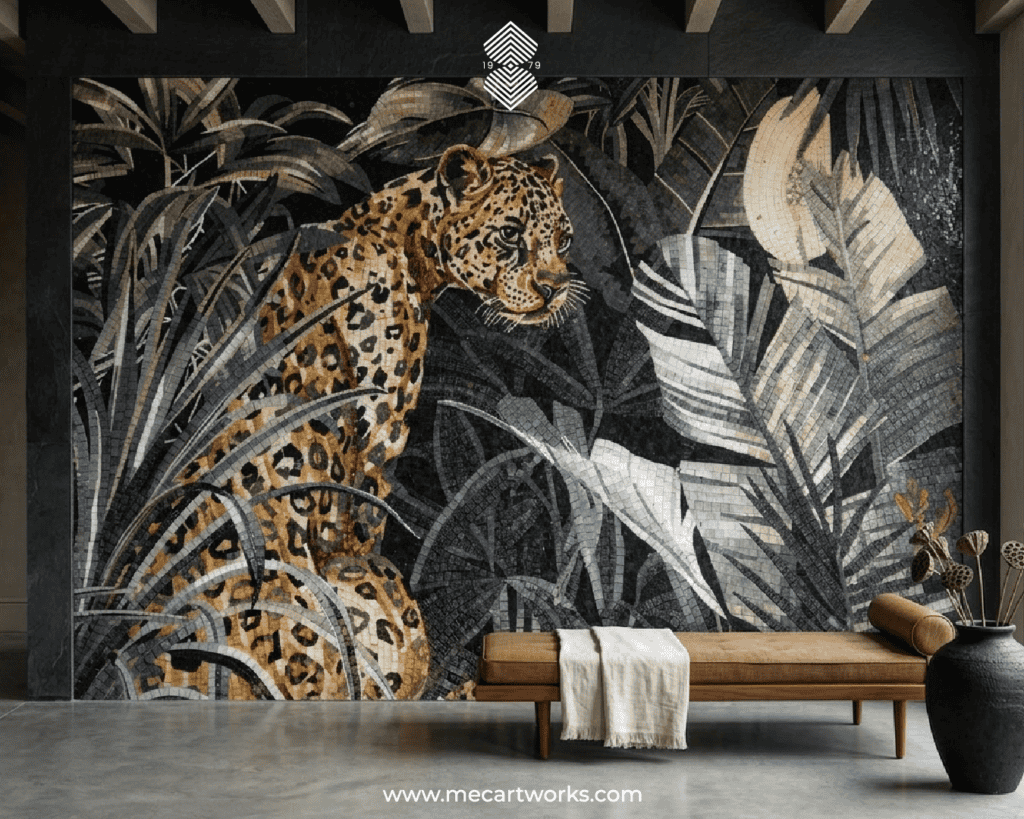
A wildlife mosaic mural does more than fill a wall. It defines the room. When thoughtfully designed, it becomes the visual anchor that organizes everything around it. Furniture placement, lighting direction, and circulation paths often respond to the mural’s presence. Instead of competing elements, the space gains hierarchy.
Large-scale murals as architectural art
A large animal mosaic mural wall design transforms spatial hierarchy. Instead of furniture being the focal point, the mosaic wall art becomes the narrative center of any room. Common installation locations for custom mosaic wall art include:
- Grand staircases
- Lobby feature walls
- Double-height living areas
- Private library backdrops
- Hospitality entrances
When scaled properly, the mosaic mural feels integrated rather than applied.
Bringing Nature Into Contemporary Interiors
Nature-inspired mosaic mural ideas for interiors introduce organic energy without disrupting sophistication. The flowing lines of foliage soften rigid geometry. Natural stone tones add warmth to minimalist settings. The leopard’s presence introduces life and narrative into structured spaces.
This approach aligns with biophilic design principles, which emphasize incorporating natural elements into built environments. Medical studies consistently show that exposure to natural imagery can reduce stress and improve focus. When you embed that imagery permanently through a custom mosaic design process, the effect becomes part of the architecture itself.
Ideal Spaces for a Leopard Mosaic Wall Mural
A leopard mosaic mural works best where it can breathe. Because it carries visual weight and emotional intensity, placement matters. You don’t tuck it into a narrow hallway or hide it behind oversized furniture. You give it room. You let it anchor the architecture.

Luxury Residential Feature Walls
In high-end homes, a custom mosaic mural often becomes the defining feature of a primary living area. Ideal residential placements include:
- Double-height living room walls
- Staircase backdrops
- Bathroom and spa features walls
- Kitchen and backsplash
- Master suite lounge areas
Hospitality Environments Such as Resorts and Lounges
In hospitality design, first impressions matter. A large-scale botanical and animal mosaic wall art installation in a resort lobby or private lounge immediately communicates luxury and confidence. It creates a memorable focal point that guests photograph and remember. Common hospitality applications include:
- Boutique hotel entrances
- Resort reception backdrops
- Private members’ club lounges
- High-end restaurant feature walls
- Swimming pools and relaxation areas
Lighting and Interior Design Around a Jungle Mosaic Mural
Lighting can make or break a jungle mosaic wall mural.
Highlighting Texture and Depth with Lighting
Lighting changes everything. Directional grazing light emphasizes texture. Wall washers create even illumination. Focused spotlights highlight the leopard’s eyes.
Recommended lighting specs are:
| Lighting Type | Ideal Kelvin | Purpose |
| Warm white LED | 2700–3000K | Enhances marble warmth |
| Neutral white | 3500K | Balanced foliage tones |
| Accent spotlight | Adjustable | Eye focus emphasis |
Avoid overly cool lighting above 4000K. It can flatten warm stone tones. Moreover, avoid direct glare angles. Stone surfaces reflect light unpredictably. Thoughtful lighting reveals the mural’s dimensional depth.
Balancing Bold Murals with Minimalist Interiors
A bold leopard glass mosaic mural needs breathing room. Minimalist interiors provide that space. Clean walls, neutral tones, and simple furniture allow the mural to remain the focal point without visual competition. Keep surrounding materials restrained, think: soft plaster, warm wood, or muted stone. When the architecture stays quiet, the wildlife mosaic mural speaks with clarity and confidence.
Why Custom Mosaic Murals Are Timeless Installations

A custom mosaic mural stands apart because it isn’t surface decoration. It’s built piece by piece from stone, glass, or natural materials that have already endured centuries underground. When those materials enter architecture, they carry that durability with them. Unlike printed panels or wallpaper, a mosaic doesn’t depend on surface ink. Its color runs through the material itself. That difference alone changes its lifespan dramatically.
The Permanence of Stone Mosaic Artwork
Stone mosaic is one of the oldest surviving art forms in the world. Roman and Byzantine mosaics remain visible today after thousands of years. You can still see intact examples in historic sites across Europe and the Middle East. Stone offers:
- Natural UV resistance
- Structural durability
- High compressive strength
- Repairable surface integrity
- Resistance to peeling or delamination
When properly installed, a leopard mosaic mural can last for generations. Individual tesserae can be replaced without disturbing the entire composition. Grout can be refreshed. The structure remains intact.
Handcrafted Murals as Collectible Architectural Art
Each mosaic tile piece is cut, placed, and adjusted by hand. No two murals are identical. Even when the subject is similar, the stone variation ensures uniqueness. That individuality adds collectible value. Collectors and architects often value architectural art because:
- It cannot be replicated easily
- It integrates permanently into the structure
- It reflects artisan skill rather than factory output
- It gains character over time
A luxury wildlife mosaic mural installation becomes part of the architecture’s story. It isn’t movable décor. It’s an embedded legacy.
H2: Why Designers Commission Leopard Mosaic Murals from MEC Artworks
A powerful leopard mosaic mural demands more than design skill. It requires discipline in craftsmanship, material knowledge, and architectural integration. That’s where MEC Artworks positions itself differently.
MEC approaches every handcrafted mosaic mural as architectural art, not surface decoration. Each project begins with scale analysis, sightline studies, and tonal mapping. The leopard isn’t simply placed on a wall. It’s proportioned to the room’s volume, ceiling height, and lighting conditions.
Final Thoughts: The Power of the Silent Watch
A leopard jungle mosaic mural design brings that same silent authority into architecture. It merges art with permanence. It balances wild energy with disciplined craftsmanship. When you choose a custom mosaic mural, you’re not chasing a trend. You’re commissioning legacy. Stone holds memory. It records light. It ages with grace. Stand in front of a finished mural. Feel the stillness. Notice how the space shifts around it. That’s not decoration. That’s architectural storytelling carved in stone.
FAQs
What makes a leopard mosaic mural unique?
A leopard mosaic mural stands out because it combines psychological intensity with organic texture. The leopard’s gaze creates emotional engagement. Hand-cut tesserae add depth. Unlike printed art, the texture shifts under light. That makes the mural feel alive rather than flat.
Where can a wildlife mosaic mural be installed?
A wildlife mosaic mural works in residential living rooms, staircase walls, hotel lobbies, spa environments, private offices, and poolside feature walls. Installation requires structural wall integrity and proper substrate preparation.
What materials are used in jungle mosaic murals?
Most jungle mosaic mural installations use natural marble and glass mosaic tiles. Each material offers durability and long-term color stability. Glass works well in moisture-prone areas. Marble suits climate-controlled interiors.
How large can a custom mosaic mural be?
A custom wildlife mosaic mural can scale significantly. Installations over 20 feet wide are possible with modular fabrication. Artisans create sections off-site. Installers then assemble them seamlessly on location.
Are mosaic murals suitable for commercial spaces?
Yes. A large animal mosaic mural wall design performs exceptionally well in commercial environments. Stone resists wear. It tolerates cleaning agents. Moreover, it delivers a strong brand identity in hospitality and luxury retail settings.